
Blending Sustenance, Shelter and Support for His Community
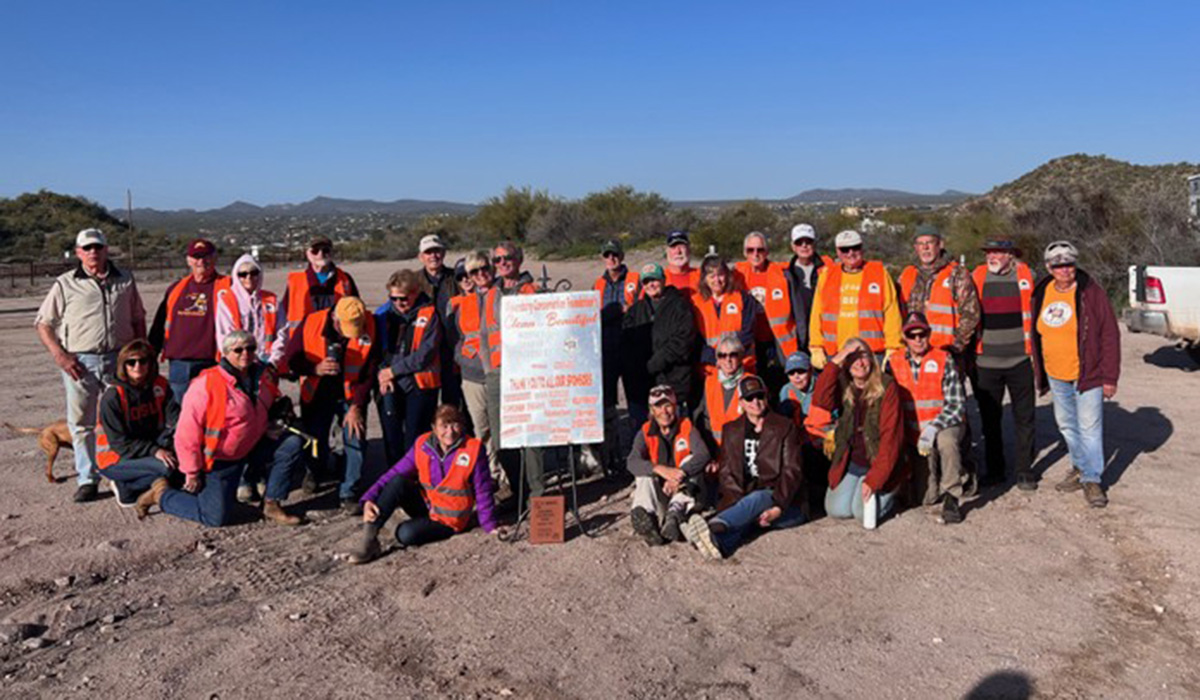
Meet Daily Point of Light Award honoree Mike Heath. Read his story, and nominate an outstanding volunteer or family as a Daily Point of Light.
While most would treat a 40-year tenure at Salt River Project (SRP) as a reason to slow down, Mike Heath uses his company’s supportive PTO and volunteer policies to fuel what he calls his “altruistic side hustle.” To the people of Wickenburg, he isn’t just a veteran utility employee, but a neighbor who treats community service as a full-time calling. Logging approximately 600 volunteer hours a year, Mike’s hands are rarely still. He hauls tires out of Box Canyon, orchestrates land purchases for those in search of a stable place to call home, hands out backpacks to schoolchildren and promotes clean energy.
As the president of the Wickenburg Area Habitat for Humanity board of directors, Mike supports the organization’s blueprint for local stability. Last year alone, he dedicated 166 hours to the affiliate, overseeing everything from the operations of the ReStore to the intricate scheduling of home builds. Under his leadership, the organization is celebrating its 33rd anniversary with a legacy of 26 completed homes and countless safety repairs. His recent efforts also secured new land for future builds, ensuring that more families can access zero-interest loans.
When he isn’t planning a construction site, Mike is often found at Project SALT (Serving And Loving Together), a food bank and clothing closet he co-founded in 2020. In 2025, Mike devoted over 212 hours to the organization, serving 1,171 households. With Mike as a member of the board of directors, Project SALT distributed 3,150 food boxes and 3,405 sack lunches, while facilitating over 7,300 clothing visits. Additionally, he is the secretary for the Place Church board, a chairman for the Valley of the Sun Clean Cities Coalition and even an honorary commander at Luke Air Force Base. Receiving the SRP Presidents’ Volunteer Service Award in both 2018 and 2024, he remains committed to the act of consistently showing up.
What inspired you to get started with Habitat for Humanity?
I had a friend who was on the board, and I went to some of the meetings and just had coffee with other people. Pretty soon, I was on the board. Then I moved up through the ranks to president for eight years. I termed out, and then they changed the bylaws so there are no term limits. They did me a favor! It’s really cool; we are able to hand over homes to families, and we provide zero-interest loans.
The Wickenburg area Habitat for Humanity isn’t as large as several of the other affiliates in Arizona where they build dozens and dozens of homes in a year. We build one every two to three years. I think we’re on our 26th home in 30 years. And we just finished purchasing a lot. For a while, buying property in Wickenburg was tough, and the house hunt and affordable housing just didn’t pan out. But we were able to buy property that needs a little work. When you hand a family the keys to a home that they’ve never had—they’ve rented and lived with other people and struggled—that’s the most rewarding part of it.
Why are you passionate about providing affordable housing?
It’s just part of basic life: shelter, food and safety. With a home comes safety, and it’s just one less thing these families have to worry about. We normally open our houses up with some food to put in their pantry, so they don’t start out empty. We try to meet their needs.
We do have the homeowners qualify for those homes because the last thing we want to do is have a foreclosure on a house! The families still make mortgage payments. Habitat for Humanity can extend their mortgage to make it easier for them. We try to make them as successful as possible. We provide financial training. We’ve worked with people ahead of time to get their credit rating in line. We have a woman who is very well-versed in finance. She works for a mortgage company, and she goes above and beyond to make sure the families are living within their budget. She’s worked with several people before to get their credit rating in line just so they can qualify. She does an excellent job with that.
Tell us about your volunteer role with Project SALT.
Well, we started out in the corner of the foyer of the church, and we quickly outgrew that. This initiative was originally just to bring in food and clothes to give to those in need. We started renting a place that was for a nonprofit, supposed to be used for families and youth in Wickenburg. There was a board of trustees, and all of them had passed except one guy. He was wanting to retire, so they ended up gifting us that building. Revamping it was a whole bunch of work, but we raised money and rebuilt it. Now, the downstairs is our “showroom” with the clothing and the food. Upstairs is a three-bedroom house that we rent out to help pay our expenses.
In 2025, we gave away 3,150 food boxes. A food box can be valued between $35 and $45. We gave away 3,405 sack lunches. A person can get a sack lunch five days a week. There were 7,319 clothing visits in 2025. A clothing visit can be one garment or a bag of garments, and normally they go out in bags. We’ve also helped fix people’s cars. That is a total of 1,171 households we helped. For the small building footprint we have, those are some major numbers.
With Project SALT, I help out with promoting and fundraising. We always say that Wickenburg should be a better place because we’re here, and we don’t want anybody to go without clothing or food.
What’s been the most rewarding part of your work?
It’s when we give something to someone who needs it. The people who run the ReStore here in Wickenburg are great—I try to stay out of their business, but there’ve been times where I get a call and refer them to Habitat. One lady needed a new washer; hers was beyond repair and she didn’t have very much money. The store manager and the volunteer at the front counter took excellent care of her. We can’t give everything away, but they did work with her, and she was thrilled.
Sometimes we get stuff at Project SALT—we don’t take furniture and appliances—so it’s given to us and we give it to Habitat. At Habitat, we’ve had some medical equipment, walkers and strollers that Project SALT has had a need for, and we give that to them so they can make a difference. I’m in the sweet seat because I get to see both sides of these collaborations.
The church started Project SALT, and we give them a substantial check to help further their mission because they’re always helping people in need of paying rent. I personally have helped people paying electric bills that are struggling or out of work. It was cool to see when Habitat donated back to the church. I see all the good stuff on each side. I’m very blessed.
What have you learned through your experiences as a volunteer?
Not to judge. I didn’t ever feel I judged people anyway, but one incident taught me a lot. When a volunteer told us they went to carry a food box out to a car trunk, and the woman already had one from two other food pantries in the area. I thought, “Oh, they’re double-dipping.” But the volunteer was right on me: “Mike, a family of four cannot live on one food box for two weeks.”
The other incident happened when some ladies from another local community came over and got clothing to take back for their yard sale. I thought, “We’re giving away clothing for somebody else to sell?” And another volunteer said, “Well, that offsets their income for rent and paying their utilities.” It goes full circle. There may be some people abusing the system, but generally, they’re not. So if we have it, we give it away. If we don’t, we find a way to meet that need.
What are your long-term plans or goals you have with volunteering?
I work for Salt River Project. June will be 41 years. My coworkers are retiring, but I don’t have any plans to retire. I like having a job to go to because sometimes I could work 12 hours a day volunteering. It’s not like work—it’s a hobby—but it’s sometimes nice to go get a paycheck!
For a while, we didn’t have an executive director at Habitat, and I was there a lot. I still sign all the checks and pick up the mail. I love what I’m doing for SRP. I grew up on a farm and I knew how important SRP was for irrigation, so I’ve been really blessed. SRP is very much into getting involved in the community.
Why is it important for others to get involved with causes they care about?
I hope I never need it, but if I only got a little bit of help in a time of need, I know how thankful I would be. Because I’m blessed, I don’t have any problem giving to others and blessing someone else. My dad had a gas station when I was in kindergarten. I followed his footsteps into diesel repair and fleet administration. He always volunteered for organizations even after a 12-hour day at work. It was relaxing for him and he enjoyed it. He was a people person. I know how that made him feel, and it makes me feel that good too.
Any advice for people who want to start volunteering?
There are so many nonprofits in need right now. If there’s something you have a passion for, just go and see what need you can fill. I served food at Andre House, a soup kitchen. I never worked so hard in a kitchen environment, but when I left, I was so blessed. To see the people come through the line and how grateful they were—nobody took it for granted.
I also volunteered at a school for unhoused children. If they had a permanent address, they couldn’t go to that school. The hard part was you could never get really close to the kid because you didn’t know when he was going to be there. You’d show up to spend time with the kid and he wasn’t there. No forwarding address, the parents just moved on. It can be very sad, but you only hope they went on to do better.
The biggest thing is finding a passion somewhere. You don’t have to have big pockets or a big wallet. You just have a big heart. Or, through volunteering, you will get a big heart by meeting the needs of a nonprofit you connect with.
Do you want to make a difference in your community like Mike? Find local volunteer opportunities.
Share this post
