



Meet Daily Point of Light Award honoree Sailee Charlu. Read her story, and nominate an outstanding volunteer or family as a Daily Point of Light.
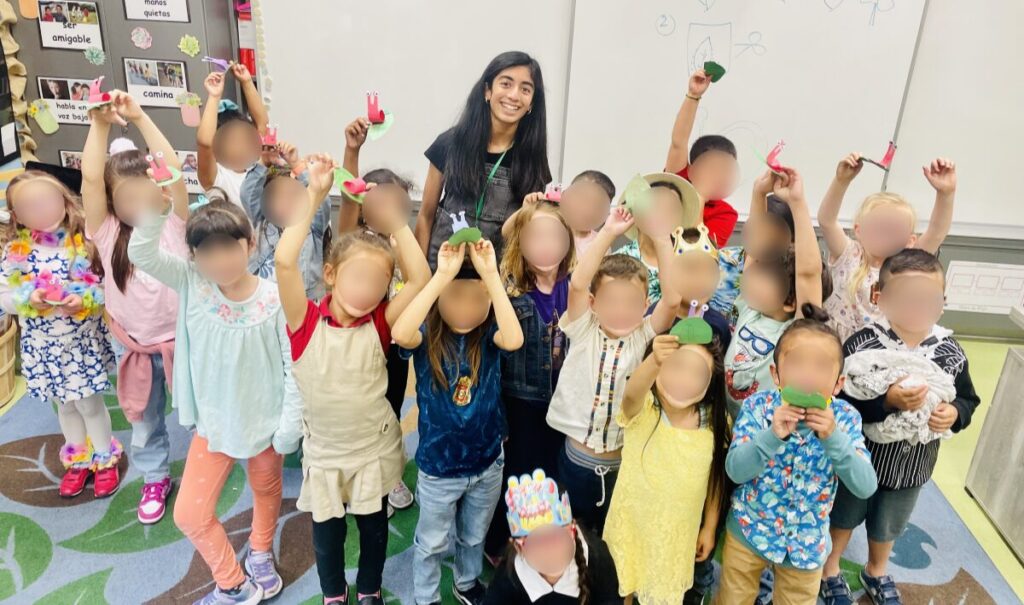
At El Sol Academy in Santa Ana, California, a little bit of transformation takes root every week. For many Hispanic ESL and multilingual students, the academic landscape can feel exclusionary, filled with racialized stigma and a shortage of bilingual educators. That’s where Sailee Charlu stepped in, founding Habla Arte in 2022. This bilingual Spanish-English visual arts and public speaking program is designed to dismantle these cultural barriers. Through a curriculum woven around cultural themes and holidays, introverted and hesitant children find the confidence to raise their hands. Here, their home language of Spanish is not something to hide, but is affirmed as a powerful source of identity, intellect and pride.
Dedicating 20 to 30 hours each month, Sailee has expanded Habla Arte to serve over 2,000 students across 12 Title I schools, mobilized more than 40 volunteers and launched the Speak Art digital app to guide hundreds of users through online programming. Her impact deepened further when she created The Lit League, one of the first multilingual spoken poetry programs for middle schoolers in the United States. Pairing classic poems with student-written response pieces, The Lit League teaches youth to dissect complex literary devices and reclaim standard texts through verse rooted in their own lived experiences, culminating in the largest middle school poetry slam in Orange County.
Sailee’s grassroots leadership is deliberately built for long-term sustainability and systemic change. Rather than creating a temporary intervention, she trains classroom teachers to run the curriculum independently, distributing 40-page self-study workbooks to every school in Orange County. She has also established a robust leadership succession pipeline so that local youth and community partners can carry the work forward. Her innovative approach has caught the attention of national foundations and local leaders alike. By authoring and illustrating the bilingual children’s book Curiosity & Me, alongside foundation grants, she has raised nearly $10,000 to keep the programming free and accessible, while gaining key endorsements from local officials like Santa Ana Mayor Amezcua and Councilwoman Jessie Lopez.
Sailee’s studies on multilingual education have been published in the Educational Role of Learning Journal and presented at major conferences in Mexico City and Sri Lanka. She has also collaborated with the Orange County Board of Education to draft and pass a landmark resolution recognizing the vital importance of bilingual education. Now, as she works alongside California Assembly Members to strengthen the state’s bilingual teacher pipeline, Sailee is looking toward an ambitious future. With dozens of events lined up across 39 Title I schools, her ultimate goal is to expand this life-changing curriculum to 378 schools within the next two years. Sailee wants to ensure that every multilingual child has the stage on which to center their own narrative.
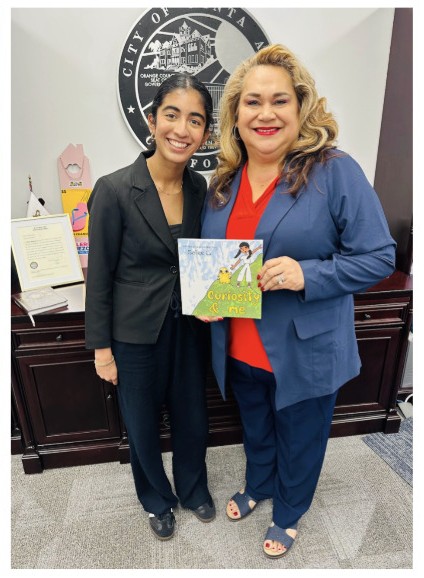
Curiosity and Me.
Tell us about your volunteer role and organization.
Attending school in Santa Ana, I often walked past La Chiquita Grocery to grab a quick snack, and I would watch how my Hispanic community was raised in the music of the Spanish language, vibrant and alive. Yet, I witnessed how the Hispanic students in the local Title I schools around me were pushed into English-only classrooms, forced into a linguistic vacuum where non-English fluency was treated as ignorance rather than an asset. Language functions as the gatekeeper to belonging. And that institutionalized belief that bilingual education is impractical and un-American, not only stifles academic and literacy growth in either language, but reinforces racialized shame, shakes a child’s underlying confidence to communicate and perpetuates the cycle of economic survival rather than closing the socioeconomic gap that has always yawned widest beneath Hispanic families.
At 13, I sat down at a dimly lit table at El Sol Academy with three children, a box of art supplies and my love for the Spanish language. That table transformed into Habla Arte, a bilingual visual arts and public speaking program, built around four pillars: art, language, storytelling and public speaking. Over four years, it has expanded into 15 Title I schools across Orange County, Sacramento and Dallas-Fort Worth, with curriculum distributed digitally to teachers in Mexico City, Argentina, Columbia, El Salvador and Spain.
We also built the Speak Art digital app, impacting more than 800 students through 600+ hours of in-class instruction, art exhibitions, summer camps and weekly workshops. To fund this program, I also wrote and illustrated my own bilingual children’s book, “Curiosity and Me,” not only exploring my own personal experience with the language barrier as an immigrant, but reaching families beyond the classroom.
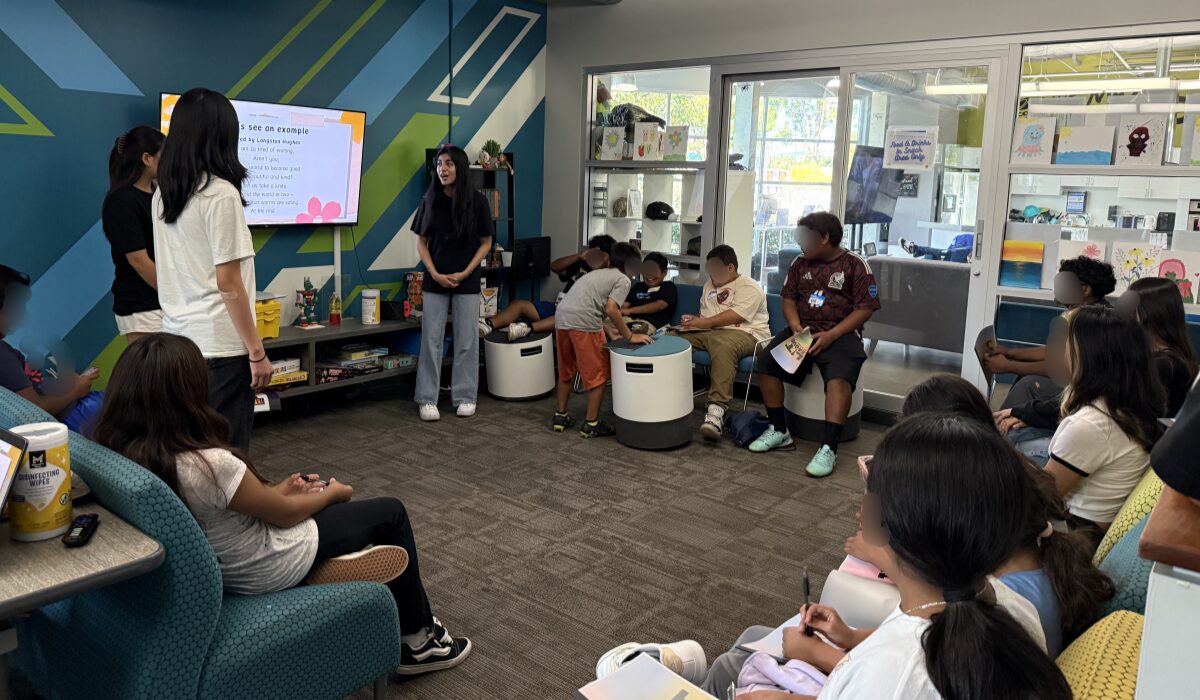
Watching my elementary students grow, I turned to the middle scholars sitting quietly in auditoriums, carrying grief and untold stories without a tool to express them. Then, two years ago, The Lit League was created, one of the first multilingual spoken poetry programs for middle schools in the United States, reaching 5000+ youth in-person and producing the largest middle school poetry slam in Orange County history. Yet teaching alone could not fix what our policies have broken. So I turned to legislation and research, growing into the Habla Futures Initiative, a movement towards enhancing bilingual spaces as we disarm the weaponization of linguistic barriers in education.
What inspired you to get started with this initiative?
Walking through El Sol Academy, I spotted clothing donations, medical aid and free meals. I witnessed these small, fierce acts of kindness a community offers its most vulnerable. After speaking with the school principal on how I could get involved, she told me that every enrichment program was in English only. No one honored the native language of the majority of the school’s own children. I began to research why, finding that despite there being 4.9 million ESL learners in the US, and comprising nearly 20% of California’s public-school students, there’s almost no structural support in the schools serving them. As a bilingual- Spanish-English speaker myself, I wanted to build a space where their native culture was truly accepted and part of what it means to be American.
But after speaking before the Santa Ana Board of Education every Tuesday for the past two years, presenting my programs and my students’ stories, I watched board members nod politely in understanding, yet nothing changed. I realized that to move institutions, I needed to speak in the language institutions responded to.
I started attending the Orange County Board of Education meetings, making the case for bilingual education through data and testimony. Councilwoman Jessie Lopez was among the first officials to publicly endorse the effort, recognizing The Lit League at Santa Ana City Council and amplifying the momentum. OC Board Trustee Jorge Valdes, whose two children were in my first Habla Arte, agreed to formally co-author the resolution alongside me. And Mayor Valerie Amezcua sat with me over months of conversation, reading every clause and editing the language with me, before writing a formal letter of support to the Orange County Board of Education. On February 2, 2026, Resolution 03-26 passed unanimously, 5-0, formally urging greater bilingual and dual-language instruction across Orange County schools.
Why is this issue so important to you?
We were told we got smarter by forgetting our culture. I want to change that perception in any way I can. Following Proposition 227, which dismantled most bilingual programs and mandated English-only instruction for the next two decades, students were expected to learn complex subjects in a language they were still acquiring. It takes five to seven years to train English fluency, yet our schools demand it overnight. While 20.3% of California’s students are English Language Learners, only 8 to 9% of schools statewide offer dual-immersion programs.
After watching the transformations in my students over the years that I could only put into words, I realized that testimony without evidence is too easy to dismiss. So I conducted a research study over four years in partnership with Dr. Elizabeth Pena and co-researcher Reinaldo Cabrera Perez as UC Irvine’s School of Education Bilingualism Matters Initiative, conducting surveys across Orange County Title I schools, analyzing quantitative and qualitative data on student artistic and public speaking growth under the Habla Arte curriculum, and speaking with teachers and administrators on their perception of the growth across the county. That research will be published in the Education Role of Language International Journal, now proceeding my findings at the 2026 California Association of Bilingual Education (CABE) Graduate Research Symposium in Sacramento, at the cross-institutional 2026 Reframing Our Language Experience (ROLE) Symposium in Mexico City and at the 2026 International Conference on Sustainable Development Goals in Sri Lanka. That evidence towards greater communicative confidence, academic and artistic excellence, and Spanish legitimacy became the spin of everything that followed.
Two weeks before I published my Voice of OC column on this crisis, a 10-year-old student told me his aunt and closest friend had been deported by ICE. His family had stopped leaving the house and he still showed up to class. His determination took root in my chest, reminding me that this issue is a living creature alive in my community.
What are your long-term plans or goals for the organization?
I’ve realized that lasting reform requires both community ownership and structural governance. For Habla Arte, our immediate horizon includes expanding to 378 California Title I schools within four years, deepening our reach across three states, and growing our six-country international partnership. For The Lit League, we have 26 events planned for 2026–2027, ranging from workshops and summer camps to virtual and in-person slams, all supported by a sustainable leadership pipeline and the continued distribution of our 40-page workbook to our partner secondary school in South America.
This July, we are launching the Habla Futures Bilingual Research Conference in partnership with the UCI School of Education, UCI Bilingual Matters, the California Department of Education, the UCI Tertulias Initiative and Dr. Elizabeth Pena. This convening of scholars and advocates across the US and South America aims to disarm the weaponization of language that propagates academic inequity. At the policy level, I am continuing to advocate for our state bill while simultaneously advising the CDE on formally recognizing translanguaging as an instructional method under Education Code 306. Ultimately, bilingualism is not a niche accommodation, but a bridge to cultural empowerment. This is how we keep the schoolhouse doors open for everyone.
What’s been the most rewarding part of your work?
At the end of my second Habla Arte class, a quiet boy wrapped his arms around me in a hug. That moment proved what I’ve always believed: emotional safety is the foundation of all learning. Over the years, I’ve watched that safety transform introverted children into eager participants, and self-conscious students into free artists. Through The Lit League, I’ve seen impacts no metric can capture, like a student processing experiences of addiction through an abecedarian poem, or a young woman sharing her survival of sexual assault with unshaken clarity before a crowd of hundreds.
What have you learned through your experiences volunteering?
I used to believe that making a difference belongs only to adults with long-established organization and enormous funds. I have learned that meaningful change is always possible if you are willing to persevere no matter the odds.
Why is it important for others to get involved with causes they care about?
I believe that the most pressing needs are hiding in plain sight in the community around you. Democracy thrives on voices being heard and injustices being challenged. Any moment when a person decides what they have witnessed is not something they are willing to walk past is a democratic act. The question is not whether ordinary people have the power to shape systems. It is whether they are willing to stay long enough to find out.
I think about the first time my students received their certificates from Jessie Lopez at the Santa Ana City Council, their bravery to speak their raw, visceral truth took shape. That moment cost nothing in terms of legislative capital, but for those students, it was the first time our government said, “We see you.” Every person who gets involved opens a door for someone else, making sure that their voice belongs in the room too.
Any advice for people who want to start volunteering?
Start with what you already love. I arrived at bilingual education because I was in love with the beauty of the Spanish language. Visual art and slam poetry already lived inside me. When you begin with genuine love, you can sustain the work long after the novelty wear off. A bill rejected by a legislator’s office does not end you. The fourteenth consecutive Tuesday at a board meeting where nothing moves doesn’t end you, if you believe in what you are building.
Do you want to make a difference in your community like Sailee? Find local volunteer opportunities.