



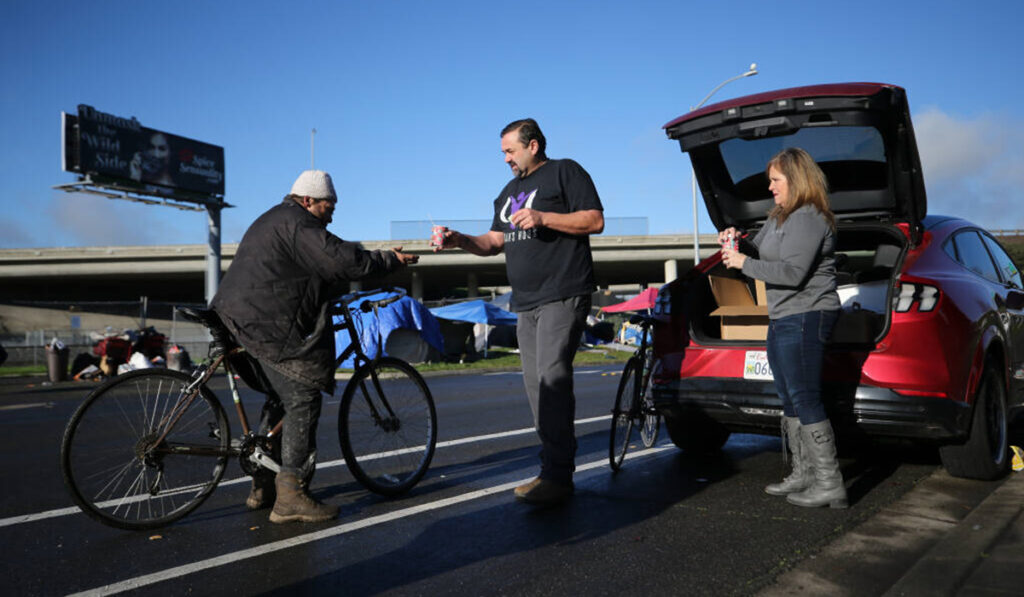
Meet Daily Point of Light Award honoree Micah Sawyer. Read his story, and nominate an outstanding volunteer or family as a Daily Point of Light.
Content Warning: Points of Light is proud to share the following uplifting and inspiring story. However, we acknowledge that portions of this story may be difficult for some readers. We encourage you to please care for your own well-being above all.
The transition from a quiet life running a construction business to the front lines of a public health crisis wasn’t a choice Micah Sawyer ever expected to make. It was born from the silence left behind after losing his 22-year-old son to a fentanyl overdose. In the wake of that devastating grief, Micah chose to build something that could help hold the weight of his pain: a nonprofit called Micah’s Hugs. While still managing his business, he and his partner have embraced the work as a secondary full-time career, each dedicating over 100 hours every month to the cause.
As the founder and lead volunteer, he is on the ground in Sonoma County, leading school presentations and coordinating distribution efforts. This is a fully hands-on endeavor, and Micah has personally invested over $100,000 of his own funds to keep the mission growing. In 2025 alone, Micah’s Hugs distributed 15,835 doses of naloxone (Narcan) and reached over 4,100 students with vital education on substance use and mental health. Since its inception, the organization has put more than 43,000 doses of the life-saving medication into the hands of the public.
Beyond immediate intervention, Micah is focused on the long road to wellness, having funded over $106,000 in sober living scholarships. He navigates the complexities of grant management, community partnerships and administrative duties with the same attention he offers to families currently walking the dark path of substance use. By engaging more than 8,300 community members last year, he is successfully shifting the narrative around the fentanyl crisis from one of shame to one of proactive response. Read on to hear more of Micah’s inspiring story.
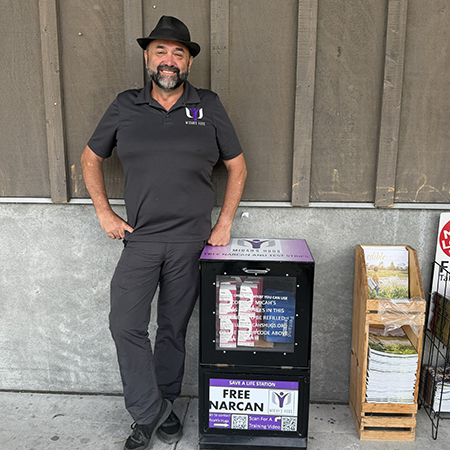
Tell us about your volunteer role and organization.
I’m the president of Micah’s Hugs, a nonprofit organization. We help people, both people that are struggling with substance use issues, and also educating the general public around the issues of substances, especially fentanyl. These days, fentanyl has become the most dangerous substance out there that people are struggling with. We do a lot of work with schools, and we’ve been working primarily with the high schools lately.
We started doing this after we lost my son, Micah Jr., who the organization is named after. We lost him to fentanyl overdose, via fentanyl poisoning. It’s been almost seven years now, so we thought, after dealing with what we had to deal with and going through the grief and the struggle and the trauma of losing a child, we wanted to try to help other people not have to go through that struggle and trauma. So we started this organization to try to help anybody we could help, especially young people and families.
What are some things people should be aware of about fentanyl?
Fentanyl has unfortunately made its way into so many different places where we’re even finding some instances of it in cannabis, in marijuana, where people would never really expect it to be. It’s not super common—but we’ve had a handful of stories of people that have gotten fentanyl overdoses from smoking cannabis. The main thing we want to tell people is just that it’s gotten into everything.
We do a lot of harm reduction, which is trying to help people not become harmed while they’re doing anything they want to do. We understand that, in a perfect world, nobody would experiment with anything, and we’d all be safe. But unfortunately, that doesn’t happen. We often say the harm reduction that we try to teach is indeed reduction; it’s not harm elimination. We compare it to wearing a seat belt in a car. There’s still danger when you drive that car, but it can help you be a lot safer than if you weren’t wearing a seat belt.
Fentanyl is everywhere. It’s in pills. A lot of people, especially kids, are experimenting with pills—things like Xanax, Adderall, Oxycontin—and a lot of times they think that because those pills look pressed and look like they come from a pharmacy, that they must be safe. Unfortunately, over 85% of the pills that are bought off the streets these days actually contain fentanyl. We try to teach people a lot about the risks and what it looks like to have an overdose on fentanyl. We do a lot of training on Narcan. We’ve distributed about 43,000 doses of Narcan into our local communities to try to help people recognize an overdose and what you can do if you see an overdose.
What’s been the most rewarding part of your work?
The work that we do has really been what’s helped me deal with my grief the best way possible. We help a lot of people try to not get into that situation of fentanyl poisoning. We also work with a lot of people who have lost children—especially those who are newer to the situation—to help them navigate it.
The rewards that come to me have really helped me a lot in dealing with my own grief. I’m rewarded every time we can help somebody. We said when we first started this, if we could save one person’s life, that would be worthwhile enough. We’ve now had many stories of people coming back to us and saying that, in one way or another, they feel like we’ve saved their lives, either through Narcan and harm reduction, or helping them get into programs to get clean and sober.
We had a young girl who we ran into a year after we first met her, and she said that we had saved her life. We realized she was actually formerly unhoused and addicted to heroin. We had met her on the streets and gave her a scholarship to get into sober living a year earlier. She looked so different and so cleaned up that we didn’t even realize it was the same woman. That was the first situation where somebody said we had saved their lives, and now that has happened numerous times. That just gives us the incentive to keep doing what we’re doing.
We had a 16-year-old kid this year from our local high school whose mom got Narcan from the school that we worked with to help supply them. He came across a pregnant woman that was overdosing in a parking lot at a shopping center. He remembered that his mom had Narcan in her car, and he ran and got the Narcan out and helped save this pregnant woman. Every time we get one of those stories, it makes us want to keep doing what we’re doing.
What’s your advice for someone who finds out that a loved one, a friend or a family member is experimenting with substances?
That’s a really tough one, because everybody wants to jump in and completely save somebody or just end the situation altogether. But it’s not as simple as what people might hope it would be. There are no perfect answers. I usually tell people to be open and honest and meet people where they’re at with love, empathy and compassion.
When I first realized my son was struggling, the first thing you want to do is just sort of grab them and shake them and knock some sense into them. Unfortunately, that doesn’t really work. If people feel like you’re judging them, it actually makes them turn away and not want to be open and honest with you. So again, it’s empathy and compassion and love and understanding that can help in these situations. Tell people that you’re there for them and see if they can open up to you and ask for some help. If you’re too judgmental, they’re not going to ask for that help.
What have you learned through your experiences as a volunteer?
We’ve learned a lot. We started out just trying to help people who were reaching out and asking for help, or people that would call us and ask us to come talk in front of their groups. We never started out with the concept of trying to run a nonprofit; that just sort of came along the way. We had some people who were donating a little bit of money to try to help us out, and they asked if they could write it off on their taxes. That’s originally why we decided we’d better become official and start a 501(c)(3) so people can get a tax deduction when they’re donating. Since then, it’s just kind of snowballed and became larger and larger. It’s not completely full-time yet, but we put a lot of time into this.
What are your long-term plans or goals with volunteer work?
We certainly like to get more funding so we can expand some of these programs. We have a sober living scholarship program that we put into place, and we’ve done over $100,000 in scholarships now that will help pay for somebody’s first two months to go into sober living. We really found there’s a hole in the system where you can get your health insurance or Medi-Cal to pay for residential treatment, and then when people get out of that, they’re often at a loss. They don’t know where to go or where to live. Many people are coming from situations where there’s a lot of drug use or alcohol use around them, and they’re trying to stay clean, and they wind up having to go right back to where they came from. It’s very hard to stay clean when you’re with a lot of other people who are using.
Statistically, people are about two to four times as likely to be successful if they go into sober living after treatment, instead of just being released straight out of treatment. So we’d like to expand that program and expand our schools program. We worked with a high school and actually broke the Guinness Book of World Records’ record for the largest Narcan training in the world. It was a half-hour training during their homecoming rally with the entire student body, and we gave out 1,400 boxes of Narcan and 1,400 fentanyl test strips to every student in the school.
We’d really like to expand these programs to more schools. Years back, we had a lot more resistance from schools, but in the last couple of years, that mentality is changing. Our specialty has always been trying to find a place where something is lacking and jump in and help where we can. If what we’re doing becomes unnecessary at some point, we’ll switch to something else.
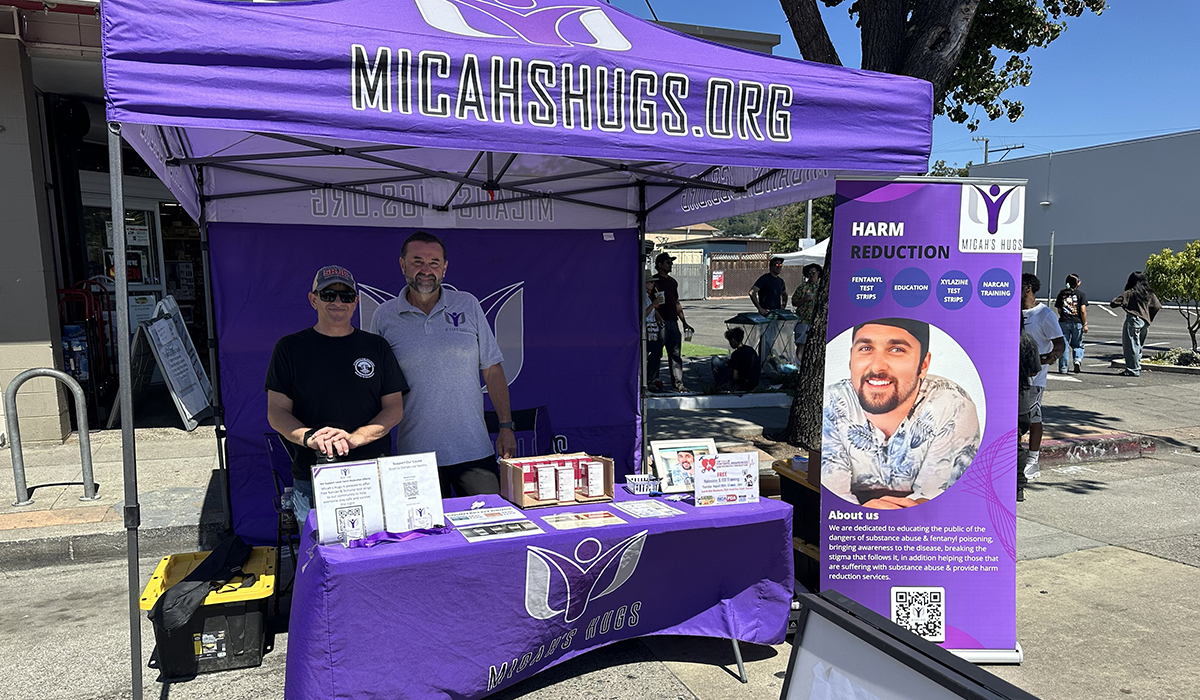
Why is it important for others to get involved with causes they care about?
It’s pretty amazing just the way it makes you feel about yourself and how you can do things to help your community. Sometimes people say volunteering can be selfish—not really, but it sort of feels that way, because of how much it makes you feel better about yourself when you see how you help somebody else out or you change someone else’s life for the better. It affects your own life in such a positive way at the same time.
Any advice for people who want to start volunteering?
I would say to just reach out to some other organizations in your area if you find something that means a lot to you. We’ve done a lot of work with unhoused populations as well. Sometimes we go down to encampments and we’ll take people with us who have never done anything like that before, and it’s really eye-opening. The day before Christmas, we went down to the Tenderloin in San Francisco. We bought 100 Burger King hamburgers and scarves and socks and hats. We brought some people who had never done anything like that before, and they were really blown away. It just really changed their opinion about how they thought about the Tenderloin residents, or unhoused people in general, once they realized that these are just people. They all have a story, and so many of them want to tell their story—how they wound up there and what their life’s been like and their struggles. We often look at those people sleeping in a doorway and we’re scared of them, or we step across the street, but you realize if you just sit down and talk to them on their level and speak to them as a person, they’re some really interesting people who have had some really unfortunate struggles in their lives.
What do you want people to learn from your story?
Have empathy, compassion and an open mind. Educate yourself. The drug overdose and substance deaths numbers are coming down, and I think the biggest reason for that is that people are becoming more open-minded and more educated. They’re learning more about what the risks are. I have not yet heard anybody say they’re having a hard time finding drugs—the drugs aren’t disappearing—but I think people are becoming more educated about what the risks are and how they can protect themselves and their kids.
The numbers, of course, are still outrageously too high. It’s not like the problem is solved, but it’s at least headed in a better direction.
We’re somewhere around 80,000 people a year dying from substance overdose, and at one point it was up to almost 130,000. Even though 80,000 is a massive number, it’s a lot fewer people than what it was at its peak. I think that’s good, and I think it’s also really interesting how much we’ve seen society’s opinion changing. When we first started this, there was a lot more negativity. We had people pushing back and saying what we were doing was wrong, that we were telling people it’s okay to use drugs. That opinion has really changed, and we don’t get near as much of that as we did when we first started doing this.
Do you want to make a difference in your community like Micah? Find local volunteer opportunities.