Working Toward a Clearer, Brighter Future
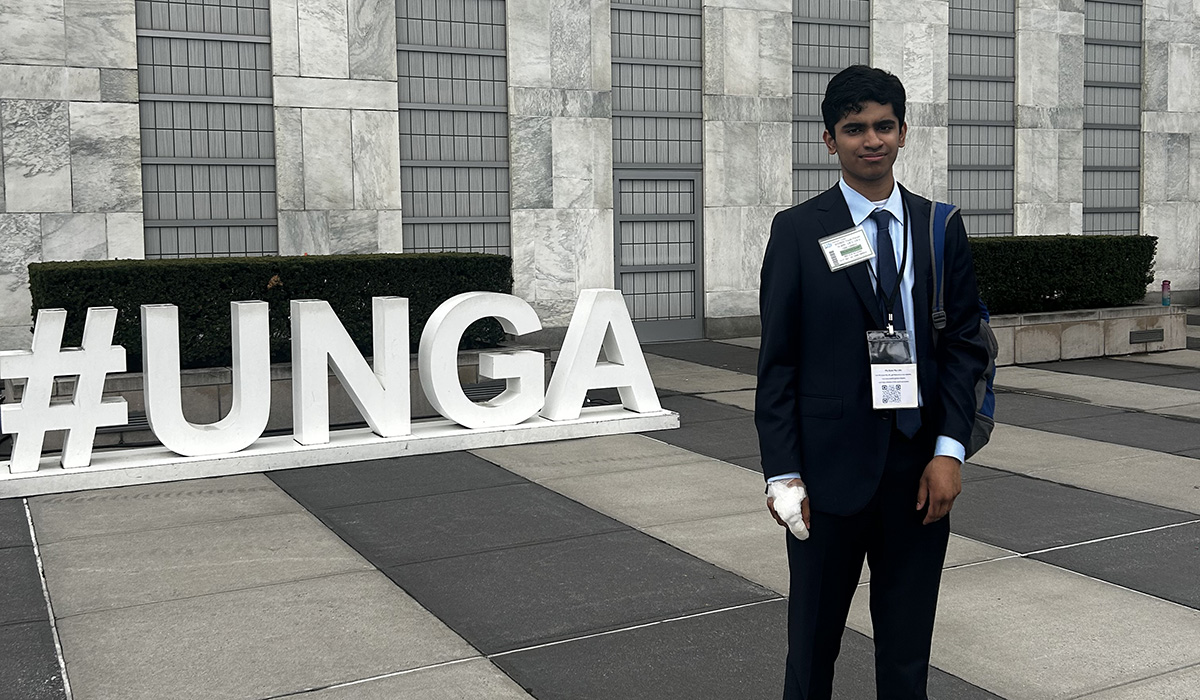
Meet Daily Point of Light Award honoree Ayaan Seshadri. Read his story, and nominate an outstanding volunteer or family as a Daily Point of Light.
Anyone with corrected vision can recall the moment they got their first pair of glasses and the world came into focus. For some, though, that is a moment that comes far too late, if at all. Nearly one in four children suffer from nearsightedness, also known as myopia, but 25% in the US go undiagnosed. That number is suggested to be higher globally due to the high number of children who have never even had an eye exam.
It’s a disease that starts as young as 3 years old, with many affected too young to understand or articulate what’s happening, leaving them without intervention. At school, a place where they are primarily doing visual work, they’re left struggling, their confidence taking a hit as well as their grades. Pediatric vision care can also be affected by socioeconomic factors, increasing the likelihood of overlooked vision problems within the underresourced population.
Ayaan Seshadri, 17, founded My Eyes My Life (MEML) in 2024 with a mission to train teachers in nursery to 5th grade classrooms to recognize the signs. He and his team of 14 volunteers in NYC, Boston, Austin and LA have trained over 300 teachers so far who, collectively, see nearly 8,000 students each day. But Ayaan goes even further.
He has teamed up with seven optometrists in the New York City area to offer pro bono eye care to children from resourced-constrained families as well as 19 families who have each agreed to sponsor care. Ayaan spends at least 40-50 hours a month on the mission. He also volunteers at a hospital and a local senior center, both of which also contribute to his interest in pursuing a career in public health.
What inspires you to volunteer?
My widowed maternal grandmother moved in with us when I was 9 or 10 years old. Realizing her needs led to me learning about the needs of senior citizens, which drew me to the senior center and hospital volunteering opportunities.
Tell us about your volunteer role with My Eyes My Lift.
The first part is talking to educators in the New York City area. I set up appointments to talk to the full lower school or preschool staff of different primary schools and preschools about myopia. It’s a 15- to 20-minute presentation. We talk about the biology of the disease and how it can progress quickly.
We also talk about why, psychologically, it might be difficult for a kid to articulate that they have trouble seeing, necessitating the vital role that teachers play. I get educators’ feedback and encourage them to not only flag students for eye exams but to promote eye healthy behaviors in their classrooms.
The other part is inspiring other youth to help and walking them through the process of doing the same thing in their own communities. Given the high rate of myopia, it’s something many of our volunteers can directly relate to.
Every two or three months, we also invite different stakeholders and luminaries in myopia to interview on our channel. In some cases, this has been patients who have suffered from high myopia themselves. In others, they’re business people developing interventions, optometrists and ophthalmologists who treat myopia or researchers focused on understanding this at population-level.
What inspired you to get started with this initiative?
MEML was inspired by my own experience with myopia as well as that of my parents. I was able to receive alacritous care, but my mom, who is severely nearsighted, was only able to be diagnosed in her mid-twenties upon arriving to the U.S. Reconciling those experiences has taught me the importance of preventative care.
My organization is focused on pre-school and elementary school educators and the role they can play in flagging kids for further evaluation. Myopia is prevalent in over 25% in the developed world and over 50% in the developing world. UNESCO data shows us that around 90% of students go to some form of primary education. Exams only happen once a year, and parents only see their own two or three kids all the time.
Teachers see their students daily, 2,000-3,000 students throughout their career.
When kids become nearsighted, they’re unable to see the white board from their seats, or to play sports that require accurate targeting like tennis or soccer. They suffer from falling grades and reduced class participation. Worst of all, myopia takes a toll on their sense of self-worth and confidence, impacting mental health even at this young age. Teachers may even mistake this loss of enthusiasm in schoolwork for graver disorders like learning disability. I was able to regain a lot of esteem, both academically and socially, once I was diagnosed. That’s really what I’m trying to give future kids like me through MEML.

What are your long-term plans or goals for the organization?
I was fortunate enough to win the UNESCO Learning Planet Institute youth design challenge for 2025. Through that, I was able to connect with a lot of people from around the world–including in Tanzania, India and Kenya–and join forces on each other’s projects. As a result, I expect to have new chapters set up in all three places by June.
Another project that stemmed from that is a children’s book to normalize nearsightedness and teach the importance of teacher intervention in the diagnosis process. I’m hoping to find a partner for the illustration process this year.
What have you learned through your experiences as a volunteer?
I’ve learned the power of focusing on issues relevant to the local community, your loved ones or yourself. It allows you to find creative interventions and have a personal touch through your connection to an issue. Start there and then map out a broader national or global plan.
What do you want people to learn from your story?
Understand the power of devising a simple, scalable solution to a community problem… like using a 15-minute presentation to activate teachers as a catalyst to lower the rate of undiagnosed myopia in children.
Do you want to make a difference in your community like Ayaan? Find local volunteer opportunities.
Share this post
