As business and CSR leaders cautiously await the start of the Atlantic hurricane season (June 1 – Nov 30), Points of Light has created a list of tips to help shore up your corporate disaster relief and response plans.
Here are some basic principles of corporate disaster relief to consider:
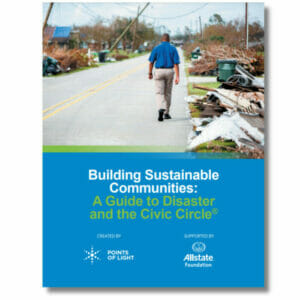
Provide employees with ways to take action throughout the disaster lifecycle by sharing this guide. Click image to download.
Ensure all employees in the affected areas are safe and accounted for, which might be a function of your HR department. If you don’t have a system in place (i.e., a hotline for employees to call or a phone tree for leaders to reach out, etc.), think about creating one to be prepared for the next natural disaster.
It’s instinctual to want to help others, so get in front of employees’ requests to be deployed. Know that spontaneous, unaffiliated volunteers can become burdensome, so devise plans to be ready with organized and strategic support, once the impacted areas have been deemed safe and ready for volunteers.
Find opportunities through one of our volunteer centers that are on the ground and often leading volunteer logistics.
Once impacted areas are ready for volunteer support, check in with your company’s risk management team to provide them with the chance to vet potential opportunities.
Think through the skills your employees have to offer the organizations responding to disasters. Skills-based volunteering from companies can play a significant role in response and recovery, not to mention building community resiliency. Check out Common Impact’s report, Disaster Response: From Relief to Resiliency, to find out how.
While employees might be driven to organize collection drives, palletized in-kind donations work best. Can your company work through an organization like Good 360 to provide much-needed supplies in bulk?
Launch a workplace giving campaign specific to the disaster and tailored to your top relief partners. Remind employees that cash contributions during a disaster go much farther than donated items.
Ensure impacted employees are aware of your company’s employee assistance/hardship fund and how to take advantage, while reminding the rest of your workforce how they can contribute.
Reach out to your nonprofit partners to find out how they have been impacted and how they are responding. Find resources to help you design a grant-making strategy through the Center for Disaster Philanthropy.
Keep up with your industry peers and their commitments by visiting the U.S. Chamber of Commerce Foundation’s Disaster Corporate Aid Tracker.
As you and your team respond to natural disasters, remember to stay safe and well. And tell us if Points of Light and our
2023. While we’re getting ready behind the scenes, changemakers from all over the world are gathering in Chicago for this power-packed event.
The Points of Light Conference is an annual gathering for changemakers who are passionate about civic engagement. The event includes over 50 workshops with actionable takeaways led by industry experts, as well as the opportunity to connect with 1,000+ fellow changemakers in the nonprofit, business and government spheres from all 50 U.S. states and nations around the globe.
This year’s preconference, which starts today, will feature two engaging days of networking, learning sessions and activities, for
Member-led discussions on cutting edge strategies.
Engaging talks by dynamic speakers.
Reflective sessions on building healthy, sustainable and impactful organizations.
Networking opportunities to spark new collaborations.
Failure Night, where we connect with each other and turn failure into triumph.
The main conference will start June 14, and here are some of the speakers you can expect to hear from if you’re attending, or if you choose to subscribe to
, you can catch the main stage sessions plus special content recorded especially for on-demand access starting June 20. Points of Light is proud to partner with these experts in social impact and corporate social responsibility (CSR) to present inspiring, educational and timely content that will help equip you and your organization to continue creating change.
Sheryl Lee Ralph, Emmy-Award Winner, Singer, Producer and Activist
From bringing characters to life on screen, performing on Broadway, producing, landing the title of national bestselling author with her literary debut, and her deep-rooted philanthropic endeavors which touch lives across the world, Emmy Award Winner, Tony Award nominee, NAACP Image Award nominee and Independent Spirit Award winner Sheryl Lee Ralph has become a staple in the entertainment industry, with an acclaimed career spanning over three decades. Sheryl can currently be seen starring on ABC’s smash hit comedy series Abbott Elementary opposite Quinta Brunson. Read more about Sheryl’s unique use of the arts in HIV/AIDS activism and other efforts.
Johnny Cupcakes, CEO & Brand Hysteria Expert
At the age of 19, Johnny Cupcakes was the founder of the world-renowned t-shirt brand, Johnny Cupcakes. Today, he is known for helping companies create blueprints for building brand loyalty, creating memorable experiences and inspiring innovation. With stores across the globe and high-profile collaborations with giants such as The Simpsons, Power Rangers, and Nickelodeon, Johnny was named America’s #1 Young Entrepreneur by Business Week, Top Innovator in Retail by The Boston Globe, and featured in INC magazine as the CEO of one of the world’s fastest growing independent businesses. Read more about how Johnny is helping some of the world’s largest companies rally toward real, sustainable change.
Neil Bush, chair, Points of Light
Neil Bush is an international business expert who is active in service. He serves as chair of the Points of Light board of directors, where he expands the vision of his father, President George H.W. Bush, to inspire, equip and mobilize people to action that changes the world. This work increases capacity for vital social services and for innovative solutions that lift individuals, strengthen families and renew communities. Read more about Neil’s involvement with Points of Light and other philanthropic efforts.
Michael D. Smith, CEO, AmeriCorps
Michael D. Smith is the eighth CEO of AmeriCorps. He was nominated by President Biden and confirmed by the United States Senate in 2021. CEO Smith has dedicated his career to social justice and public service focused on reducing barriers and expanding opportunity for underserved children and communities. Before taking the helm of AmeriCorps, CEO Smith served as executive director of the My Brother’s Keeper Alliance and director of Youth Opportunity Programs at the Obama Foundation. He also served in the Obama White House as Special Assistant to the President and Senior Director of Cabinet affairs. Read more about how Michael is elevating unity through service at AmeriCorps.
Nikki Clifton, president, Social Impact and The UPS Foundation
Nikki leads UPS’s global philanthropy, social impact and community affairs efforts as part of the UPS Corporate Affairs, Communications and Sustainability team. She oversees the company’s efforts to respond to the world’s most pressing social, humanitarian and environmental needs. Nikki has been instrumental in UPS’s response to human rights and social justice issues, including spearheading and coordinating UPS’s anti-human trafficking awareness and education. Her Ted Talk, “3 Ways Businesses Can Fight Sex Trafficking,” has garnered more than 1.5 million views. Read more about how Nikki is helping to dismantle systemic racism through strategic internal and external engagement.
Shermann “Dilla” Thomas, Co-Founder, Chicago Mahogany Foundation
Chicago historian Shermann Thomas, or Dilla, as he is affectionately called, is a fascinating blend of modern historian, cultural worker and public employee. Dilla has become a Chicago social media sensation by going viral on TikTok. His 60-second history videos on everything Chicago have been viewed over 8 million times, and he has amassed a following of 150K followers across all platforms. Dilla has been featured on all manner of Chicago media and has also appeared nationally on both The Today Show and The Kelly Clarkson Show. Dilla is a proud lifelong resident of Chicago’s South side. Read more about how Dilla is exemplifying Chicago’s vibrant history and culture through media.
The Points of Light Conference starts on June 14, but you can still register for On Demand, which allows you to watch the main stage sessions and specially curated workshops beginning on June 21! Head over to the Points of Light Conference page to learn more and sign up.
Meet Lawrence E. Bathgate, II, a Man of Service and Civic Engagement
. The awards honorindividuals who demonstrate the transformative power of service and who are driving significant and sustained impact through their everyday actions and words that light the path for other points of light. The power of recognition resonated with Bathgate.
It’s his success in his professional life that propelled him into his service. As an accomplished lawyer and co-founding partner at Bathgate, Wegener, and Wolf P.C., his practice areas include real estate, business transactions, municipal law, mergers and acquisitions, wills, trusts and estates, patent infringement litigation and class actions. But his proudest accomplishment may be one of his quietest. His firm offers scholarships to children of staff. When the COVID-19 pandemic shut down the court system, and no revenue was coming in, he continued to support the students he had committed to.
“If a person has been blessed, then they have an obligation to contribute, to share their time and energy and resources and ideas,” said Bathgate.
Bathgate’s impact has been far and wide, reaching across the aisle and the country through his roles on several boards of directors, including the Board of Visitors at the University of Texas M.D. Anderson Cancer Center, Houston; a Council Member of The Woodrow Wilson International Center for Scholars, Washington, D.C.; the National Committee of the Arts of the Kennedy Center, Washington, D.C.; The Board of Boy Scouts of America, New York Council; and the Board of Directors of the New Jersey Performing Arts Center, Newark.When asked how he became involved and what motivated him to stay engaged, he had a simple answer.
“I’ve always said yes to things,” Bathgate said.
He recounted the story of getting out of law school and starting his first job in his hometown. The phone rang, and an assemblyman from Ocean County asked him to be the driver for the assemblyman and a gubernatorial candidate. Bathgate said yes, and the trio ended up in a picture on the front page of the newspaper.
He went on to get involved with the Boy Scouts and his local community college. He became president of the animal shelter in Ocean County and worked to raise funds for it. He helped raise campaign funds for gubernatorial candidates by rallying donors. All those efforts led to his becoming parliamentarian of the New Jersey State Assembly when he was just 29 years old.
Twelve years later, he would host a fundraiser for presidential candidate George H.W. Bush. Bush was a champion of volunteerism and community service, and Bathgate recognized something in him that he knew would resonate with people. Bush’s values and approach to service stood out, and Bathgate knew Bush was poised to serve the country. And he was right because, not only did Bush become America’s forty-first president, but he later went on to found Points of Light, with a mission that champions civic engagement around the world.
“One of the best things Points of Light does is shows, on the international stage, how much American volunteerism is alive and well,” Bathgate explained. “In other countries, the government might pay for arts centers, hospitals, museums. In America, philanthropic support is the architecture of these places, and volunteers give their time to operate them.”
With the backbone of philanthropic support and giving his time to causes he cares about, Bathgate has built a legacy of service throughout his lifetime. When asked how he measures the impact of service and ensures his efforts are making a meaningful difference, Bathgate pointed to perseverance.
“It’s a continuum,” he said. “You don’t get to a goal and then you’re done. You move on to the next one. There’s always a new goal to reach for. You donate time, energy, resources.”
And when it comes to his best advice to share with someone who is interested in getting involved in community service, he had three tips.
“Number one, be polite and be kind. Number two, always be on time,” he advised. “Number three, say yes to things. Get involved.”
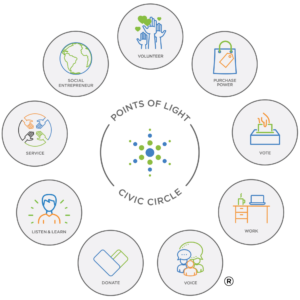
Lawrence E. Bathgate, II, is a prime example of someone who drives real sustainable change using the various pathways of the Points of Light Civic Circle:
Voice
Mr. Bathgate’s involvement in civic and political activities, including serving as the Parliamentarian of the New Jersey State Assembly, demonstrates his engagement in public discourse and advocating for causes close to his heart.
Volunteer
His work with the animal shelter in Ocean County and the Boy Scouts of America exemplifies Mr. Bathgate’s dedication to hands-on volunteerism and the importance of working with his community.
Donate
Mr. Bathgate’s involvement in raising funds through large-scale fundraisers for political campaigns highlights his commitment to contributing money, time and resources to causes he supports, ensuring they have the necessary financial backing to succeed.
Social Entrepreneur
As a co-founding partner at Bathgate, Wegener, and Wolf P.C., Mr. Bathgate leverages his legal expertise to make a significant impact within the business realm, contributing to the economic growth and development of his community.
Listen & Learn
Participation in various boards and committees, such as the University of Texas M.D. Anderson Cancer Center and The Woodrow Wilson International Center for Scholars, reflects Mr. Bathgate’s dedication to staying informed and continuously learning, enabling him to make more informed decisions and contribute to the greater good.
Service
Active engagement in civic and philanthropic activities, including his involvement with The George H.W. Bush Points of Light Awards, exemplifies Mr. Bathgate’s commitment to celebrating the power of recognition and making a tangible positive impact in the lives of individuals and communities.
Vote
As a longtime political fundraiser, Bathgate understands the importance of facilitating the political process and supporting candidates who champion cause areas he values.
3 Reasons to Attend the Points of Light Conference This Year
2023 is a gathering for changemakers, like you, who are passionate about civic engagement. With over 50 workshops with actionable takeaways led by industry experts, and the opportunity to connect with 1,000+ fellow changemakers in the nonprofit, business and government spheres from all 50 U.S. states and nations around the world… this opportunity is not one to be missed!
There are plenty of
The Points of Light Conference is known for being a power-packed event full of inspiration and education from industry-leading experts. Our Opening Plenary offers an engaging lineup of social impact experts to support and inform the individuals, companies and organizations all rallying toward real, sustainable change. Participate in workshops on advancing equity and inclusivity, training and engaging volunteers, successfully partnering with other organizations, measuring impact and more.
So Much to Explore at Conference
Conference Attendees: Last chance to register for the Idea Exchange Dinners, specially curated conversations hosted by Points of Light and Chicago Cares.
Civic Engagement Leadership Summit: A Theatre Stage Page Metaphor for Leadership
Civility & Civic Engagement: The Opportunity for Business to Help Find Common Ground, Inside and Outside Your Company
The Hidden Power of Purpose: A Special Screening and Discussion with AARP: This feature-length documentary film offers inspiring stories with the latest scientific research, interweaving insights from the world’s leading health experts whose work affirms that living a life of purpose and living longer are inextricably intertwined. Join members of the AARP Purpose Prize team following this special screening for a discussion about applying your lived experiences to find your purpose in life.
Enjoy moving conversations that explore how our lives have changed amidst the complex challenges we’re collectively working to solve. Hear from Sheryl Lee Ralph, Emmy-Award Winning Star of ABC’s Abbott Elementary, singer, producer and activist; Johnny Cupcakes, CEO and brand hysteria expert; Michael D. Smith, CEO, AmeriCorps; Neil Bush, board chair, Points of Light; Shermann “Dilla” Thomas, historian and founder, Chicago Mahogany Foundation, and more.
Digital Offerings
This year, you have the chance to get real-time access to anything and everything about the 2023 Points of Light Conference with our complimentary app. Download it by clicking this link on your mobile device to view sessions at a glance, read details about each one and “favorite” those you plan to attend. You can also send messages and network with colleagues within the app, as well as view a venue map of the conference space.
Can’t attend in person in Chicago and still looking to ensure you’re up to date on the latest ideas and trends in social impact? Our on-demand option is perfect for you. You can choose from 20+ sessions including exclusive, new workshop content just for on-demand access, replays of our mainstage moments and access to top-rated sessions from our 2022 Points of Light Conference.
Enjoy learning and professional development — in your location of choice and on your schedule — while getting a taste of what the Points of Light Conference offers. If you are attending in person, you will have access to all of the on-demand content as part of your registration. Access to on-demand content will be available from June 21–Sept 30.
from June 14 to 16, 2023. With lake and city views and walkability to many attractions around town, you’ll be right in the center of all the action. Plus, Points of Light Conference attendees can unlock
just by showing their conference badge at select attractions, restaurants and events, from the Museum of Contemporary Art to the Chicago Cubs to the Hard Rock Café.
If you’re looking for things to do while you’re in Chicago, take notes from the experts. Three
are co-hosting this year’s event, and we asked them for input on some of their “can’t miss” Chicago foods, experiences.
Ready to get registered? Head over to the Points of Light Conference page to reserve your spot and get the education, tools and networking you need to reignite your passion so you can continue to drive real and sustained change.
How Employee Volunteer Councils Can Foster Volunteer Program Success
A formal leadership or governance structure for your employee volunteer program can extend the reach of your staff, provide development opportunities for employees and sustain the momentum of continually increasing community impact. Most effective employee volunteer programs use some type of leadership structure – either committees or individual champions – to support the management and operations of the program at a regional or local level and to scale their program’s initiatives throughout their company’s footprint.
No matter which structure is right for your program and corporate culture, successful implementation is critical to generating enthusiasm and buy-in from your employees, connecting with senior leadership and serving as a foundation to drive the long-term success of your evolving volunteer program.
We’ve compiled many reasons why developing and implementing a champion or council structure is beneficial, which you’ll find in our
on employee volunteer champions and councils. But what does a council structure look like in composition and responsibilities? Read on for those details!
Employee Volunteer Council Composition
Typically, employee volunteer councils vary in size based on the employee count in a particular location or market and vary on their style or organizational makeup based on what fits within the operations and culture of the company. Volunteer committees can represent specific teams, departments, physical locations, Employee Resource Groups, orientation waves and alumni/retirees. They can even be composed of spouses of executives.
Each employee volunteer council typically includes:
A cross-section of employees with different functions, management levels and tenure.
Volunteer event organizers, senior managers and/or representatives from key departments.
Large employee volunteer councils may have an executive board or steering committee that helps to decide on details for meeting agendas and events for the year, and also communicates with senior leadership. These boards are usually made up of committee co-chairs, secretaries, treasurers and communications leads. Larger councils may have an executive advisor or sponsor that sits on the executive board and helps in the decision-making process. These senior leaders are a great resource to promote activities and to advocate for additional resources.
Someone has to lead the charge to get it organized, though—whether that is through self-assembly, a call to action or the identification and selection of committee members by HR or senior leaders. The company’s social impact team typically provides the training, resources, templates and forms, and overall support. Each committee should have a charter that explains how to get the committee started, its connection to the national or global social impact team and strategy, and its responsibilities.
Volunteer Committee’s Responsibilities
Let’s take a look at what might be included in a committee’s charter by outlining the potential responsibilities of a volunteer committee and its members. Again, these will vary by company size and culture along with the goals that the social impact strategy hopes to achieve each year.
A volunteer committee may:
Champion corporate citizenship as core to the company’s mission, values and business – infusing citizenship into the DNA of the business at all levels and across the company’s employee network.
Serve as a conduit for employee feedback on the direction of the company’s CSR strategy and employee volunteer program. Represent employee voice by surveying employees to determine their interests in volunteering and other community engagement activities.
Set goals each year, which reflect employees’ interests and support business objectives.
Recommend and acquire resources for the volunteer program.
Support the development and implementation of policies, procedures and the evolution of the employee volunteer program.
Identify opportunities and challenges that may affect implementation or support of the program as it relates to their respective division/business unit and employees and make appropriate decisions to keep goals on track.
Support employee volunteer leaders or committees in other offices.
Recruit others to help lead and manage activities throughout the year.
Communicate with employees regularly to share successes, recognize achievements and motivate them to get involved.
Identify nonprofit organizations for potential collaborations.
Provide input and recommendations to the social impact team.
An employee serving on the committee may be asked to:
Serve a time-limited term.
Attend planning meetings.
Participate in managing activities throughout their term.
Celebrate the success of volunteer projects with employees and the community.
Share with others their enthusiasm for and satisfaction from volunteering.
Establishing a formal leadership or governance structure for an employee engagement program is crucial for volunteer program success and long-term impact. Whether through committees or individual champions, this structure extends the program’s reach, fosters employee development and sustains momentum in community engagement. By developing and implementing a champion or council structure, companies can maximize the impact of their social impact work and create a culture of social responsibility.
Beyond Volunteering: How Social Entrepreneurs Revolutionize Problem Solving
Civic engagement comes in many forms, like volunteering, donating, voting or using your voice. But have you heard of social entrepreneurs? These individuals get to the root of causes. They identify a need that has not been met by traditional structures and work to solve it, often through innovative means.
This month, Points of Light is focusing on
, a framework that opens the door to social impact through volunteering as well as less traditional avenues, including using your purchase power, listening and learning, and more.
What Does a Social Entrepreneur Do?
Social entrepreneurs use creativity to think outside the box. Unlike socially-conscious business entrepreneurs, social entrepreneurs are defined by their resourcefulness and relentless pursuit of innovative solutions to complex problems. Social entrepreneurs must raise funds to finance their initiatives, but their work centers on creating effective solutions to society’s most pressing issues above all else.
Social Entrepreneur Examples
While many small business owners may be socially conscious, social entrepreneurs are on a particular mission to meet a need that hasn’t been met by governments, corporations or nonprofits. Then, they find an innovative way to go about meeting this need.
These Daily Point of Light honorees are social entrepreneurs who use their hearts, hands and minds to help strengthen communities and solve persistent problems.
William Cabaniss– sells vanilla extract, donated 135,000 meals to East Tennessee.
Sara and Mateo Molina – sells cookies benefitting most vulnerable people in Cali, Columbia.
Darius Brown – started Beaux & Paws to sell his handmade bowties with proceeds supporting animal shelters.
Arushi Gupta– creates artisanal stickers and donates all proceeds to over 20 children’s hospitals across the U.S.
For instance, Wangari Maathai was the first African woman to win the Nobel Peace Prize for founding the Green Belt Movement in 1977. This movement helped work toward a solution to the vicious cycle of environmental destruction and poverty in Kenya, as it allowed a sustainable alternative – planting trees to generate income. To date, the
has planted over 51 million trees in Kenya alone, and over 30,000 women have been trained in trades like forestry, food processing and beekeeping.
Celina de Sola, co-founder of
, is forging partnerships among institutions and individuals to empower youth, mobilize action and build communal resilience as the organization works to address the root causes of poverty, violence and migration in Latin America and the Caribbean. Glasswing builds partnerships with institutions like public schools to achieve long-term change through youth-centered, trauma-informed programming.
David Yeung is the co-founder of
, an umbrella of brands offering a diversified and innovative social enterprise model – to promote shifting to a plant-based diet as a crucial means to tackle global warming and food insecurity. The company’s vision is to provide easy ways for people in Greater China and East Asia – as well as the rest of the globe – to reduce meat in their diets and therefore contribute to a more sustainable and eco-friendly way of eating.
What the Research Says
Did you know that more than half of the public agrees that small business owners should take a public stand on social issues, and that 67% of small business owners agree? Or that nearly three-quarters of the public makes donations at the point of sale?
Research is critical to understanding the global population’s perspectives, opinions, habits and preferences – crucial elements for current or aspiring social entrepreneurs to have a pulse on.
In support of Small Business Month, thanks to the generosity of
, Points of Light is excited to announce the release of a new research report, Leading Locally: Small Business and Social Change. This report explores the expectations, perceptions and ways in which small businesses are taking action to support social issues and their communities.
While the report will be released on June 6, 2023, Points of Light will also host a special webinar on July 19 at 1 p.m. ET to explore the key findings and insights with the research team led by Derrick Feldmann, managing director of
While this article focuses on social entrepreneurs and small businesses, larger socially-conscious organizations are needed in today’s world, too. Points of Light’s The Civic 50 recognizes the 50 most community-minded companies in the nation each year as determined by an annual survey administered by True Impact. See the 2023 honorees here.
Supporting Social Entrepreneurs
Find social entrepreneurs who are working to solve issues you care about, and choose to back them with donations, direct purchases or promotion via your social networks. Uplift these individuals and organizations, and you’re contributing to the social entrepreneurship movement.
You can also choose to support small businesses, especially those that include social responsibility programs or initiatives. For more ideas on how you can get involved with social entrepreneurship and lend your time, talents and resources to any cause area, check out Points of Light’s
Want to explore more? Check out these additional resources:
Civic Life Today: Social Entrepreneurs: This digital magazine explores how these innovators get to the root of causes by identifying a need that has not been met by traditional structures and working to solve it. This resource is free to download.
Reclaiming Social Entrepreneurship: This TED talk from social entrepreneur Daniela Papi Thornton explores the difference between being a social business founder and a system change leader.
Social Entrepreneurship 101: This online course from Acumen Academy helps budding social entrepreneurs to chart their course for changemaking, tackling problems across public, private and nonprofit sectors.
Learn the Secrets to Showcasing Your CSR Impact
Strengthen your social impact strategy, data and communications, even in an anti-ESG environment.
White Paper: CSR and ESG—A Practical Guide to Social Impact Reporting
.
The events of the past few years have encouraged the public to be more socially conscious. They’re ready to take action to spark change in their communities, expecting the companies they support to do the same. But how can businesses effectively communicate the impact of their corporate social responsibility (CSR) programs without being accused of greenwashing or lip service? That’s where the combination of impact data and storytelling comes in.
Impact data provides quantifiable evidence of the effectiveness of your social impact, demonstrating just how much your CSR programs are bettering society. However, data alone can be dry and difficult to relate to. That’s where storytelling comes in. Stories humanize the data and make it more engaging for your audience.
And the increasing prominence of ESG (Environmental, Social, Governance) reporting adds a new wrinkle to sharing the results of our social impact efforts. A lack of sector-wide standards around social impact reporting makes it challenging to know just what kind of data to collect—and how to measure it well.
That’s why our partners at True Impact created their latest white paper: CSR and ESG: A Practical Guide to Social Impact Reporting.
With this guide, ESG professionals will have the tools to use CSR to help power the “S” in their ESG reporting and CSR professionals will have the insights to substantiate their corporate social impact via ESG reporting.
The white paper offers an easy-to-incorporate framework to help your team better demonstrate the value of CSR to company leadership and shareholders, drive improvement for stakeholders and strategically communicate the value of CSR in your ESG reporting—even in the face of ESG backlash.
This guide will give you the knowledge to:
Align your social impact initiatives with clear business value for the company.
Substantiate your CSR initiatives with validated social impact data.
Generate strategic insights about your programs to drive decision making.
Strengthen your CSR storytelling and communications, even in an anti-ESG environment.
The report also includes dozens of reports, resources and templates from some of the top organizations in the sector, such as Edelman, Deloitte, Chief Executives for Corporate Purpose (CECP), PwC, KPMG, The Conference Board, BDO, Sustainalytics, IBM, the UN Principles for Responsible Investment and the most common ESG reporting frameworks.
Data plus stories can lead to compelling impact for your company and local community. This guide can help you and your team propel that impact even more.
Template for Partnering with an NGO on an Employee Volunteer Project
In today’s socially conscious world, people and organizations are eager to make a positive difference in their communities. Employee volunteer programs have emerged as a powerful way for companies to engage their workforce while contributing to the greater good. Collaborating with a nonprofit organization for an employee volunteer project can amplify the impact of such initiatives, yet it’s crucial to remember that success lies not just in the intention to help, but also in the execution of these endeavors.
One common pitfall that corporate social responsibility leaders may encounter when embarking on employee volunteer projects is assuming that their chosen nonprofit partner fully understands their needs and expectations. While nonprofits are dedicated to their causes, they operate under different dynamics and may have limited resources, making it essential for you as a corporate citizenship leader to confirm the details of your collaboration.
After you have locked in a volunteer project with your NGO partner, which might take several conversations and a site visit or two, send them an email using the following template to confirm the details of your upcoming in-person volunteer project. Then, be sure to add it to your volunteer leader or council toolkit. This email can be adjusted as needed but will show your company’s gratitude for providing meaningful volunteer opportunities, confirm event details and roles and responsibilities. By taking the time to communicate clearly and align your goals upfront, you’ll set the stage for a collaborative effort that not only benefits your employee volunteer program and its participants, but also leaves a lasting, positive impact on the community with whom you will be partnering.
Dear [name of NGO partner contact]:
I am delighted to confirm our volunteer activity with you and [name of NGO] on [date/time] at [project location]. Although our arrival time for volunteers is [time], a handful of folx from my team will arrive at [time] to help with set-up and any prep work needed.
As we discussed, we will recruit [number] volunteers to perform the following:
Task one
Task two
Other tasks
I understand you will provide [supplies, equipment, volunteer leaders and other relevant items] for our group and activity. Could you also provide me with any specific logistical instructions, including access to the site, parking instructions and public transportation options by [date] so that I can share them with our volunteers?
In advance of our employee volunteer project, [company] will be providing a grant of [funding amount] in order for your organization to [purchase additional supplies, provide stipends to needed contractors, or recoup your expenses, etc.]. The check should arrive by [date] via [shipping mechanism].
I will arrange for [company] to supply lunch/dinner for our volunteers and [# of NGO staff, other relevant event attendees], planned for [time]. We will also bring water and snacks to have on hand throughout the event.
Attached please find our organizational photo release form which is required for all volunteer activities. Signing this form will confirm that [NGO] will secure and keep on file the necessary releases from all non-company participants in this activity. This allows us to take photos more freely at the event for use on our website and for other marketing and internal purposes. Should anyone hesitate to sign, we can designate on their nametag that our photographer should not capture their image.
I’m including my contact information below so it’s easy to stay in touch. Please let me know if you have any questions or concerns. Otherwise, I will follow up in [general timing] to lock in a complete schedule for the day’s activities and collaborate on speakers.
On behalf of [company], I thank you and the team at [NGO name] for helping us make this volunteer project a success. We are looking forward to working alongside your team and beneficiaries while creating a positive impact on the community!
Sincerely,
[Your name, followed by e-mail and cell phone number]
Points of Light Conference 2023 Co-hosts Talk Inspiration, Impact and Ideas
, happening June 14 – 16, 2023 in Chicago, is a global gathering for people, like you, who are passionate about civic engagement. With more than 50 educational workshops, inspirational leadership discussions and opportunities to connect with peers, this conference offers something for every champion of social good.
Back in November, we chatted with
on everything from what inspired them to participate as co-hosts to this year’s special service project at conference.
What inspired you to co-host the Points of Light Conference in 2023?
Chicago Cares:
Chicago Cares believes service is a building block of a just and inclusive society and an essential part of how we gain civic literacy and build civic leadership. Service brings people power to the work of change and builds bridges across differences that are the foundation of a healthy society. Co-hosting the Points of Light Conference in Chicago is a concrete way we invest in service.
HandsOn Suburban Chicago:
It is an honor to bring together so many talented people who want to influence positive change in the world—having the opportunity to share Chicago its unique experiences, beautiful architecture, incredible cultures and fabulous neighborhoods and provide a memorable experience in the Windy City.
What are some of the KEY THEMES AND TOPICS that you’re excited to explore during the conference?
Chicago Cares:
Across the themes and topics, we are excited to talk about collective action! We believe service isn’t service if we do it alone. Service is a commitment to acting together. When we are more deeply bound to one another socially and civically, transformational change is possible. Many of the workshops and sessions encourage us to refocus on the work for collective impact. Where can we come together in new and different ways? Where can we take risks together and build our power together? What can service make possible? We anticipate powerful learning and rich dialogue together.
How have past conferences helped attendees to make a positive impact in their communities, and what is a success story that you can share?
HandsOn Suburban Chicago:
Being reinvigorated and refreshed, brainstorming and learning about ways different communities and cultures can use a similar idea with very different results, can be amazing. Sometimes the big lessons are to learn from mistakes or missteps of others, to ask additional questions, create bridges and explore ways to move forward. Last year during “Failure Night,” I was reminded of the importance of looking at all of the people involved in communication when making changes to a program. Thanks to the genuine sharing of one of our leaders, I was able to make a swift change before any potential miscommunications happened.
What are some of the unique features of the 2023 conference, and what sets it apart from other events in the civic engagement space?
Chicago Cares:
Whether it’s the Conversation Igniters, the Idea Exchange Dinners or the integration of arts and culture into the event, Chicago’s conference will be a one-of-a-kind experience for a one-of-a-kind city. Chicago has a rich history and legacy of innovative and powerful civic engagement. We are home to so many civic champions and leaders and so many cutting-edge and impactful organizations. As a result, the tapestry of civic engagement work is woven from a great diversity of stories, histories and activities which will be on full display at the Points of Light Conference. We encourage you to think of Chicago as another teacher from which you can learn. Each neighborhood and community has a story to tell and something to teach us about ourselves and our future.
Share one tip that can help attendees get the most out of the conference.
HandsOn Suburban Chicago:
Think broadly and join workshops outside of your everyday work. This expands new ways of thinking and meeting new people.
Tell us more about the community-designed and driven service project planned for the conference. What kind of activities will attendees participate in and how will this benefit the local community?
Chicago Cares:
Every Chicago Cares service experience is uniquely designed in partnership with local leaders to move community goals forward. We listen directly to our neighbors most connected to the issues and then influence how volunteers and companies serve and give to advance community goals. Chicago Cares and our partners Northwest Side Community Development Corporation in Belmont-Cragin have been working for years to increase public art that celebrates the culture and history of the community while inspiring community pride and new investment, particularly along commercial corridors.
How will the mosaic mural project at conference support the community’s branding initiative and encourage economic development?
Chicago Cares:
The mosaic that conference attendees will support was designed by community members and creates opportunities to draw people into the community to shop at local small businesses, engage with their neighbors and encourage activity along key commercial corridors. The project is an opportunity to support a community-driven, community-designed work of art that supports “place-keeping,” and economic development. Members of the Northwest Side Community Development Corporation corridor ambassador program will be on hand to share more with volunteers.
What advice would you like to offer those considering attending the conference?
HandsOn Suburban Chicago:
Take advantage of the incredible networking opportunities, as well as the knowledge of the people who come together worldwide. I treasure the talented people I have met who are willing to share, because we are all connected with similar visions.
If you haven’t yet registered for
in Chicago, head over to our conference page today! Don’t wait – regular registration ends May 31, 2023.
The Role of Volunteers in Humanitarian Disasters: Insights from the IAVE Forum
As I stepped into EDP’s Portugal headquarters to join International Association for Volunteer Effort’s (IAVE) forum on the role of volunteerism in humanitarian disasters, I was greeted with a hug from a stranger. IAVE GNVL European Regional Coordinator Sonia Fernandes with Social Entreprenu Pista Magica excitedly shared her memory of learning from Points of Light twenty years ago, an experience supported her in creating a school of volunteering in Portugal.
I was humbled to see that the day kicked off grounded in the underpinnings of Points of Light’s mission to equip, mobilize and inspire. IAVE CEO and host of the convening Nichole Cirillo reminded the crowd that, “…as disasters continue with greater frequency and impact, we need volunteers in all three of the disaster phases, and in particular, in building the systems and mechanisms for recovery.”
The day’s work centered on the role of volunteers in response to the war in Ukraine. Iulia Barbanegra of Moldova Volunteer Center detailed the multi-faceted actions put together to support the 100,000 refugees who flowed immediate into Moldova following the beginning of the war. The team put together a hotline, a call center and structures for humanitarian aid that included border checkpoints, accommodation centers and education activities. MVC quickly sorted volunteers into areas of the greatest need even as they were fielding calls from across Europe from people who wanted to help.
“We didn’t have housing, even for Moldovan volunteers, let alone others,” she recounted. “Some of the refugees were angry, and of course, they have a right to be angry, but we had no time to train [our volunteers] on how to handle.”
The increasing necessity of preparing volunteers, both mentally and physically, in addition to the burden placed on volunteer centers, would emerge as a thread through the day’s conversation.
Dr. Amjad Mohamed Saleem, manager of volunteering, youth and education development from International Federation of Red Cross and Red Crescent Societies, shared the words of a Red Cross volunteer: “Kindness and humanity are superpowers.” Those words reminded me of the importance of the different elements of the Points of Light Civic Circle®. Are volunteerism and service pivotal change-making vehicles? Yes, but so is the act of building resiliency. Dr. Saleem continued to share that, despite what may appear as an overwhelming need, the first action of the Red Cross is to prepare volunteers vs. jumping into action.
I watched as heads nodded in the room with a shared understanding that, without proper training and mental health support, volunteers can ultimately become added challenges themselves within a disaster site.
There is a constant push and pull between the volume of interest from spontaneous volunteers and a need for formalized programs with trained volunteers. The Civic Circle offers much-needed options for those who “just want to help” by creating pathways to listening and learning about a cause area, using their voice to amplify stories of those impacted, and donating funds to support recovery.
If an organization as well supported and well established as the Red Cross can’t support the influx of interest from volunteers, there is a clear necessity to offer a greater diversity of ways for people to engage and become part of the solution.
As we moved from response to resiliency, I anticipated we would focus more on infrastructure and less on the necessity of training, but I was wrong. Increasingly, humanitarian volunteering comes with risk. Over the last year, there were over 300 deaths of volunteers as recorded by Medicos do Mundo. The single greatest risk for volunteers is a lack of formalized training before engagement. Marcio Silva shared Medicos do Mundo’s model of training which begins with “While I’m delighted you dreamed as a little girl to go as a first responder to a disaster site, you’re not cleared as you’re not trained.” Medicos do Mundos has put together an emergency volunteer training module that aligns skill sets with needs. They assume the necessity of skilled-based volunteering.
“You can’t run an emergency response without resources or communications,” Silva said, noting that intentionally keeping infrastructure supports apart from operations is a recipe for failure. There remains an increasing need to harness the energy and passion of those who want to volunteer in other ways. Points of Light’s Civic Circle offers that roadmap for a wide array of engagement strategies.
Executive Director Wolfgang Krell of Augsburg Volunteer Center shared how his organization had delineated the idea of formal and informal volunteering due to the necessity of volunteer centers responding to spontaneous disaster volunteers in a way that harnesses and focuses energy.
“Expectations need to be checked as we have volunteers that want to change the world in one week, and it is very difficult to do this,” said Krell. “Volunteering makes the world go round, especially in times of crisis.”
We headed into lunch, wrapping up the topic of community volunteers in the disaster preparedness portion of the day with Nicole Cirillo challenging us: “What can we do now? Networks are the key to resiliency. Time and time again research shows that you have a greater chance to survive and thrive as a part of a Network. Her words recalled my own experience with Points of Light’s Global Affiliate Network, a testament to the idea that the most powerful solution to challenges is collaboration.
The afternoon kicked off with Lorrie Foster, director of corporate at IAVE, reminding us that when a disaster strikes, phone ring off the hook with employees asking, “What can we do?” We then had the opportunity to hear from three companies with various takes on volunteer response programs.
“Intervention Model for Emergencies resembles closely the Points of Light Civic Circle as it asks employees to listen, learn, use their voice, be a part of social activation and donate to be ‘better citizens,’” shared Francisco Moro, Fundacion Telefonica.
Moro’s take on skilled based volunteering around disaster work is that this role falls to companies. He emphasized how critical it is that companies provide the technical skills to grow an NGO’s capacities. In other words, a company cannot just be an emergency response vehicle, it also needs to also provide preparedness and resilience support.
The most essential part of disaster response is to react to what people need, not to what you think they need. For example, when the war in Ukraine began, people wanted to send food, but the costs are astronomical to ship food to a foreign company. The true need was funding and monetary donations rather than food.
When disaster strikes, it’s common for people to feel compelled to help, but experienced social impact professionals know the importance of being gatekeepers when it comes to volunteer power. They understand the need to coordinate with first responders and provide the right help at the right time in the right ways — not just from volunteers but expert volunteers who can offer guidance in their core areas of expertise.