Finding Purpose by Donating: An Interview with Blake Canterbury
Blake Canterbury is a social entrepreneur dedicated to good and the Founder of Purposity. Blake founded his first company based on social media in 2009: beremedy. It was named one of the “3 reasons we’re still tweeting” by CNN and one of the leading organizations in bringing aid to Haiti after the major earthquake. Blake has worked for agencies and major brands launching national TV campaigns and mobile apps. His work has been featured in media outlets and publications internationally.In addition to leading Purposity, he also currently sits on Compassion International’s Board of Directors.
Purposity is building the future of generosity and comes from the core belief that humanity finds purpose through generosity. Visit www.purposity.com to learn more and download from the App Store or Google Play.
Why did you create Purposity?
Most people are “pursuing happiness” in life. However, the way most are going about it is all wrong. We believe there’s a way to live that leads to true, sustained happiness. And that’s living generously. So creating Purposity was really about inviting people into a journey towards a life that they ultimately would like to live.
Our name comes from a marriage of “purpose” and “generosity.” We believe that purpose is actually rooted in generosity. We believe that identifying your purpose in life should be the precursor to everything else you do. But we see that many people don’t pursue their purpose until much later in life. We actually think this should be pursued before things like personality tests or strength finders. Once you’ve identified your purpose, it becomes the lens through which you can say “yes” to great decisions and say “no” to good decisions. It becomes your motivation every day when you wake up. Absence of purpose is why many people often feel stuck and unclear – and then begin to search for meaning.
The theory behind Purposity is that if people had a way to live generously that was more fun, easy and transparent, millions of people would begin doing so… or living more generously than they currently are.
As we looked at generosity today, we found that for most people their ways to live generously tended to be traditional methods that have been around forever. We thought that if we could use great technology and build a lifestyle brand, we could reimagine what generosity looks like for our generation. And we could invite millions of people to find purpose.
How can someone be a responsible and impactful donor?
The answer to a problem is always “easy” from a distance. But the closer you get, the messier it becomes. It’s why it takes deep work, experts in the space and good data around outcomes to understand how to address issues in local communities.
The sooner we can assume less about what people need and want, and find out what they actually need and want, the more responsible we can be. We can be better donors when people have a say in what they need.
Another key to donating responsibly is keeping the dignity of the other human being intact. It is keeping in mind that you are enabling a human being. And not reducing it to a transaction. If you can do that, it will immediately bring clarity to the situation.
Purposity was designed with both of these things in mind. Each need on our platform was identified by a school or nonprofit professional that is working directly and deeply with the individuals being served. Needs are identified with direct input from the recipient, so they’re not receiving hand-me-downs or surplus items. We’re honoring their dignity when they can provide inputs on what they’d want. With each need, we are also sharing an individual’s story, so our users understand who they are, their situation and how a particular item will help them toward a more sustainable situation.
Some people may wonder how making a small donation or supporting just one person can be meaningful. Can you share a story that demonstrates this type of impact?
Look, every step helps. For somebody needing support, every piece of the puzzle gives hope.
Here’s one example. There was a family who was unhoused, and the mom and dad had had two children while they were living on the streets. They were connected with an organization who worked with the parents to help them get jobs. The parents saved money and were able to buy their first home. We were able to help outfit their home – from silverware to pots and pans to a set of bunk beds for their two boys.
We actually got to be part of delivering the items, which is rare. And we helped install the bunk beds. We kept the boys outside until the beds were ready. When they ran inside, they saw the first beds that they could ever call their own, and instead of jumping on them like you’d imagine in a movie, they came running over and gave a total stranger a hug.
Whether the impact is a bed or a pair of shoes or formula for a newborn baby, there’s no answer I can give in an interview that can share the depth of impact that one single item can have on another person’s life.
What is your vision for where donating is going?
Our vision is one of neighbors helping neighbors. We believe that people would help their neighbor if they knew they had a need. When I was growing up, if we didn’t have an egg or a bag of sugar to bake cookies, we’d ask our neighbor and they’d give it to us. It was natural. We believe that if we invite people into a simple way of doing this – rooted in trust and transparency – it’ll scale in local communities. It’ll scale nationally. It’ll scale globally. And millions of people will be helping their neighbors. They’ll be living generously. And we will have democratized philanthropy. So much so that people may no longer call it philanthropy or donating. It’ll no longer be a philanthropic act. It’ll simply be a natural way of living.
Purposity connects requests for donations to potential donors in a community. How is technology changing the way people donate? Is this the future of donating?
Yes, this is the future of donating. Technology is just enabling new ways to be generous. It has the potential to make donating more fun and more transparent, and the data that comes with technology has the potential to make it more effective.
In Purposity’s model, when you buy a pair of shoes for a child, you get a notification in real time letting you know the shoes have been delivered. When we do this, it helps build trust with the donor and it’s fun! This in turn inspires donors to donate more and volunteer more, and more deeply invest in organizations.
Technology enables the kind of transparency that’s always been hoped for in the space and transparency should build trust. The more trust a donor has in the organizations and in the folks they support, the more reasons the donor has to give to and through the organizations that support all aspects of the individuals and communities they are serving.
We’re on the forefront of what technology is going to be able to do for giving. We’re building new ways for people to live generously that have never been done and we can’t wait to release them to the world. We believe that those organizations that adopt it early will be better positioned to stay ahead of the curve as the sector continues to evolve.
What is your ultimate goal for people who engage with Purposity?
Really, it’s that people would pursue their next selfless act. Culture tells us that we can buy our way to happiness, and the more we live this way… buy this thing, dress this way… we’ll be happy. But when you think about life from the end of life and what really matters, it’s what you did for others that comes through. The sooner we can invite people to understand this and for it to become a lifestyle, the quicker everybody’s life will be better.
Volunteering Can Bring Peace of Mind, For Your Community and Yourself
We often think of volunteering as inherently beneficial to those who are being served. But what about the benefits that it offers volunteers themselves? This Mental Health Awareness Month, we’re looking at volunteering as a means to boost mental health.
Perhaps you’re part of the 85% of Gen Zers who say that “taking care of their mental health is important to them, with 1 in 3 saying it is extremely important.” Maybe you identify with the one third of Americans who are “experiencing symptoms of anxiety or depression” since the start of the COVID-19 pandemic.
In addition to recommended treatment and self care practices, adding in a volunteer activity might make more of a difference than you think. According to study after study, volunteering is consistently shown to improve mental health, physical health and general satisfaction with life.
In fact, even if you start out feeling far from happy or content, volunteering has been shown to dramatically elevate mood and overall well-being. There are a few reasons for this. For one, engaging in a volunteer activity connects you with others — both those being served and fellow volunteers. It also alters brain chemistry, releasing dopamine, oxytocin and serotonin, which are the feel-good hormones responsible for boosting moods. And those who are more content with life tend to volunteer more, creating a kind of feedback loop of giving and receiving.
Almost half of Gen Zers said that they think about their mental health or take steps to improve it frequently, and over half said that their mental health has been negatively impacted by the pandemic. In a time with so much social unrest and racial injustice, it’s easy to see how people are struggling with mental health issues, anxiety and depression. According to Points of Light’s research, 52% of Gen Z and 36% of millennials say mental health is a top issue area/cause they’re interested in getting involved with and taking action on.
And volunteers can also support those seeking mental health support. Nonprofits are supporting mental health in innovative ways in response to the increase in mental health challenges people have faced in the past year and a half. Spark the Change Colorado, for example, has created their Mental Wellness Program, which connects licensed and insured mental health professionals who volunteer their time and expertise to low-income Coloradans in need of counseling.
Whether you’re looking for ways to stay connected to others as a retired person, want to build different skills for a future career or just need a mental health lift, volunteering is one route to take that serves both you and others in the process.
You can look for volunteer opportunities around a specific cause, find out what needs aren’t being served in your community yet or try a few different one-time volunteer activities to see which organization might be a good fit. If volunteering with others or with a formal organization seems too daunting, you can always start small – offer to mow the lawn for an elderly neighbor or drop off food to a local food bank.
Interested in volunteering for a cause you care about? Search Points of Light Engage for thousands of virtual and in-person volunteer opportunities.
A Deeper Look at Social Intrapreneurship: An Interview with Mark Horoszowski
Mark Horoszowski is the CEO at MovingWorlds, a social enterprise that helps companies scale their social impact programs by engaging employees. Markis a founding adjunct faculty member and lecturer on Corporate Social Responsibility at the University of Washington Tacoma’s Center for Leadership and Social Responsibility.
Tell us more about social INTRApreneurs.
We tend to be eager to create these exciting new labels or get people to self-select as “social intrapreneurs,” but the reality is that most of the people we call social intrapreneurs do not identify themselves as that. They are simply individuals trying to make their company and the world a little better. In fact, I’ve spoken to a lot of people that run away from this label as they fear it could have a negative impact on their career.
So my first piece of advice here is to ditch the label and start small. In our guide for social intrapreneurs, we suggest that companies need to both “do less harm” while also contributing to “do more good.” Let’s take a marketer as an example. A marketer can “do less harm” by ensuring that any place that they are paying to place advertisements exists for social good. This past year we saw so many ironic combinations – like companies that were lambasting fake news websites, while their ads were showing up on these very sites and, in turn, providing a financial incentive to these websites.
Alternatively, marketers can “do more good” by reimagining their marketing strategy and shifting away from traditional efforts to cause-based marketing campaigns that direct all their marketing spend to social causes. You don’t need to be a fancy intrapreneur to propose this, rather, you need to be a strategic marketer that analyses your assets and thinks about using them in ways that reduce harm and contribute to the sustainable development goals.
Many people are familiar with social entrepreneurs – those that start their own organizations to solve a problem. But what are social intrapreneurs? And what’s the difference between the two?
My colleague created a simple infographic to explain this difference here. The basic idea is that a social ENTREpreneur finds a new business model to create a social impact. A social INTRApreneur finds a way to make an existing business model create more social impact.
Social intrapreneurship sounds like being an advocate. How are they the same? Different?
Coming back to the idea of labels, I do think that we miscategorizethese individuals. An advocate does things beyond the company’s existing business model and operations to create a more sustainable and equitable enterprise – like advocating for employees on the board, organizing walkouts, campaigning for unions, etc.
We definitely think there is a need for employee activists, but this is different from intrapreneurship. An intrapreneur is working directly in the core business, marketing, supply chain and other day-to-day operations to increase the competitiveness of the enterprise while making a positive impact and/or creating less harm.
Can you tell us about social intrapreneurs you’ve worked with in the past? What impact did they have?
Ricardo Wagner at Microsoft may be one of the best examples I’ve seen because he has found ways to be an intrapreneur in every role he has served in. Ricardo has long been passionate about accessibility in software. While on a skills-based volunteering project through the MySkills4Afrika program, he realized that there were inequities in some algorithms, and so went to the technical leaders to help them understand how their technology could be improved.
As time went on, he saw a bigger need for accessibility, but since he is not an engineer, he could not influence this directly. Instead, he started working with partners to understand their needs, and then brought his findings back to the business as a business opportunity, showing how Microsoft could financially benefit and accelerate progress towards its mission by building more accessible software. His work led to massive business deals with the Canadian government.
He didn’t stop there. From this, he learned that there was even more that could be done and then assembled a team to generate a new technology and business model around accessibility. I love Ricardo’s story because he shows that you can start small and then keep growing as you see more opportunities, and do that in a way that is positive to your own career.
How do you gain buy–in from others, including leaders?
In our MovingWorlds Institute and corporate CSR workshops, we talk about the need to “immunize corporate antibodies” and “navigate the naysayers.” Most guides on social intrapreneurship will talk about the need to build the business case, align with corporate priorities and mobilize champions – and indeed this is critical – but it takes just one naysayer to block an initiative like this. As such, it’s important to spend time identifying who may block your idea, and then figure out how to convert them to champions (or at least have them not be a blocker.) We recommend starting with systems-mapping and building executive sponsorship as early as possible to help navigate these naysayers.
Being a social intrapreneur isn’t for everyone. How can others support a social intrapreneur within their own organization without becoming one themselves?
I agree with this, but I think it’s because we want people to be these big and audacious social intrapreneurs. Look – most people don’t want to be intrapreneurs. It’s risky. It’s hard. I think we need to change the conversation and show that every person, no matter their role, can make small changes that can make an important difference. In our guide explaining how professionals can use their job to help contribute to the Sustainable Development Goals, we tell people to simply start conversations with their colleagues to brainstorm how they can both reduce the harm they may be creating in their day-to-day jobs, while also contributing to positive progress.
Creating Connection With Spark the Change Colorado and Samen voor Eindoven
A global movement for good requires the power of volunteerism, service and civic engagement. And that’s exactly what Points of Light Global Network affiliate
is on a mission to do: spark change and inspire a movement of good, leading to a world with stronger, more resilient, equitable and connected communities through the power of volunteerism.
Spark the Change provides direct services and volunteer programs, as well as resources, training and support for organizations and community leaders. Kelly Groen, director of Spark the Change’s Mental Wellness Program, talked to us about their unique mental health initiative.
Spark the Change Colorado volunteers put in the work needed to convert the Denver Coliseum into a women’s shelter at the start of the COVID-19 pandemic.
“Our mission for the Mental Wellness Program is to connect licensed and insured mental health professionals who volunteer their time and expertise to low-income Coloradans in need of counseling,” she said. “First, we connect volunteer private practitioners to pro bono clients through our private practice referral line. Second, we operate a host site model, where we place a volunteer professional at an established host site, such as a school, shelter or nonprofit, to provide mental health support to clients and staff at the site.”
Most often, barriers to mental health are financial or related to accessibility within traditional avenues. Spark the Change’s clients are often unable to afford treatment due to being uninsured or being unable to afford deductibles or copays. Many clients are also unable to find an appropriate or available clinician through other avenues of care.
“Through our host site model, we’re also able to lend support to the clients being served by other leaders of service in our communities,” says Kelly. “We form partnerships with schools, shelters and service nonprofits across the state, working in tandem to find a volunteer who can meet the unique needs of their population. Volunteers are placed within these organizations free of charge, to better support the mental health needs of clients and staff. We provide services to individuals, couples, families and groups, and our volunteers serve clients of all ages.”
From helping with issues like anxiety and depression to stress management, grief, loss, family issues and coping with life changes, Spark the Change’s Mental Wellness Program is making mental health a priority — in a time when these types of issues are front and center.
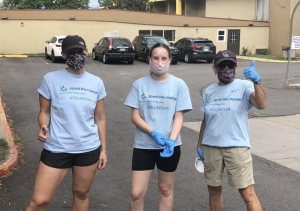
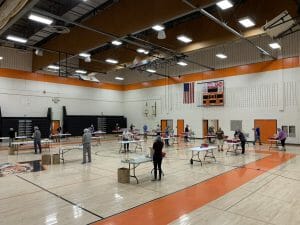
Spark the Change Colorado partners with Harvest Pack to provide days of service, packing hundreds of meals for those in need. Events have been transformed to accommodate social distancing, PPE and all health and safety protocols so volunteers can feel safe while giving back.
in Eindhoven, Netherlands, is the bridge between companies, social organizations and the local government to work toward a more cohesive and inclusive society. Samen voor Eindoven means “Together for Eindhoven” and the organization works to design and implement corporate volunteer programs.
“Corporate volunteers embrace our values and are committed to making a vital contribution to our local community. By using their professional skills and talents for community organizations, corporate volunteers themselves experience more meaning and job satisfaction,” says Esther Hofstede, founder and director of Samen voor Eindoven.
Through the use of smart technology, Samen voor Eindoven is able to mobilize corporate volunteers through a digital platform, maximizing efficiency, impact and flexibility. Social volunteers can enroll in recurring calendar programs and skill-based programs.
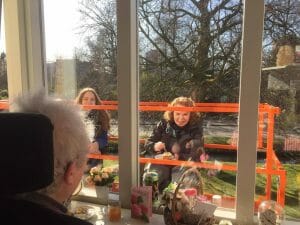
Corporate volunteers engage with initiatives like donating “wishtrees” to almost all 23 nursing homes in Eindhoven, creating a website for Eindhoven residents with foreign roots, making video calls to people who are currently unable to go outside and publishing a “feel good newsletter” with only positive news, sent to elderly residents of nursing homes.
More than 10,000 vulnerable people in Eindhoven were provided with vitamin A during the pandemic, which included providing company over a socially distanced meal.
“It turns out that when you really put corporate volunteers in touch with groups in need, there is more understanding and the gap between the groups is reduced,” Esther says. She encourages increased corporate volunteering, which she calls “a win-win: impact for the beneficiaries and volunteers, substance for the Corporate Social Responsibility policy of companies, and a more attractive workplace for involved employees.”
Kelly Groen at Spark the Change Colorado encourages volunteers to get involved: “While there are countless ways to make an impact, including mindful recognition of your individual purchase power and using your voice and vote to make a difference, volunteerism will always be a necessary cornerstone of civic engagement. There are a multitude of benefits to volunteerism, both to the community being served and the individual serving. There is no comparison to the feeling you get from giving your time and talents to improve the lives of other members in your community.”
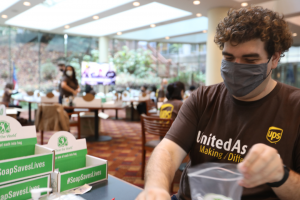
Laura Lane, UPS Chief Corporate Affairs, Communications and Sustainability Officer
In spite of the challenges brought on by the COVID-19 pandemic, I remain optimistic. In these mettle-testing times, the generosity of the human spirit has remained strong. Even amid social distancing, we’re still finding ways to connect with each other and help communities around the world.
These moments of shared humanity provide an important lesson:
We need one another
. We cannot allow this pandemic to create divisions among us —
we are stronger together when united in purpose
.
Collective Momentum
Even before the pandemic, there was a critical need for community engagement. But now with the virus taking its toll on economies around the world, the number of people in need has skyrocketed.
inspires us to action at a time when collective momentum for volunteerism has never been more critical.
In my role as UPS Chief Corporate Affairs, Communications and Sustainability Officer, I have seen how our half-million UPSers have risen to address our world’s most daunting challenges during the past year. That UPS mindset for engagement is reflected in our purpose statement:
Moving Our World Forward by Delivering What Matters.
To us, giving means more than just writing a check — it means combining our skills, passions and time with our logistics expertise, transportation assets and NGO partnerships to make a measurable difference in our world.
And delivering hope for people and our planet means setting ambitious goals for engagement where it matters most. We already met our goal of providing more than 20 million volunteer hours a year ahead of schedule.
In response to some of the past year’s social unrest, we took on a new commitment to advance equity and justice by dedicating more than 1 million more volunteer hours toward Black and underserved communities.
And in our effort to address climate change, we also set a new goal of planting more than 50 million trees by 2030, including the 15 million we already planted. We know the world is counting on us to deliver what matters, which is why UPS will continue to drive meaningful change wherever we can.
Driving Meaningful Change
As essential workers throughout this pandemic, UPSers have delivered everyday essentials and critical PPE; we have helped businesses reinvent their supply chain strategies; and now, maybe most importantly, we are delivering lifesaving vaccines around the world to help defeat this virus.
Service is in our name, and we will continue to serve in every way we can. So, as we celebrate Points of Light’s Global Volunteer Month, we hope our incredible UPSers help give everyone good reason to be optimistic about our future because we know delivering what matters means delivering hope.
Commonwealth Point of Light Spreads Essential Supplies in the Gem of Africa
she knew it would eventually be adaptive to meet the evolving needs of her village. She started off collecting and distributing shoes to young people in the remote villages of Botswana, but in time, Madibana realized that she could help create bridges between her community and essential items like sanitation pads and hand sanitizer — especially during the COVID-19 pandemic.
Madibana returned to Botswana, known as the Gem of Africa, in 2012 after finishing her master’s degree on scholarship in media and communications in England. As part of her scholarship, Madibana committed two years after her studies to her choice of community service. She took community service to the next level by creating the Nayang Association, and hopes to turn it into a full social enterprise.
“This charity is my baby,” Madibana said. “We still have villages where lacking shoes is very rampant — kids literally travel to school without shoes and we’re talking about a country that is like a semi-arid desert.” she added.
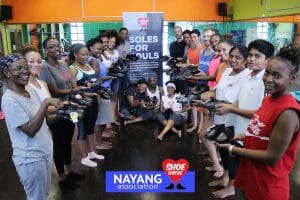
The Nayang Association’s Soles for Souls program has collected and distributed more than 6,000 pairs of shoes for kids and students in remote villages of Botswana.
Remote students commonly walk miles back and forth to school in broken shoes or barefoot, even in the winter months, to make it to class every day. To meet this need for suitable footwear, Madibana created one of the main Nayang Association’s programs, Soles for Souls, and has collected more than 6,000 pairs of shoes for kids and students.
While building relationships with teachers of partnering schools, Madibana realized that teenage girls can miss around 50 days of school every year if they don’t have proper sanitation pads. This unmet issue became something she wanted to be a part of solving, and the Nayang Association has distributed more than 10,000 pads to girls in need since 2015.
Before Madibana began her work, it was common for teachers to spend their own money on resources like shoes and pads for their students.
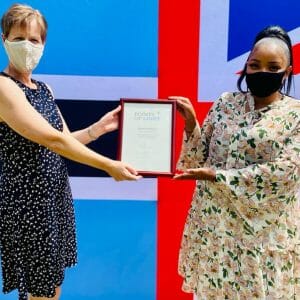
Her spirit of community service has not gone unrecognized. The Prime Minister of the United Kingdom awarded Madibana with a
for her service and dedication to being a global leader of transformative change.
The Nayang Association operated throughout the COVID-19 pandemic, but the charity followed CDC guidelines and were unable to guarantee the right sized shoes for students without fitting them in person before sending pairs out for distribution. However, the charity quickly began incorporating purchased and donated hand sanitizers with their shoes to children and their families to help reduce the spread of the virus.
The Prime Minister of the United Kingdom awarded Madibana with a Commonwealth Point of Light award for her service and dedication to being a global leader of transformative change.
Shoe donation is a continuous need that will always need champions of service like Madibana since a child’s shoe size can change in the matter of months. Most of the shoes of Soles for Souls are donated from individuals and companies, with the charity filling in any gaps if any child still needs a pair of shoes.
Madibana is excited about the charity’s upcoming branded shoe launch which involves various members of her village through the design, construction and manufacturing phases. It’s been a dream of hers for nearly three years since the charity frequently purchases ready-made shoes from countries like South Africa and Zimbabwe. The Nayang Association team is looking forward to creating sources of employment and working with local artists, Madibana said.
The charity has also been constructing ablution blocks — buildings that house private showers and toilets — for children in the villages it serves.
“My thing has always been to tell people that you don’t have to be rich in order to make a difference. Find out what a local charity is doing, especially if it’s close to your heart,” Madibana said.
Tackling Poverty and Inequality With HandsOn Northwest North Carolina and HandsOn Mexico
Serving those who are living through poverty or inequality has long been a focus of the volunteer sector. Many nonprofits concentrate their efforts on getting resources to those in poverty and working to build a more equitable world for those bearing the brunt of discriminatory, unjust or incomplete systems.
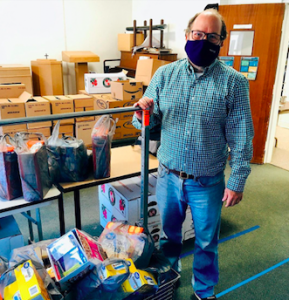
A Project Lighthouse volunteer delivers donated items to a local food pantry.
(HandsOn NWNC), a Points of Light Global Network affiliate, mobilizes people and organizations that inspire community change. Working with approximately 500 different nonprofits in a six-county area, HandsOn NWNC provides organizations with a wide variety of services that help them meet the challenge of their missions in the most effective and efficient way possible.
This includes offering leadership and professional development opportunities to staff and volunteers at all levels of the organization, as well as engaging and mobilizing approximately 5,000 volunteers a year in service across the network.
Amy Lytle, executive director at HandsOn NWNC, says, “We work with
everyone
; there is no age requirement to serve! We work with organizations large and small, and our network reaches out beyond our smaller-sized city to some of the more rural counties that surround Winston-Salem, NC. We work with companies, the school system, civic and religious groups. In terms of the organizations in our network, the vast majority of them are smaller or mid-sized, many of which serve a variety of marginalized communities and/or are led by people of color.”
Amy and the team at HandsOn NWNC are focused on building racial equity in volunteering in particular. At the end of 2020, they launched an ED Roundtable for organizations led by people of color. This self-directed and organized group is currently led by a participant volunteer leader, who is the founder of a small nonprofit that focuses on health, wellness and access to healthy food in her neighborhood.
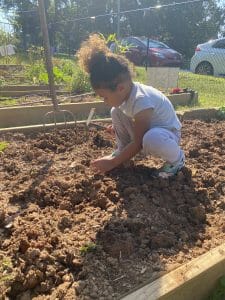
Kelees, a 3-year-old volunteer, helps out at the Kimberley Park Community Garden.
With support from the Starbucks Foundation and Points of Light, the Roundtable is just one way that HandsOn NWNC tries to support smaller, grassroots organizations and increase racial equity within both the local nonprofit sector as well as the community.
From larger efforts like the Roundtable to local efforts with individuals, HandsOn NWNC is making an impact in the fight against poverty and inequality. Take Rosa Johnson, for example, one of the volunteer leaders that HandsOn NWNC works with. Rosa has single-handedly created a small urban community garden across the street from a local Title 1 school. Over the past year, HandsOn NWNC has formed a relationship with Rosa and has come alongside her to help mobilize additional resources — including donations and volunteers — to help make the garden more sustainable.
Amy Lytle says, “Service has the power to unite people across differences and increase social capital; it builds empathy and can inform other forms of civic engagement, such as voting and public policy advocacy. Service can transform individual lives while also working to change systemic issues.”
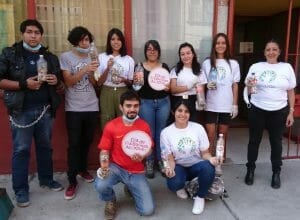
A group of young people, members of an NGO partner and an international volunteer accepted the challenge to collect cigarette butts in order to reduce water pollution and to prevent drains from clogging.
, exists to inspire, motivate and support people interested in investing their time to improve the quality of life for disadvantaged people, animals and the environment. By connecting people with organizations related to their interests and skills and promoting programs, events and campaigns to highlight what people are doing for their communities, they uplift and inspire others to get involved.
Blanca Ramírez, acting executive director at HandsOn Mexico, shares a few notable projects. “Recently we worked in conjunction with the YMCA to support a group that lives in a rural area of the city called Ajusco. In this particular neighborhood, it is fairly common to find young people using drugs or who are part of criminal groups. The YMCA decided to build a community center to provide more options for the local youth and their families to spend their free time. We contributed to projects such as restoring the community center, building a garden and creating a soccer field. The community center also provides leadership development services, activities and workshops to guide people in how to start their own business.”
HandsOn Mexico is working to tackle poverty in creative ways, too. The nonprofit works with a community organization in Xochimilco, initially collaborating with the Umbral Axochiatl organization to clean the canals and remove plastic waste. The villagers welcomed the volunteers and encouraged them to continue caring for the area. The objective, in addition to maintaining a clean natural space to create the right environmental characteristics to revive the axolotl, a native animal, is for the inhabitants to return to work their lands in a sustainable way. This involves using the natural resources that the area offers, resuming ancestral techniques and inviting scientists to implement best practices that allow obtaining organic products and recovering some native crops that were being lost.
HandsOn Mexico worked with a corporate group to clean the canals in Xochimilco.
Thus, the Xochimilco inhabitants became small businesspeople, forming a group called “Grupo Tlacuache.” This project created an interdependent cycle in which the environment is conserved through the sustainable commercialization of the natural resources of the area and the economic income for the families in the area is improved.
Blanca Ramírez advises people to “include time in your schedule for volunteering at least once per month. It’s worth spending time on a cause you care about. Every other activity you do in your life will be more meaningful if you volunteer often.” And to other nonprofit leaders, she says, “Remember that your work is impacting more lives than you imagine. Your effort is inspiring others and changing lives. That donation, that activity you organized where people met new friends living in different circumstances than theirs, is making a difference in the beneficiaries’ lives as well as in the volunteers’ lives.”
HandsOn NWNC’s Amy Lytle also has words of encouragement for volunteers and nonprofit leaders: “If you’re interested in volunteering, JUST DO IT! There are so many ways to get involved, no matter your passions, your skill set or your time limitations. There is a project or an opportunity out there for you. For nonprofit leaders — YOU’RE DOING GREAT! You’ve just reached the one year mark of working through the front-lines of a global pandemic. Whatever you’re doing, it is enough. Be kind to yourself, provide grace to others, and ask for help when you need it. You owe it to your mission and your stakeholders to not burn yourself out trying to accomplish the impossible.”
“Lifting As We Climb”: How Service Became a Step Up
Points of Light board member Marty Rodgers has led a life of service as a result of being raised in the tradition of giving back.
“My parents always focused on serving our community,” Marty said. “My dad was a family doctor who did house calls, working with the poorest of the poor and teaching residents. My mom was an organizer serving our community and our church. I was raised with the belief that ‘to whom much is given, much is expected,’ and service was a common expectation at both my high school and college.”
Marty Rodgers, Accenture
Today, Marty is a senior managing director at the global professional services company, Accenture. Professionally, he helps individuals and companies imagine, envision, and prepare for the future in the areas of strategy, IT, and operations management. He also leads his corporate teams in volunteer opportunities in the community.
At Accenture, he strives to ensure that the communities he does business with, from Maryland to Florida to Texas, are taken care of. “We have a responsibility to make sure we’re part of the fabric of those communities and that we’re taking care of both shareholders and stakeholders.”
Service has been woven into his professional life since he started his career, too.
Marty first became involved with Points of Light in 1990 as a pro-bono volunteer, when he started his first job in the service sector designing a fellowship program (the Youth Engaged in Service “YES” Ambassadors Program) to connect young people with nonprofits. In fact, two of his mentors Father Monk Malloy and Dr. Johnnetta Cole who were respectively the Presidents of the University of Notre Dame and Spelman at the time were on the founding board of Points of Light, which makes him especially proud to be a board member today.
“Since I first began my work at Points of Light, I’ve always believed in the power of service for all people at each stage of life. It’s the great connector to work on problems that our communities and country face. Service provides the opportunity to find common ground and roll up our sleeves, working together on a problem eye to eye, arm to arm, and hand to hand. In doing so, we realize our common humanity and our agency to affect change in this great experiment we call democracy in America.”
Through his work at Points of Light, Marty met Senator Harris Wofford and went on to work with him on Capitol Hill as a legislative assistant in charge of national and community service.
He worked on multiple pieces of legislation with the mission to advance public service, including the founding of AmeriCorps and the establishment of a national day of service on the Dr. Martin Luther King Jr. holiday. He also contributed to a series of efforts and programs designed to create service as a pedagogy within multiple pieces of education-related legislation.
Marty’s perspective about service mirrors Points of Light’s Civic Circle. “People are looking to align all the different aspects of their lives around who they are, what they stand for, and what they believe in,” he observes. “Whether it’s the rise of socially responsible investing, purchase power, advocacy, or where you choose to give your time, talent, and treasure, service today is about alignment of purpose across all dimensions of our lives.”
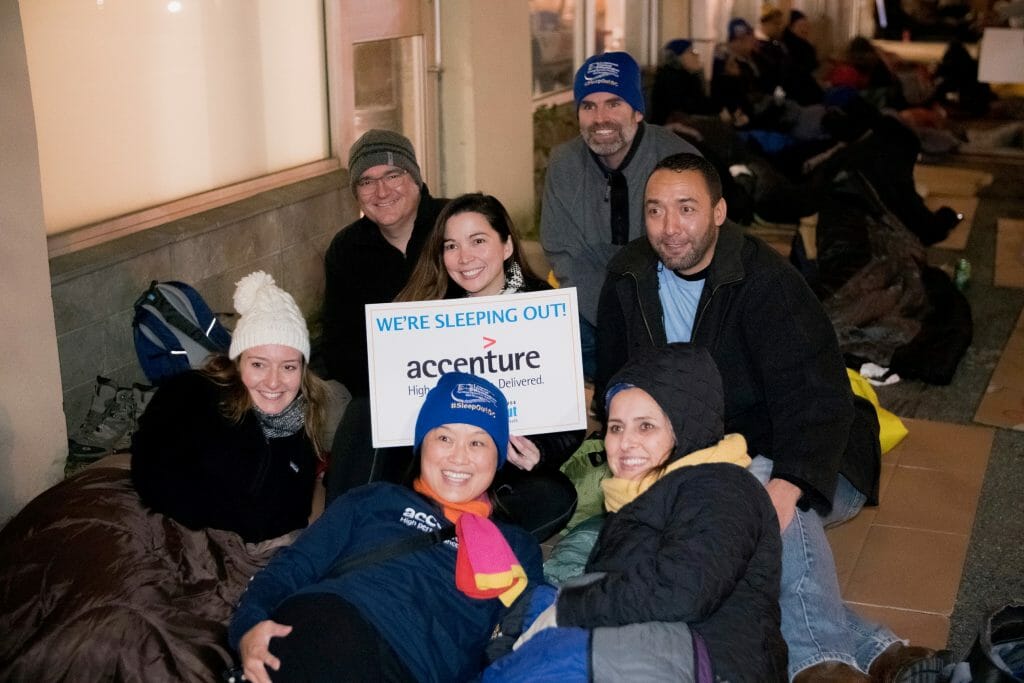
Marty Rodgers, far right, and Accenture volunteers participate in a “sleep out” to raise awareness and funds for homeless youth.
One particular facet of the Civic Circle that Marty feels strongly about is voice. “I was raised to believe in the power of one’s voice, of sharing your experience, journey and truth. That’s the responsibility that we bear for the opportunities we’ve been given. As a person of color who has had all these opportunities, I believe that once you get a chance to be at the table, it’s your responsibility to use your voice and your power — they’re ultimately the same thing — for those who aren’t at the table.”
The idea of “lifting as we climb” coined by Mary McLeod Bethune has always appealed to Marty. “The higher we climb, the more we must lift, continuing to open the doors of opportunity for others,” he says.
Marty is passionate about bettering schools — whether public, Catholic, or charter — and creating opportunities for youth from under-resourced and at-risk environments. Marty is an advocate for education and continues to serve on the board of the Children’s Defense Fund among other organizations including KIPP-DC, Consortium of Catholic Academies, and the University of Notre Dame.
He often quotes one of his mentors, former boss, and founder and president emerita of the Children’s Defense Fund Marian Wright Edelman, who said, “Service is the rent we pay for living. It is the very purpose of life, and not something you do in your spare time.” We at Points of Light can attest that through his work on our board and service in all aspects of his life, Marty is certainly paying it forward.
5 Ways to Get Involved and Support Women’s and Girls’ Rights
Here at Points of Light, we know that leading a civically engaged life isn’t just about volunteering or donating resources, though those are important parts of our
. But there are countless ways you can support women and girls in your community and beyond. In honor of Women’s History Month, here are five ways to contribute your time, talent and creativity to uplift women this month:
Mentor a younger generation
Empowering girls and younger women is one way to make a positive impact that could shape the future for generations to come. Take Juliette Gordon Low, the founder of
, for example. Gordon Low started the organization with just a few close friends and family members to learn new skills and help others in need. Today, Girl Scouts teaches young women to lead themselves and others, advocate for what they believe in and stay active and informed around global issues. Another highly-regarded youth mentorship organization is
There are plenty of organizations dedicated to protecting and advancing women’s rights. From stopping domestic violence and protecting victims through work with your
, you can make a difference with your voice, your time and your skill set. Passionate about putting an end to human trafficking? Check out organizations like
One of the biggest opportunities in the women’s right arena is support for parents, particularly low-income families or single moms. Could you start a diaper drive for the women in your local community like
, which advocates for eliminating the gender pay gap, providing workplace benefits like maternity leave, paid sick leave and ending discrimination against pregnant women and new mothers.
A method of civic engagement that’s newer and so impactful, using your dollars to support businesses championing women is a prime way to make an impact. Find
Changemakers often start by assessing their own community needs and working with the community to find solutions. So take a look around… what’s lacking? Which individuals, businesses or organizations need more support? Think about issues affecting women specifically. Could you donate feminine hygiene products to local homeless shelters, underserved communities, or students? Check out the work that teenagers
As you think through your civic engagement opportunities this Women’s History Month, remember that no action is too small. To find more ways to get involved, check out
Daily Point of Light honoree and Points of Light Youth Network member Sage Hirschfeld talks about why listening and learning is important both for youth and adults.
Listening is one of our world’s most underrated skills. It has the power to expand your worldview and drastically improve your relationships. I implore you to take a moment and imagine what our world would look like if people genuinely listened to each other and put effort into learning about other people’s perspectives, logic and reasoning for their beliefs and actions. That world seems pretty nice, right? It’s also pretty different from the one we live in now.
Why is that? Why do we live in a world where we don’t listen to each other?
Taking the first step to listen is hard. Sometimes we hear things that hurt, either because they include stories of pain and abuse or because they call into question things we previously believed. Sometimes when we listen, we hear things that just don’t make sense in our heads and it takes us time to understand. That can feel really frustrating.
But humans do things that are hard and frustrating all the time (shout out to taxes and physics homework), so what makes listening and learning so different?
The reason we don’t live in a more listening world is because we haven’t built up the stamina for it.
Sage Hirschfeld: “
Once we understand that listening isn’t easy, we’re more forgiving of mistakes, we’re more receptive to the time it takes and we’re more resilient in the messy reality of the learning process.
”/ Sage Hirschfeld
Listening and learning are processes that take time and struggle and that’s not what our society values. Our society has taught us to appreciate what’s fast, easy, and convenient. That’s how we like our food, our social media and even our information. With the polarization of news sources, the information we’re given is filtered based on what will be the most convenient truth for our consumption rather than based on what’s actually happening.
Over time this erodes our ability to tolerate the discomfort that comes from absorbing information that might make us pause. This process involves considering how this information fits into our worldview and whether we need to re-evaluate some of our previously held beliefs. Our listening and learning muscles atrophy and we’re left with very little stamina for perspectives or information that don’t fit neatly into our expectations.
On top of this, our society normalizes that lack of stamina. In America, it’s common to write someone off completely when they have an opinion that differs from yours. Even in our highest levels of government we see this happening. That’s not normal! But we’re so used to it that we’re more surprised to hear about a bipartisan piece of legislation being passed than we are about our government literally shutting down when members of congress refuse to listen to each other.
So what can we do about this?
For the past few months, I’ve been co-facilitating an eight-week virtual seminar on reproductive justice. I’ve watched our multi-generational group take in a curriculum full of stories of injustices that were hard to listen to and perspectives that were so different from their own that it took time and some serious mental legwork to comprehend.
But still, week after week, people kept showing up.
We sat in the discomfort of hard truths and waded through discussions where we felt uncertain. People would ask questions, share stories, make mistakes and then forgive each other (and themselves) for these mistakes. At times it was hard but no one shied away. Or if they did at first, they returned each week to try again.
The secret was that we didn’t pretend it would be easy.
Once we got past that, we were able to go into the struggle together. And that made all the difference.
Once we understand that listening isn’t easy, we’re more forgiving of mistakes, we’re more receptive to the time it takes and we’re more resilient in the messy reality of the learning process.
The key to a more listening world is to see it realistically: a place where there are just as many misunderstandings and mistakes as there are now, but instead of taking them as a sign to jump ship and stop trying, seeing them as signs that we’re not done learning yet, that we need to listen a little harder.
I don’t know exactly how to get to that world. But if I had to guess, I would start with listening. Today, tomorrow, and every day after that.
To read more about listening and learning, download the latest issue of Civic Life Today.