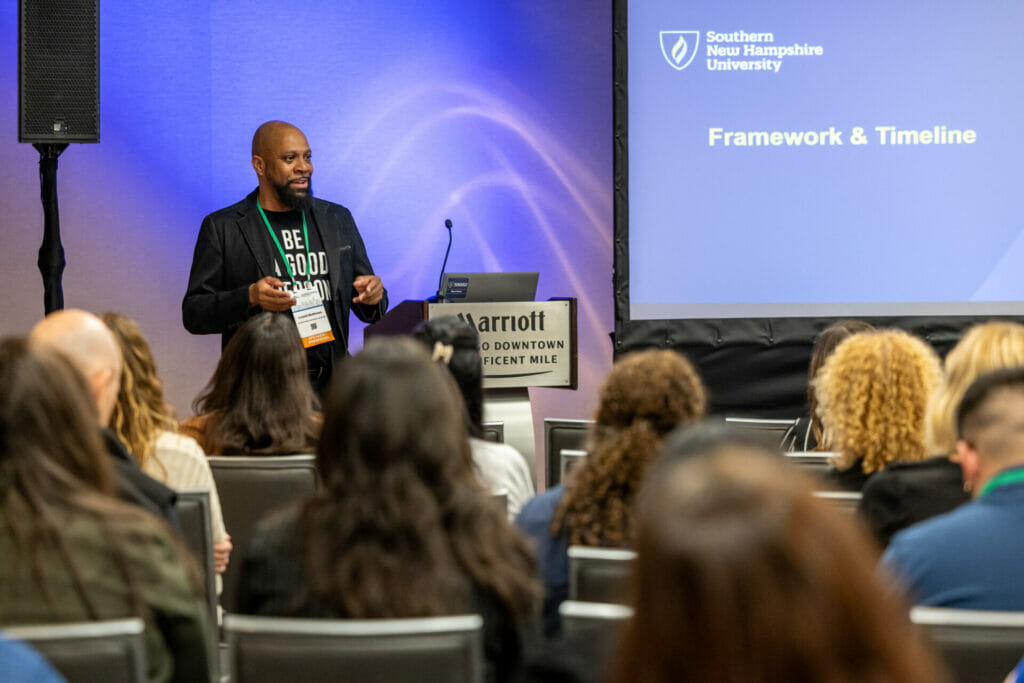
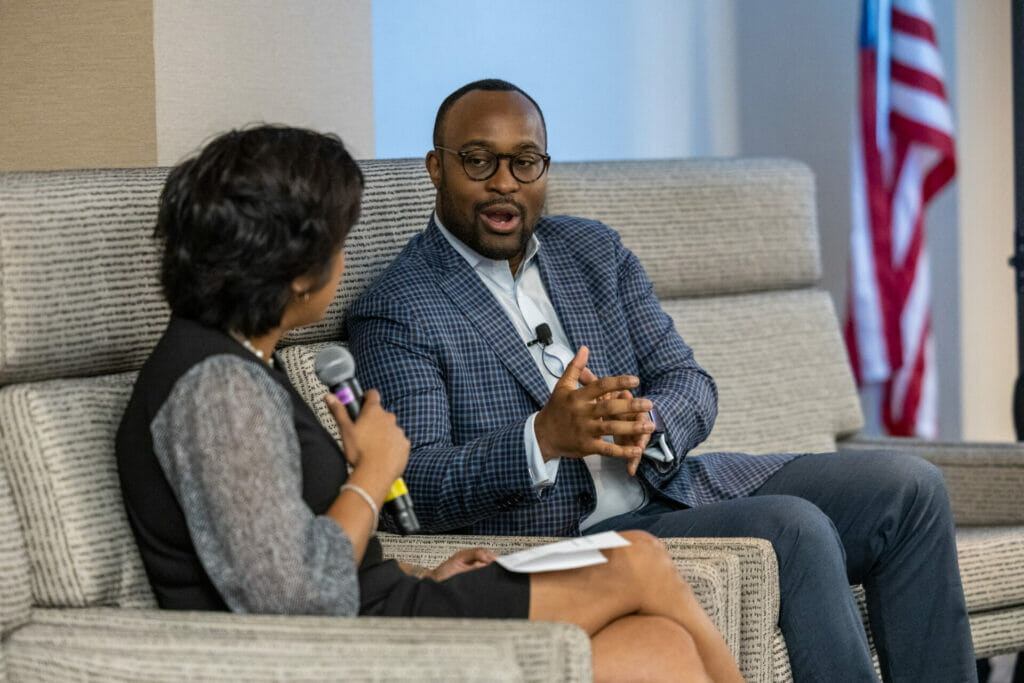
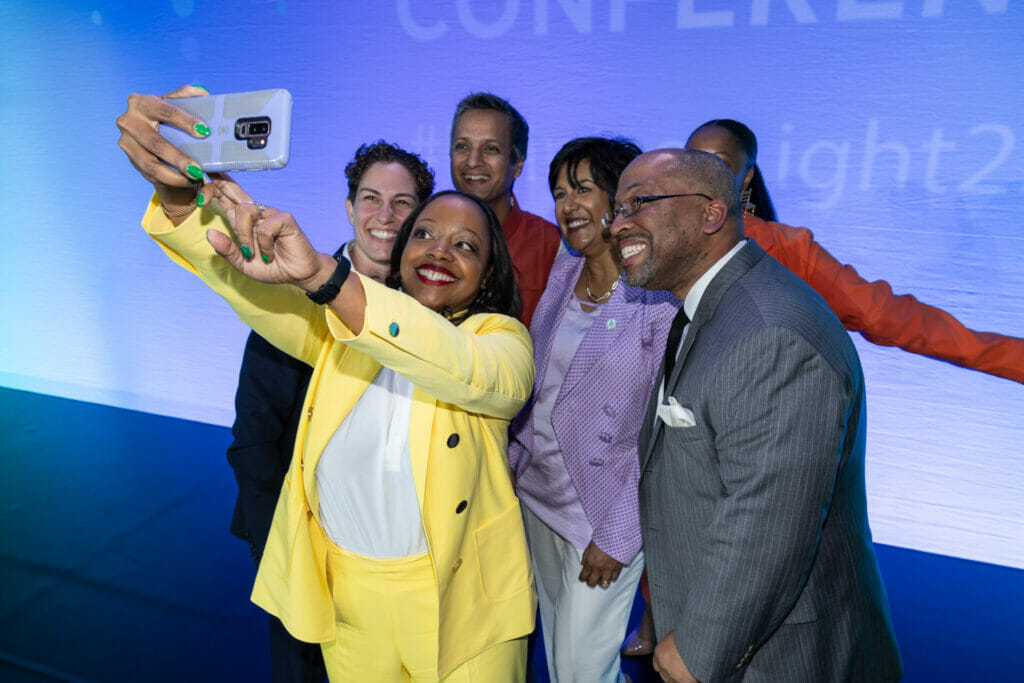
(CSC) gathered in Chicago last month before the official kickoff of the Points of Light Conference. The conversations were lively with folx reconnecting with peers and making new connections.
Although we stay connected via virtual meetings year-round, some of the best learning and inspiration comes from our in-person events. When we gather,
always flow from our guest speakers and peer conversations. I was scribbling fast notes to keep up with the great thoughts shared by our dynamic speakers, many of whom – like me – are Chicagoans and all of whom are doing good in the world, whether that is through academia, social entrepreneurship, filmmaking, storytelling or business.
More than 100 of us packed the room to hear from Dr. Nicholas Pearce, clinical professor of management and organizations at Northwestern University Kellogg School of Management and founder and CEO of
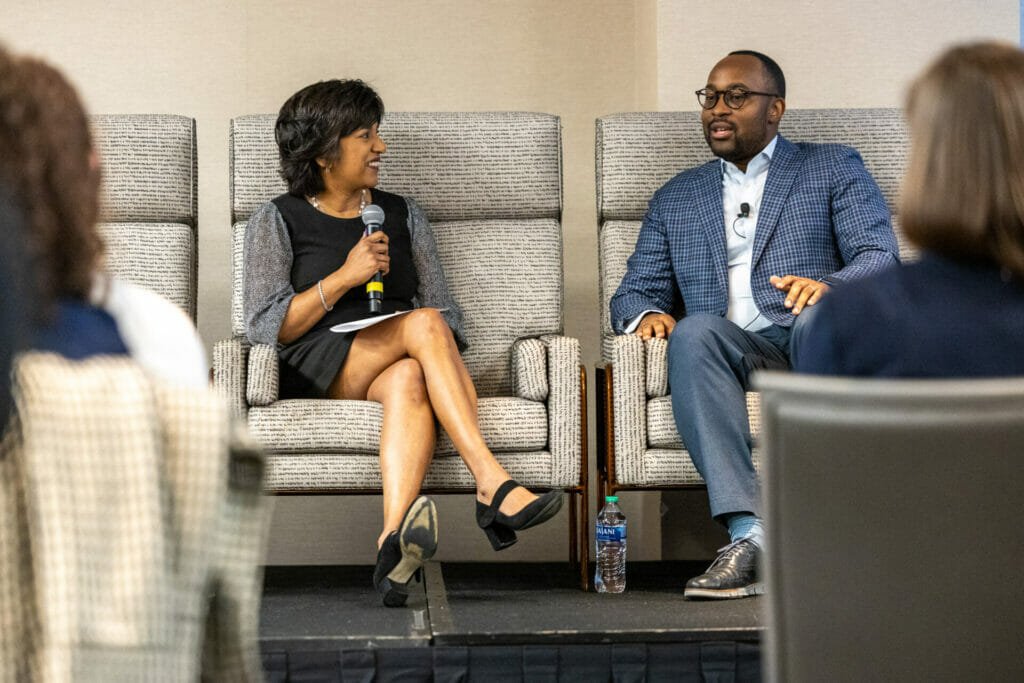
; and a panel moderated by Marianna Ruiz, executive vice president and executive creative director at Edelman, featuring Brenda Robinson, head of film finance and inclusion strategies at HiddenLight Productions, Diane Quon, producer at Quonco Productions, Mark Mitten, founding and managing partner of Mitten Media, and Nate Clark, global director of corporate social responsibility at John Deere and president of the John Deere Foundation.
Here are just a few of the top takeaways from our time together:
Pursue Purpose as a Pathway
Staying connected to your purpose, particularly as a CSR professional, is a daily pursuit. We must “connect soul to role,” said Dr. Pearce, and really do the work we are built for as individuals. And even when you have connected soul to role, rest is essential. It’s not a reward we earn after working until exhaustion; we have to work from and out of rest, not for it. On the days when your work feels like an uphill climb, when a program isn’t having the impact you hoped or the business integration you know matters isn’t materializing, that’s when you most need to reconnect to purpose.
Learn and Lead Locally
Real and sustainable change happens at the hyperlocal level, but only if we start by listening and learning from the community. As CSR and employee volunteer programs go to scale or become global, the voices of the local nonprofits and neighborhood leaders can get lost, leading to systemic inequities going unaddressed. Jahmal Cole shared some powerful reminders about why the grassroots connection is key and encouraged all of us to conduct community asset maps before seeking to partner or program in a geography.
Stories on the Screen = Social Impact
Films can make us think or act differently, and that’s especially true for documentary projects that introduce us to new places, people, and realities. As panelist Brenda Robinson said, “The first thing we [filmmakers] look at is how to you change minds and hearts with art.” CSC member John Deere is one company that has leveraged filmmaking for social impact (learn about America’s volunteer fire service in
), but even if your company never makes a documentary, there are some transferable storytelling lessons all of us can learn from. One that’s stuck with me: storytelling is about listening and learning, and that’s the foundation for high-impact social action, and it can come in many forms, like your internal corporate newsletter, a panel conversation, a first-person share from a colleague or nonprofit partner, or even a social media post.
New Corporate Service Council Chair, Anita Whitehead, president and chair of the KPMG US Foundation in conversation with Dr. Nicholas Pearce, clinical professor of management and organizations at Northwestern University Kellogg School of Management and founder and CEO of The Vocati Group.
In our time together, we also announced our next Corporate Service Council chair: Anita Whitehead, president and chair of the KPMG US Foundation. Since the CSC started in 2005, our chair companies have played a critical role in leading the council and ensuring that we continue bringing together top brands, purpose-driven leaders and subject matter experts.
I’m looking forward to gathering with all the forward-thinking and purpose-driven CSC members at our next events to keep the conversation going. And if you want to be in the room where all this inspiration and learning happens,
Bridging Divides: The Role of Business and Civic Engagement in Addressing Polarization
In a world characterized by increasing polarization, businesses and business leaders find themselves at the center of a brewing storm. Action might come with backlash and silence could signal complicity. What can corporate citizenship practitioners do to mitigate the negative effects of polarization inside and outside their company and help others find common ground? The Business Summit at the 2023 Points of Light Conference explored this theme and the crosswinds that corporate citizenship leaders are navigating daily.
68% of Business Summit attendees believe that polarization has impacted their workplace.
Points of Light’s Chief Global Corporate Solutions Officer Katie Stearns kicked off the session with a focus on the business case for engagement. Although the question of whether companies should voice opinions on societal issues remains contentious, research indicates that, around the world, stakeholders expect them to take a stand. Depending on the issue, roughly 70 to 90% of respondents in the
said they “expect CEOs to take a public stand on issues” such as climate change, discrimination, and the wealth gap. The same goes for smaller businesses. Points of Light’s recent
reports that the general public has high expectations of how small businesses get involved in social issues. For instance, half the public and two-thirds of small business owners ranked speaking out as “pretty important or essential.”
A
report highlights that 88% of CSR leaders believe companies should be courageous and take a stand, even if it means alienating some people. With this much buy-in, it becomes a business imperative to determine a course of action and who better than social impact professionals to champion this work? Stearns doubled down on this point by highlighting the power corporate citizenship leaders have to positively shape the discourse and dealings inside their company, which ultimately trickle out into society.
“You have influence. Not just at the table with senior leaders when they’re deciding how to engage on an issue publicly, but also internally as interpreters and agents of your company’s core values, civic engagement strategies, and culture of service,” said Points of Light’s Chief Global Corporate Solutions Officer katie stearns.
CSR leaders can navigate economic and social pressures successfully by being prepared and joining the bridging movement as a safe space to invest in democracy and civility. Bruce Bond, co-founder and CEO of a bridging organization called
, shared that, although media might emphasize our polarity, many studies reveal that Americans are closely aligned on major social issues. He also introduced their
as one of the models that companies can use to empower employees to have respectful conversations in the workplace and emphasized one of its most appreciated tenets to take winning off the table.
Then, Bruce welcomed three business leaders to the stage to share how their companies are navigating polarization in the workplace. The panel included Pamela Everhart, senior vice president, regional public affairs and community relations at Fidelity Investments; Nick Nottoli, director, reputation management and insights at Allstate; and Clarita Santos, executive director of corporate and civic partnerships at Health Care Service Corporation (HCSC).
The panelists agreed that the pervasive challenge of polarization requires companies to implement strategies that create civility and build empathy within organizations. Consistency in both corporate action and application of values is vital for gaining and maintaining stakeholders’ trust.
Here are some approaches that the panelists shared:
Authenticity is Essential: Senior leaders must recognize the importance of engagement and move beyond the sidelines. Demonstrating authentic reasons for taking a stand can help companies gather allies and build collective courage. Case in point, Nottoli described the societal engagement framework that provides Allstate leaders with a decision-making tree on whether the company takes on an issue. Criteria for taking a stand include: an issue that aligns with company values, impacts stakeholders, is relevant to Allstate’s business, and on which the company can meaningfully affect change.
Proximity Matters: Contact theory suggests that simply being around others can promote tolerance, acceptance and allyship. Activities such as volunteering together, offering listening and learning sessions, providing nonpartisan voter education, and creating space for open dialogue can help employees connect beyond political differences while also developing a deeper understanding of their community and the issues affecting it. To build civility, each panelist emphasized the importance of putting relationships ahead of any task. In fact, Santos mentioned that the CEO of HCSC is often quoted as saying, “it’s okay to disagree but not be disagreeable.” Social connection built through supportive and inclusive relationships strengthens an individual’s wellbeing and also the resiliency of communities.
“If my corporate social responsibility team is thinking alike on an issue, then we’re not thinking,” said Pam Everhart, senior vice president, regional public affairs and community relations at Fidelity Investments
Culture is Key: Since most of us spend half our waking lives at work, mutual respect built inside workplaces can have positive consequences for society. Employees are more likely to stay and thrive in an environment where they feel respected, heard, valued, and connected to a larger purpose. That culture should also be inquisitive and ready to explore an issue from all sides as no one person shares the same lived experience. Everhart encouraged the audience to question their own echo chambers and build “challenge networks.“ She said, “If my corporate social responsibility team is thinking alike on an issue, then we’re not thinking.” Truly, workplaces need to embrace having better arguments to enable the discovery of better solutions. As ambassadors of organizational values, every CSR practitioner has the power to influence and champion an inclusive culture.
To conclude the Business Summit, Founder and Managing Partner of
and Co-Founder of NYCNext Maryam Banikarim took the stage to share a story of a recent project she dubbed, The Longest Table. Put simply, during the COVID-19 lockdowns in 2020, she and her New York City neighbors hosted an outdoor meal where more than 500 community members came together – even those who might not normally break bread together. This simple act of community building is now being replicated around the world. She ended her keynote with two significant learnings from the project that resonated with attendees: it takes just a few to build a movement and that there is no better time for “we, not me.”
In today’s polarized world, businesses have a significant role to play in helping society find common ground. Although challenges persist, there are strategies that can promote empathy and mitigate the negative impacts of polarization. By embracing these strategies, companies can foster a sense of purpose, enhance employee wellbeing, and contribute to a more cohesive and inclusive society. As CSR leaders can demonstrate, community engagement breeds belonging and service truly unites.
5 Questions to Jumpstart Your Employee Volunteer Strategy and Program Design
Big corporations as well as small and midsized businesses all want to know whether there’s a perfect time to start providing employees with opportunities to create social impact. Thankfully, when it comes to employee volunteer strategy and program design, there is only one answer: Now.
While there’s a lot more planning that needs to go on before launching a corporate social responsibility strategy, many those who ask this question have a ‘perfect’ timeline in mind, such as business age or development stage, when it fits the budget or leadership interests, or conversely, they have no idea when or how to engage the right nonprofit partner. In truth, if you’re asking this question, there’s likely no reason to wait.
Corporate community engagement can take many forms, from workplace giving programs to providing volunteer time off (VTO), which allows employees to volunteer during regular work hours, to organizing group service experiences for your employees. Even giving employees time off to vote is community engagement.
It’s important to know that no matter what kinds of community engagement your business decides to undertake, they all provide myriad benefits, so the sooner you get started, the sooner you’ll be able to capture the value for your company, your employees and the communities where they live and work.
Corporate social responsibility programs that engage employees provide benefits far beyond a healthy return on investment. We’ve made a list below of who gains significant value and how, regardless of the program type.
https://www.youtube.com/watch?v=u_HFYfS2cE8
For companies:
Makes the company more attractive to job seekers
Builds authentic brand value and values locally, regionally, and globally
Provides financial returns
Strengthens workforce skill sets
Increases employee engagement, productivity, and retention
Helps identify emerging leaders
For employees:
Allows employees to feel more fulfilled personally and professionally
Helps employees listen and learn about community challenges and opportunities
Provides team-building opportunities
Provides resume builders and new skill development
Allows employees to feel more connected to their employer while living out organizational values
Forming partnerships with nonprofits also benefits the organization itself by providing much needed human capital resources from hands-on volunteers to board members, as well as advocates for the community issues they’re working to solve. When companies engage employees in creating positive change, all stakeholders reap rewards.
While you should certainly start as soon as possible, there are some important questions to answer before you develop your community engagement strategy and launch initiatives.
What type of programs work for your company?
As we mentioned before, this can take many forms, from a company-wide donation campaign to hands-on, off-site work. Make sure you design programs that meet community needs first and appeal to most employees. However, you’ll want to create them with enough flexibility to include anyone with potential limitations.
Why are you doing it?
While we’ve provided numerous benefits the company and employees can enjoy above, it’s important to identify why your company wants to undertake engaging employees in community—and that ‘why’ should ideally align with business objectives, culture and values. This clarity will ensure that your company maximizes its most powerful resource, your people, and achieves meaningful impact for all.
How will you measure success?
To properly assess the progress and success of your strategy, you’ll need to know what KPIs to track so efforts and achievements can be communicated to partners, stakeholders, leaders, and employees alike. Listening to and partnering with communities and the NGOs your corporate social responsibility programs support can help you to truly understand the positive impact you are creating. For an excellent primer on inputs, outputs and outcomes—the data you’ll want to collect and share—read through
by True Impact, a leader in social impact measurement.
How will you convince senior leaders?
While community engagement programs are highly beneficial, you also need to be able to communicate the ‘why’ as well as the ‘who, what, when, where, and how’ to executives and stakeholders, or it may never come to fruition. Think of this as another incredibly important business strategy with objectives, tactics, metrics and an annual timeline to back it up. They might also be interested in data from third-party sources that proves the return on investment and, if so, check out ACCP’s
Whether you offer ways for employees to make individual or group contributions, ensure you understand what actions and issues are meaningful to them. An employee survey can help you uncover themes and ideas. Context can also create meaning. So, offer opportunities to learn about community issues before volunteer projects and time to reflect and resources to stay engaged afterward. Most importantly, ensure the work is meaningful to the community or your nonprofit partner.
Now that you’ve got the basics of what you need to consider, it’s time to get started. If you need more information, we’ve got plenty of valuable resources
Amplify Your Social Impact: Combine Elements of Points of Light’s Civic Circle®
If you’re looking to amplify your impact as you contribute to social good, start by considering which activities you’re engaging in. The truth is that civic engagement comes in many forms, and by combining various types of efforts, you can make your impact exponential rather than linear.
is a framework that helps guide individuals to live full civic lives by demonstrating nine different ways to get involved in causes they care about. Today, we’ll cover three of these avenues so you can consider how you might combine them to magnify your efforts and make your impact stretch that much further.
Volunteering
Of course, when many people think of civic engagement, they think of lending their time and talent through
. And for good reason – nonprofit organizations and NGO’s thrive on the collective power of their volunteers. Volunteers enable these organizations to do the best work they can with the resources they’ve been allotted.
It’s a good idea to think through your volunteer activities to ensure they align with your passions, capabilities and schedule. Whether you volunteer once a month for a few hours, a few times a year with a corporate team or every weekend, you are making a difference in the world!
to a cause or organization you care about, you allow for your dollars or goods to be put to the best use possible to benefit others. Donating allows organizations to continue their mission and spread awareness about a cause area. Donations can also directly benefit recipients – as in the case of a natural disaster.
Be aware that donating is only helpful if the donations – monetary or in-kind – are truly what the organization needs. Unwanted or unneeded donations are often trashed, contributing to waste. So be sure to do your research and ask for what donations are most helpful before you donate!
to elevate the causes they care about. Whether you’re sharing information via social media, talking to friends or family members about a specific issue, or marching in a peaceful protest, you can use your voice – which includes your own opinions, perspectives and concerns – as well as contributing to a collective voice rallying around a cause area.
Combining your voice with other types of civic engagement can be a powerful way to make your mission and message louder, clearer or more accessible to others. That said, be mindful that you don’t use the element of voice for performative activism, but rather that you “walk the walk” along with “talking the talk”!
Reclaiming the Public Square: Bringing Communities to the Table
Unlocking the Power of Voice through Community Engagement
The Fourth of July should be a time of reflection about the state of our nation and what we hope for its future, but how do we keep the momentum going year round? Civic engagement requires a renewed commitment to drive real and sustained change in communities worldwide. The work demands an inclusive public square where everyone’s perspectives are heard, valued and leveraged.
, president of The Field Foundation of Illinois, has a long history of bringing together disparate voices as a strategy for tackling systemic racism. In a recent presentation at the
, he highlighted the importance of reactivating the public square as a space for civic discourse, idea exchange and community celebration. Ash emphasized the need to reclaim this space and rebuild the civic relationships that underpin our society.
“I have spent all my career dealing with the various facets of segregation fueled by systemic racism that has plagued our beloved city [of Chicago], while recognizing its brilliant architecture, public art, diverse cultures and civic generosity,” said Ash.
To truly harness the power of voice, it’s essential to ensure that all community members have a seat at the table. The
is one of its most powerful elements, because true change occurs only when everyone’s voices are included and respected.
So, how can we bring communities to the table and activate their voices within the public square?
1. Value Differing Voices
Creating an inclusive public square requires actively seeking diverse perspectives and ensuring a platform for underrepresented voices. This means asking community leaders who have historically been marginalized to lead the conversations. A more comprehensive understanding of the issues that affect communities will, in turn, demand inclusive solutions.
2. Promote Dialogue and Active Listening
Engaging in open and meaningful dialogue is essential for fostering civic engagement across different groups and generations. Encouraging active
builds for empathy for and promotes the sharing of others’ experiences and perspectives. Actively seek opportunities for community members to come together, exchange ideas and engage in constructive conversations.
, communities need to lead decision-making processes. Ensure that established inclusive and collaborative decision-making mechanisms exist, such as community forums, town halls or advisory committees. Decisions made by a community result in a more active and participatory democracy.
4. Cultivate Community Leadership
Invest in community leadership who share the understanding that inclusivity is crucial for sustaining long-term change. Identify and support emerging leaders, providing resources, training and platforms necessary to amplify their voices and drive positive transformation. By nurturing community leadership, a ripple effect is created, inspiring others to step forward, take action and become advocates for change.
Bringing communities to the table is a fundamental step in activating the power of voice within the Civic Circle framework. By promoting dialogue, facilitating collaborative decision-making, and cultivating community leadership, we can create an inclusive public square that reflects our national communities.
The journey toward a more equitable and just society requires collective action, and by combining elements of the Civic Circle, you can amplify your impact. Each one of us has the power to contribute and make a difference. So, invite others to the table, and reclaim the public square as a space where all voices are valued, heard and respected.
What are your thoughts on activating the power of voice through community engagement? How can we bring communities to the table? Follow us on social media to share your ideas and experiences.
Listen and Learn from Our Research on Under-resourced Communities
Knowing that under-resourced communities are often some of the most overlooked, nonprofit organizations around the world are focused on tackling issues that often affect them like poverty, homelessness and food insecurity. These organizations, along with the volunteers and businesses that support them, lend their time, talent and resources to addressing these tough issues through volunteering, donating and using their voice – all elements of the
.
The Civic Circle framework is an essential tool that not only opens more pathways to civic engagement, it allows you to make your activism and advocacy work even more impactful. One of the best places to start is by
Poverty and homelessness is a prominent issue, with 4 in 10 people surveyed indicating concern. When we look at the ways that people are getting involved, the “Top Actions Taken” and what people consider to be “Most Influential” are
.
These are certainly critical actions, but it’s important to ensure that they’re not misguided or performative. With the absence of listening and learning, volunteers and donors may not be making the greatest impact they can – or worse, their impact may not be what’s needed most by the people who are most affected. That’s what makes listening and learning such an integral first step.
If you’re engaging with activism around poverty and homelessness, start by asking yourself a few questions:
Am I listening to what the community needs?
Could I be more effective with a deeper understanding of the issue?
How do the social organizations I’m partnering with incorporate listening and learning into the opportunities for action they’re already providing?
Read about how Diannah Pennyman launched her nonprofit to aid people who are unhoused in Ohio and beyond.
Food insecurity is still prominent in communities around the world, even in the most developed nations. Hunger and food insecurity have been pervasive and enduring needs for a long time and, as with many other issue areas, the pandemic revealed the disparity and urgency around these issues. Thirty percent of people are concerned about food banks and hunger when compared to other issues, according to our research.
Food banks are a critical service to communities, both in times of disaster and day-to-day. It makes sense that the ways people are taking action around these issues are the traditional ways we respond to this need – by volunteering and donating. However, by incorporating other forms of engagement, like
, we may be able to work collectively toward addressing the root causes. In other words, by combining elements of the Civic Circle, you can amplify your efforts and make a bigger impact.
When engaging with activism around food insecurity, consider a few questions:
How can I use my voice to campaign for more balanced allocation of resources in underserved communities?
How can I advocate for better legislation that supports food insecure communities?
How are the social organizations I’m partnering with address systemic change that could increase impact on a larger scale?
Check out how Miami teen Julia Krass is working to solve hunger and food insecurity in South Florida.
Want to keep diving? Take a look at these topics to find out how you can leverage our research to take civic action in your own community:
Disaster Corporate Aid Tracker: Stay Informed on Corporate Response to Recent Disasters
Use this tool from the U.S. Chamber of Commerce Foundation to stay up to date on the corporate response to recent disasters.
Disasters often leave record-breaking devastation in their wake. And while you can’t foresee how severely they may disrupt communities, your company can be prepared with a plan to support recovery efforts.
Your preparation might include exploring the ways companies have supported relief efforts from similar disasters. Short of searching through countless press releases, is there an easier approach to find out the ways in which industry peers and competitors have responded once a disaster occurs and damages are assessed?
The U.S. Chamber of Commerce Foundation’s Disaster Corporate Aid Tracker has been a tried-and-true tool to keep the corporate citizenship sector tuned-in. As companies respond and pledge to help devastated communities recover, the tracker is updated with their commitments.
If you’re curious to know how other companies are responding to current and past disasters, use the Disaster Corporate Aid Tracker to stay informed and strategic.
Building Collaborative Networks for Social Impact: Insights from the 2023 PreConference
“My challenge to all of us is this: to have the courage to reclaim a healthy public square that calls us to come together and to use our collective power to care for each other,” said Daniel O. Ash, president of Field Foundation of Illinois, at his opening keynote for the 2023 PreConference in Chicago, hosted by KPMG and sponsored by UPS.
It was an inspirational way to kick-off conversations with the
, reinforcing the value of their own efforts as leaders in societal-changing social impact work in communities around the world.
The day continued with informative breakout sessions, led by members of Points of Light’s Global Network Assembly. Sessions ranged from Disaster Management, facilitated by Chris Cameron of HandsOn New Orleans to Corporate Activation Goals & Strategies, facilitated by Jay Cranman of HandsOn Atlanta to Engaging Volunteers in
led by Rob Pabon of Chicago Cares. Attendees then moved to a second round of sessions with Assembly Chair Vanessa Diamond, Greater Richmond Community Foundation and Assembly Co-chair Julia Aramendi, Volies, building collaboration and offering opportunities for networking.
Day one ended with a fireside chat on “The Power of Networks as Change Makers,” which I had the privilege of facilitating with
(IAVE) CEO Nichole Cirillo.
“Networks are the key to resiliency,” said Cirillo. “The more people who use a network, the better and stronger it becomes.”
She went on to challenge perceptions of volunteerism sharing that, “volunteerism has shifted from civic duty to systems change Our younger generation is flipping the perception from civic duty to civic dissent.”
Cirillo emphasized how volunteering is finding the solution and delivering it to solve a societal problem. She also touched upon the importance of connecting the work to on the ground impact. We ended the day with her encouragement to take chances to reach one’s full potential.
“Failure is how we change and grow,” she said. And those words proved especially true later that same night.
“An excellent plan. What could possibly go wrong?”
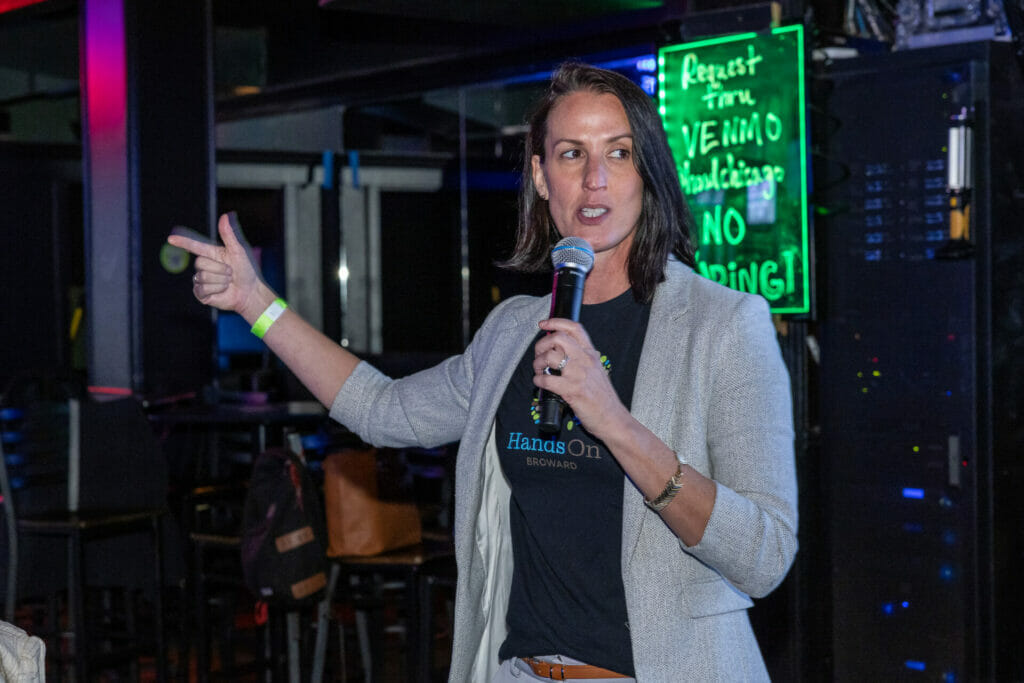
— Kristina DaSilva, COO, HANDSON BROWARD, describing a moment in her career at Failure Night 2023.
Failure Night hosted by Tim Atkins at HandsOn Atlanta was a raucous gathering of Points of Light affiliates who came together to share their biggest failures, reminding us that failing is an essential part of learning and growing. The crowd represented, shoring up the presenters with warm laughter and understanding. Five brave leaders embraced vulnerability and shared their tales of failure, accompanied by valuable lessons learned:
I did my best to use humor with a healthy dose of humility to expose the hazards of ignoring stakeholder instructions and placing all your bets on hope.
Kristina da Silva, CEO at HandsOn Broward, shed light on the unpredictable nature of events, emphasizing that they often take on a life of their own, deviating from carefully crafted plans
Rosie Drumgoole, chief programs officer at Chicago Cares, imparted the vital message that neglecting self-care should never be an option.
Alana Jorge, operations director of Atados, divulged the consequences of picking the worst possible timing for an event—during the World Cup and elections, for example—reminding us timing is everything.
Stephen Davalos, vice president of external affairs at L.A. Works, demonstrated the repercussions of chasing grand ambitions while ignoring the subtle cues conveyed by the universe ultimately resulting in an overwhelming array of headaches.
Day two began with the group hearing “Bright Spot” stories from leaders worldwide as they showcased their impactful work, including that of Riakos Adams from
. More breakout sessions followed, ranging from Effective International Expansion and Engagement with Leila Saad and Stephen Joseph of Common Impact to How to Expand Your Impact and Reach Through Building up Your Network with Hannah Wojno & Kaynan Rabino from Ruach Tova.
PreConference ended with a historical first-ever shared luncheon between Global Network affiliate and the Points of Light Board of Directors. Board members, including Neil Bush, Nikki Clifton and Jeff Hoffman, mixed and mingled with affiliates. Lunch concluded with a fireside chat between Points of Light Board Member Michelle Gavin and Points of Light Interim CEO Diane Quest that focused on shared learnings from the Global Gathering in Brazil.
Gavin noted that it was a privilege spending time with affiliates and added, “It was like a cup of coffee in the morning. It was a jolt of energy that made me excited for the future of the organization.”
, who has given the last 13 years to supporting and building her community.
The event ended with palpable excitement, an invitation to Warsaw Poland February 4–10 in 2024 for the Global Gathering, and a reinforcement of the power the Points of Light Global Network, especially when its members connect and learn in person, together.
operates with innovative volunteer-mobilizing organizations that serve more than 145 affiliates across 39 countries around the world. Together, we are inspiring, equipping and mobilizing more people to use their time, talent and resources to create positive change in their communities.
We spoke with Andre Salkin from
, a Points of Light affiliate in France, to discuss how the organization is creating positive change in its region and beyond. Benenova was created in 2013 and is currently present in four regions in France: Paris, Nantes, Lille and Rennes. The organization’s mission is to facilitate the civic engagement of as many people as possible by offering a large variety of short, collective volunteer missions accessible to all through special programs of inclusivity.
Learn more about this nonprofit’s outstanding work in the realm of inclusive volunteer opportunities.
What role does volunteerism play in your organization’s overall mission and objectives?
Since 2013, Benenova’s primary mission has been to mobilize citizens to get involved in a wide variety of volunteer missions with a focus on making volunteering accessible. Not only through the variety and choice of volunteer opportunities offered on our website, but also through inclusive programs which provide an entry into volunteering for those with physical or mental disabilities and those in situations of precarity. We do this by working closely with our volunteers and partner associations to ensure each mission is suited to the needs and desires of those involved.
Benenova also promotes a change in the way we envision volunteering. Our programs of inclusivity encourage a reversal of the relationship between the helper and the helped. Our volunteer base is largely young and new to volunteering. Forty-three percent of our volunteers had their first experience with Benenova, and 53% are under the age of 35. Rather than going out and “serving” a community, we want to show how volunteering serves us all, even the volunteers. To volunteer is to strengthen our bond within our cities and neighborhoods – to be really and truly included.
How are you engaging with volunteers to inspire them to participate in community service activities?
Our specialty at Benenova is providing an introduction to volunteering for those who are interested in getting involved. One of the ways we do this is through the “permanence,” in which first-time volunteers, particularly those suffering from situations of economic insecurity or social exclusion, can come to our office and be guided through the process of becoming a fully autonomous volunteer by starting an account and finding missions that suit their needs.
We held 22 permanences last year, allowing us to accompany 110 people in situations of precarity to get involved in volunteering missions. Our most active volunteers, called “supernovas,” help out with these introduction programs, representing Benenova in public spaces.
What resources or tools are you providing to volunteers to help them get involved in their community?
Our main resource is accessibility. We offer a wide variety of volunteer opportunities on the online calendar. Across four cities, over 800 monthly listings relating to the fight against poverty, protecting the environment and aiding the youth and aged populations.
In addition to the permanence, we offer a specialized inclusive volunteer program to make volunteering accessible to those with disabilities – mental or physical. We also follow up with both volunteers and associations to ensure missions are going smoothly and everyone’s needs are being met.
Share one success story of a volunteer (or a group of volunteers) in your community who have made a significant impact.
One of our most notable success stories is that of Seijirô, a young man with ASD (autism spectrum disorder) who we accompanied as he began his volunteer journey. We started with an interview to better get to know Seijirô, his interests and his desire to help others feel useful. We were also able to identify some difficulties to take into account in order to propose adequate missions – for example, his sensitivity to noise, or difficulties related to fine motor skills or speech.
We worked with Seijirô to find a form of volunteering that worked for him, and we worked with the volunteer associations to ensure the task remained suitable for Seijirô. While Seijirô admitted the tasks were difficult for him at first, volunteering made him feel useful, and like he was able to help others. Alexia, a psychologist who has worked with Seijirô and his parents for years, echoed Seijirô’s positive sentiments, saying that volunteering made it easier to go about daily tasks, improving Seijirô’s mood and sense of personal autonomy.
The entire mission of Benenova revolves around adapting and welcoming every person willing to give time to a cause or an association. In that sense, the inclusive volunteer program is simply an extension of our values and core mission.
What are some future plans for your organization to continue promoting volunteerism and civic engagement?
There are two large yearly milestones for Benenova – World Refugee Day (June 20) and World Volunteer Day (December 5) – both big opportunities for Benenova to raise awareness and rally involvement in volunteerism.
We are also in the process of making a film about our 10 years of social involvement, incorporating spoken testimonials from those involved at every level of the organization. In addition, one of our most current objectives is the expansion of corporate volunteerism – getting salaried employees engaged in volunteering by presenting real initiatives to companies.
What’s one piece of advice you’d give someone who’s looking to get more involved in their community through volunteerism?
The best advice is to stay human-centered. We can never be in touch with every individual, but we can stay available and accommodating. All people can give is their time – the least we can do is be thankful.
2023 Points of Light Conference Recap
The City of Chicago graciously welcomed more than 1,200 attendees to the 2023
on June 14–16. The annual gathering attracted social impact experts from nonprofits and corporations from around the world. With more than 50 educational workshops, inspirational leadership discussions and opportunities to connect with peers, conference offered something for every champion of social good.
“All of you represent a bright point of light for our country and for our future,” Neil Bush, board chair of Points of Light, said to attendees.
The Voices of Opening Plenary Spoke With Conviction
This year’s all-conference Opening Plenary featured global leaders and special guests, including influencers and entertainers who exemplified Chicago’s vibrant history and culture. Attendees enjoyed moving conversations that explored how our lives have changed amidst the complex challenges we’re collectively working to solve.
Shermann “Dilla” Thomas, co-founder of Chicago Mahogany Foundation opened conference by sharing his own story of how he found the motivation to learn the streets of his hometown — his father’s requirement that he know his way around in order to use the family car. That was Thomas’ first step into becoming a Chicago historian. He would go on to learn that Chicago’s diagonal streets are often former indigenous trails. He shared that Jean Baptiste Point du Sable was the first permanent non-Indigenous settler of the city, and how Ida B. Wells, known for her anti-lynching work, spent four decades in Chicago championing the Light of Truth Monument, righting wrongs by turning the light of truth on them.
, Community Builder at South Side Weekly, moved the audience to tears by sharing their poem Sequoia, which drew parallels between the striking features of giant redwoods and Black, Indigenous and people of color, and underscored the message that we must lead change today by leaning into the past.
agreed that, “In every community there is a social fabric that knits people together.”
“Your voice matters. Raise your voice. Listen, act and refine,” said
, board chair, Points of Light, added, “It’s impressive to me that more and more companies are embracing a culture of service. This is a crucial and important driver for the service sector.”
All that in just the Opening Plenary. The conference went on to highlight so much more.
Sessions for Every Social Impact Leader
Conference continued with more than 50 workshops designed especially for social impact leaders. There was something for every social impact expert. Some of the highlights included:
Deconstructing Privilege to Reimagine Equity, which explored how the United States’ roots in a frontier mentality, stealing land and developing a capitalistic economic system based on chattel slavery and examines how we have all been colonized within varying cultural norms. Presenters then helped the audience develop a strategic plan to aid in deconstructing dominating postures and lean toward reframing individual personal ways.
Engaging Older Adults in Service and Volunteerism posed the questions, why is it important to engage older adults in national service and volunteerism? What new information is out there that will help you be effective in recruiting and retaining older adults? How can you apply these learnings to your everyday work? Attendees learned how our society is aging, what older adults are looking for in volunteer and national service opportunities, and how to meet their needs.
Intersection of Skills Based Volunteering and Talent Development challenged attendees to unleash the superpowers of employees to develop skills-based volunteering programming that meets both their development and social impact goals. Audience members walked away with the next steps needed to build a skills-based volunteering programming with buy-in from stakeholders across their companies and their communities.
Some of the most valued sessions included two Civic Talks, one on Perspectives on Health Equity: How Hyper-local and Global Strategies Align, the other around Building Community Equity: Disaster Preparedness, Response and Resilience. The first of these all-conference sessions explored the complexities of health equity and connections to systemic racism and social, economic, environmental and cultural determinants of health. Attendees learned about frameworks for collaboration that drive systemic change, hyper-local strategies and actions that advance health equity.
The second conversation delved into disasters, particularly in low-income communities, the challenges of necessarily complex multi-organizational strategies for revitalization, and how a reactive versus proactive response from the public and private sectors can deter revitalization.
Throughout the entirety of conference, celebrating the diversity of Chicagoland, Points of Light partnered with
to bring a community-designed and driven service project where every attendee could engage. This activity had participants creating a special mosaic mural for the Belmont Cragin community. This project offered attendees an opportunity to learn more about the importance of place-keeping and how this public art piece supports the community’s branding initiative, highlighting local businesses and encouraging economic development.
Closing Plenary wrapped up the event by featuring inspirational stories from young civic leaders who demonstrate that age has no limit in addressing the issues facing our world, moderated by Tina Tchen, executive vice president and chief strategy and impact officer, Obama Foundation. The four panelists talked about their experiences in community building and social impact work.
Miracle Scott Hale described how her mother’s activism was an example she follows today. Christopher Eubanks, Jr. works with Urban Male Network and talked about why he gives back to his community to give others a way out.
“It’s all about your environment,” he said. “I had options and opportunity. So many people don’t.”
Nylana Murphy is a tribal member of the Navajo Nation and serves as a student mentor and an advocate for Native Students in STEM. She is currently a NASA intern at Marshall Space Flight Center in Huntsville, Ala.
“What really defines the road to success is your passion,” said Murphy.
JahkilJackson is the founder of Project I Am, a nonprofit organization he created when he was eight years old to build awareness around homelessness.
“Community really isn’t the environment around us, it’s the people,” he shared.
As she wrapped the session, Tchen pointed out the group’s four big takeaways for the audience: do something you love, ask questions, connect with others and try something new.
The culmination of were remarks from Emmy and Critics Choice Award winning actress, who currently stars on ABC Networks Abbott Elementary,Sheryl Lee Ralph. She engaged the audience with singing and words of inspiration.
“In these dark times, take time to be a light not just for yourself but for others,” she said.
Corporate Social Responsibility in the Spotlight
The Corporate Service Council Meeting welcomed Dr. Nicholas Pearce, CEO and founder of The Vocati Group, who urged audience members to, “Connect your soul to your role.” He encouraged them to stay the course because CSR work takes time, patience, perseverance and rest.
Attendees also heard from Jahmal Cole, CEO and founder of My Block My Hood My City.
His best advice: “Do an asset map of a community before you go in.”
He encouraged people to be thoughtful in assessing who the social impact leaders are in a given community and determine what resources they have versus what they need to fully support the community.
The session wrapped with Storytelling for Social Impact: Inspiring Action Through Film and Media, featuring Nate Clark, global director, corporate social responsibility & president, John Deere Foundation, John Deere; Mark Mitten, Academy Award-nominated and Emmy-winning documentary film producer; Diane Quon, producer, Quonco Productions; and Brenda Robinson, head of film finance and inclusion strategies, HiddenLight Productions.
“The first thing we look at is how do you change minds and hearts with art,” said Robinson.
The Business Summit covered Civility & Civic Engagement: The Opportunity for Business to Help Find Common Ground, Inside and Outside Your Company. The panel included Moderator Bruce Bond, co-founder and CEO of Common Ground Committee; Pamela Everhart, senior vice president, regional public affairs and community relations at Fidelity Investments; Nick Nottoli, director, reputation management and insights at Allstate; Clarita Santos, executive director of corporate and civic partnerships at BCBSIL; and Maryam Banikarim, founder and Managing Partner of MaryamB.
The group discussed how communities around the globe are increasingly faced with diverse political, economic and social pressures. Meanwhile, companies are stepping into uncharted roles as leaders and advocates in civic engagement and community-building. This session explored how businesses – especially CSR leaders – are using their resources, time, talent and voice to encourage civic action and thoughtful dialogue that illuminates common ground and unity.
That’s a Wrap for ‘23
Overall, the 2023 Points of Light Conference welcomed over 1,200 people, all of whom shared a purpose to change the world collectively, each by doing their own part. Attendees networked, shared their expertise and best practices, and listened and learned throughout. One attendee summed up their experience by saying:
“I always enjoy the inspiration I take home after being around so many like-minded individuals. I enjoyed our smaller group breakout sessions and the opportunity to hear from some inspirational speakers.”