How Doing Good Deeds Year-Round Can Begin with Good Deeds Day
The mission of Good Deeds Day transcends the day itself. Dedicating time to volunteerism and helping others can be year-round, even for the Good Deeds Day team, who’ve seen its mission become a ripple effect of good for thousands of volunteers.
Good Deeds Day is an organization and annual event where volunteers from around the world dedicate a day to volunteering and helping others and is built upon the idea that every individual can do something to improve the lives of others. Essentially, it’s a global movement of doing good that helps its partners — companies and nonprofit organizations — create positive change. Plus, the organization helps connect volunteers to the causes they care about any day of the year.
This year’s Good Deeds Day will take place on April 11, 2021. In order to make the day accessible to anyone around the world, it’s hybrid approach is designed to allow anyone to participate in events either in person or virtually. Participants can easily send an Ecard to an individual, organization or cause they care about if they are unable to volunteer outside.
Traditionally, thousands of people go out and volunteer and partner with hands-on community initiatives on Good Deeds Day, which features a diverse range of projects, entertainment and food vendors for participants.
The 2020 Good Deeds day undertook a major shift because of the COVID-19 pandemic and its events were held virtually. The focus became doing good from home. Yet, the organization didn’t view the pandemic as a roadblock. It began to shift its messaging to encourage partners to continue their important work to creatively address the issues communities were facing around the world — like food shortages, medical supply scarcity and hardships caused by job loss.
Originally based in Israel in 2011, Good Deeds Day spread by word of mouth to other countries after a few years of operation and became global in 2011.
“I think maybe part of its growth was through Jewish communities, because in Judaism, we have a concept of Tikkun Olam, which means to repair the world. It’s about being a positive change, and we should work on making the world a better place,” said Hannah Wojno, the director of International Good Deeds Day
Wojno moved to Israel nine years ago when the organization and movement was on the brink of becoming global and has always been involved in community initiatives from a young age.
“Good Deeds Day strives to create a positive, sustainable long term impact in the world,” she added. “It helps individuals around the world see themselves as positive change makers who treat people with kindness.”
Good Deeds Day is the pinnacle of doing good year round, but it was also a result of a relentless effort to understand how to maximize the volunteer skills of its global community.
In order to understand the communities that it works in, the organization’s team conducted two surveys on volunteering. They found that people just don’t know how to do good and what organizations would accept them as volunteers. Additionally, people felt that they didn’t have the time to commit to the causes they cared about. As a result, Good Deeds Day is designed to remove the barriers to volunteering and gives people a taste of what it feels like to be a part of something bigger than themselves.
The Good Deeds Day movement can teach anyone that every individual has the power to make a difference and one cause can light a volunteerism spark in someone to do the same for their fellow neighbor. It’s a good teaser and taste of what they can do year round, according to Wojno, and it exploded around the world.
One of Good Deed Days recent accomplishments was Good Stock, the largest global conference of doing good. The virtual conference featured keynote speakers of educators, nonprofit professionals, volunteers, government officials and other leaders from around the world who dove into key topics like leading change through volunteering, being good in business and the sustainable development goals.
Good Deeds Day was able to bring more than 2500 participants together from over 93 countries around the world for Good Stock.
“The most rewarding part of the work is seeing our partners — which are small organizations around the world that don’t have a lot of resources make a significant positive difference in their communities,” Wojno said.
“I believe this is how we create a better world through regular people doing just normal positive things and treating each other really well,” she added.
Fidelity Continues to Deepen their Commitment in the Communities they Serve
Last year has been unlike any year in recent times. As we tackled a global pandemic, we also were confronting issues of social justice and racial equity. As employers operating in this “new normal,” we should all be asking ourselves, “What does corporate volunteerism look like in 2021? How do you continue to create authentic community engagement?”
The importance of corporate social responsibility has grown over the last several years. Consumers increasingly value companies not just by what they produce, but how responsibly they operate as a business.
At Fidelity Investments, we paused to take a deeper look at our community relations efforts and listen to our nonprofit partners. Our goal was to focus on better aligning our community relations efforts with our expanding focus on diversity and inclusion.
“We are deepening our commitment to supporting racial equity across all of our programming and partnerships, and finding new ways to understand and support the underlying issues that underrepresented and underserved communities are facing”, said Teresa Pelletier, Vice President of Community Relations.
For a decade, Fidelity volunteers have helped beautify school campuses in regions where Fidelity has a large employee presence by painting classrooms and building outdoor seating. While the work we’ve done at schools has been a tremendous help to our partners over the years, we will begin to look even deeper into the issues that the students in our communities’ face. In partnership with Points of Light, we have evolved our School Transformation Day programming to a Season of Transformation for 2021.
The Season of Transformation will focus on “listening, responding and reflecting.” Our Points of Light Global Network affiliates will convene nonprofits in the communities and Fidelity associates for Listen and Learn sessions. The goal is to help Fidelity associates better understand the systemic issues affecting students and local communities and the challenges within the education sector and get connected with the ecosystem of community partners supporting students and their families.
Fidelity volunteers, working with Points of Light, will respond by designing meaningful and impactful virtual or at-home projects and programming to supply local schools with much needed resources.
Lastly, once the programming has been completed, Points of Light Global Network affiliates will help our volunteers reflect on the impact of their collective efforts and understand how they can act in their communities to support sustainable change.
By focusing and better understanding the needs of underserved communities, while adapting to a virtual environment, we are continuing our focus of supporting the communities where we live, work, learn and serve.
Civil Rights in the Nonprofit Sector With HandsOn Greater Richmond and CAF Southern Africa
While human and civil rights have been issues at the forefront of society for generations, they’ve increasingly gained traction over the past hundred years or so. And in the past several years, with more viral footage of racial injustices, it’s become a prominent issue that can no longer be denied. With a focus on promoting equity and fighting discrimination, many nonprofits are leading the charge in a more just society.
, a Points of Light Global Network affiliate and the volunteer center program of the Community Foundation for a greater Richmond, is actively striving to offer equitable experiences and continue to improve their internal processes.
The nonprofit partners with individuals, families and organizations to make giving easy and effective, strengthens nonprofit organizations through grants, training, volunteer mobilization and other supports, provides leadership and insight to important community issues and promotes a culture of philanthropy and service. HandsOn Greater Richmond helps people find their civic path, supporting them in finding out how they can use their time and money.
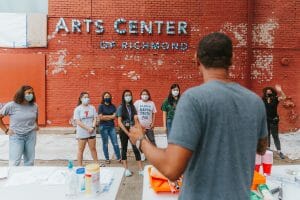
Muralist Hamilton Glass speaks with community volunteers before they work together on one of the 17 murals created in summer of 2020 in response to conversations around racial justice in Richmond, VA.
“Our work is to build mutually beneficial relationships,” said Vanessa Diamond, senior vice president, Civic Innovations. “Our job is to effectively educate, engage and inform people who are interested in a certain topic area. To do this shifts the power dynamics so that we’re volunteering
with
community, not just
to
community.”
Their goal is for community members to be informed and educated about the region as well as their own knowledge and motives, before helping, honoring the lived experiences of the populations in the region.
, HandsOn Greater Richmond helps civically-minded individuals to more strategically direct their energy, aligning their passions, skills and talents with an issue their community needs.
as a framework for all of their initiatives and decision-making. “The RVA Engage Vision and Guiding Principles were developed in 2019 through a collaboration of community engagement professionals in the nonprofit, corporate and educational sectors,” Vanessa explained. “They were shared at the 2019 Civic Impact Summit and continue to serve as a foundation for many conversations throughout the region.”
Another Points of Light Global Network affiliate partner,
, is a civil society infrastructure organization acting as an intermediary at the intersection between philanthropy and civil society. CAFSA’s primary reason for being is to grow and champion charitable giving in order to support a vibrant and resilient civil society, which is one of the core pillars of South Africa’s young democracy.
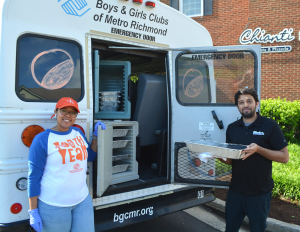
HandsOn Greater Richmond volunteers assist with food delivery to students.
As an intermediary, CAFSA is well-placed to understand the needs of both its corporate and nonprofit clients. CAFSA is both a purpose and a knowledge-driven business, and so all their consulting and advisory work with corporate clients is based on evidenced-based research. CAF produces the annual
, which measures generosity behaviors, such as donating money, time and goods to those in need. The WGI also tracks giving trends across the globe and enables CAFSA to monitor these generosity behaviors closely.
CAFSA is cause-neutral, which means the organization leaves no good cause behind. The organization focuses its interventions on the groups and communities who are most marginalised in society.
Gill Bates, CAFSA’s CEO, shared, “After the apartheid era ended, the country was liberated from an inhumane regime which systematically excluded people of color from the economy, employment, quality education, housing and healthcare. In spite of this hard-won political liberation, South Africa continues to struggle with the apartheid inheritance of poverty, inequality and unemployment. While South Africa is now a constitutional democracy and is regarded as a middle income country, the nation continues to have one of the highest ratios of income inequality in the world.”
CAFSA’s nonprofit partners work across all sectors, including but not limited to child welfare, care of the elderly and those with disabilities, women’s rights groups, education, literacy crisis intervention, environmental activism, youth development, entrepreneurship, social justice and alleviation of poverty and hunger.
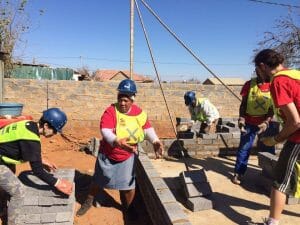
The CAFSA team got involved with a Habitat for Humanity Build in Orange Farm in Gauteng.
“Volunteering in South Africa is ingrained in the fabric of the country’s philosophy of Ubuntu, which, loosely translated means ‘a person is a person because of other people.’ In other words, I am because you are. This speaks to our humanity as a people,” Gill shared. “Another African proverb expresses similar sentiments and says, ‘If you want to go fast, go alone. If you want far, go together.’ Volunteering is a critical component of a civically engaged life, particularly in South Africa. Civil society and the nonprofit sectors are critical components of South Africa’s young democracy and continue to hold the government, the corporate sector and itself accountable.”
Serendipitously, HandsOn Greater Richmond’s Vanessa Diamond shared that she’s been using her voice since childhood thanks to parents who were activists in anti-arparthied South Africa. She encourages anyone looking to lead a more civically engaged life to find an issue important to them and then get educated on the solutions before jumping in.
“Really explore to determine what kind of organization you want to be contributing your time, effort, money and voice to,” Vanessa says. “If you’re really inspired or really angry about something that’s happening, that will ensure you have the passion to actively be a part of the solution. You have what it takes to make the difference. We often think someone else will do it, but it’s up to all of us to be the solution.”
HandsOn Suburban Chicago and HandsOn Tokyo Shape the Future by Impacting Youth
If you want to see some of the biggest and most challenging issues facing the United States today, look no further than the classroom. The education system in America is a microcosm of today’s most pressing national and global concerns — including discrimination, violence, and income inequality.
And while the effects of these hot-button issues can be witnessed acutely at the classroom level, this is also the environment where some of the greatest impacts can be made. Educators reach future generations at their most impressionable ages and have the ability to positively influence them in ways that can last a lifetime.
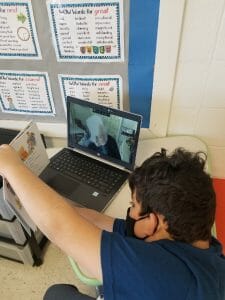
AmeriCorps Seniors RSVP volunteer Julian Schreiber spends his lunch hour reading with his Timber Ridge School student over a video call.
, a Points of Light Global Network affiliate and nonprofit dedicated to improving the quality of life in its surrounding communities.
By connecting people to enriching volunteer experiences, HandsOn Suburban Chicago engages more than 5,000 individuals annually in service. The organization harnesses the power of volunteerism to enable vulnerable populations to age in their homes and improve the socialization and well-being of seniors. But a large part of their mission is a focus on the education system in
northern DuPage and northern Cook Counties, IL
.
Chris Swope Cholewa, executive director, and Jess Park, director of School Programs, oversee initiatives that benefit low-income, first-generation students of color — many of whom are limited English proficient and require special education services to bolster their academic, emotional, and social development.
“In 2017, 42% percent of the middle school students that HandsOn Suburban Chicago served achieved satisfactory grades,” they said. “That percentage, which has been steadily climbing over the years, reached 94% last school year. In SY 2019-20, 99% of middle school students also demonstrated satisfactory school attendance and 94% met Illinois Social and Emotional Learning standards.”
These soaring improvements are due in part to HandsOn Suburban Chicago’s
, founded in 2010 with Community Consolidated School District 21. CHiL is an evidence-based afterschool program designed to prevent gang recruitment and offer homework assistance and social and emotional learning activities to high-needs middle school students in Wheeling Township.
“CHiL helps students like Brian — a low-income, English language learner in grade 7,” Chris and Jess shared. “The language barrier he frequently encountered at school chipped away not only at his performance but also his self-esteem.”
After completing a year of CHiL, Brian’s teacher sent this email: “Huge improvement in grades, confidence and participation in class for Brian, he received an A- in math for T2 (second trimester) and was so proud of himself! Thank you for all you do and all your efforts with this program!”
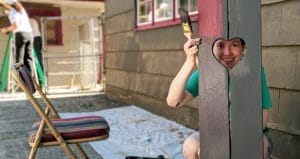
A Community Paint-A-Thon volunteer takes a break to pose for the perfect shot.
HandsOn Suburban Chicago’s volunteer-based school programs prepare more than 1,000 high-needs youth annually to succeed both in and out of the classroom. In 2015, the nonprofit launched
, which provides in-school tutoring and mentoring for low-income elementary school students in Des Plaines, Elk Grove Village, Palatine, and Mount Prospect.
The organization also engages area middle schools and high schools in a variety of service learning opportunities that include
academic lessons
, hands-on projects, and days of service in the community. For instance,
is a partnership between HandsOn Suburban Chicago, Catholic Charities and Habitat for Humanity of Northern Fox Valley. Since 1988, the Paint-a-thon has painted over 850 homes for seniors, veterans, and individuals with disabilities.
has been hard at work providing meaningful bilingual volunteer opportunities to foster volunteerism and develop leaders to serve the needs of their community. The nonprofit equips individuals, companies and community partners with volunteer opportunities, it also inspires and mobilizes youth to
While HandsOn Tokyo serves many populations in Japan — including the elderly, those with special needs and communities impacted by natural disasters — one of their primary focus areas is delivering interactive and educational activities to help underprivileged children in
children’s homes
to gain important life skills.
The children living in these homes come from complicated backgrounds, often experiencing domestic violence or poverty, and are usually suffering from social withdrawal. They’re often not very expressive or active and are used to having external support from volunteers. HandsOn Tokyo gives these children an opportunity to volunteer themselves, experiencing the impact that comes with supporting others.
This helps build crucial self confidence in the children from a young age. Motoko Kawaguchi, executive director at HandsOn Tokyo, shared a touching story about a high school girl who participated in a Tohoku volunteering trip. She was known to be socially withdrawn and seldomly expressed her emotions or ambition for the future.
“During the trip, she discovered that she really enjoyed farming and being in nature,” Motoko shared. “Later she sought an internship on a farm, and has also become more expressive and outgoing.”
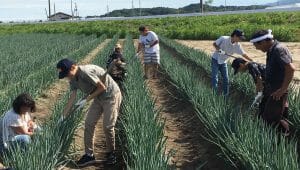
Tohoku Volunteering with Children’s Homes.
Almost all of the children who reported back after this trip said they felt a sense of accomplishment and pride in being “appreciated by others.” Many want to volunteer again and have encouraged others in their group homes to volunteer in the future. These volunteer trips are also an important opportunity for the children’s caretakers to better understand each child’s fullest potential.
HandsOn Tokyo has done outstanding work over the past several years, impacting the lives of 19,867 recipients in 2019 and 16,222 lives in 2020, even amidst the COVID-19 pandemic when the nonprofit was forced to shut down in-person volunteering.
Motoko encourages those considering volunteering to jump in without hesitation. “If there’s any particular cause or group that works with the issues that you feel strongly about, without a second thought try volunteering with them,” he said. “You will not only make an impact in the community but it is very likely that you’ll benefit even more in return.”
“Volunteering is the ‘engaged’ component of a civically engaged life. By investing time and labor into improving the quality of life in a community, volunteers acknowledge that the well-being of every individual is integral to the well-being of society as a whole,” said
Jess Park of HandsOn Suburban Chicago. “
Volunteerism thus begets a more complete understanding of how social issues arose, the role social institutions play, the responsibilities of citizenship and what it takes to inspire change.”
Employee Volunteerism and the Impact of Purposeful Partnerships
Companies have a unique and critical role to play as partners in fostering a thriving society. As both business and civic leaders, companies are responsible for serving the diverse needs of employees, customers, community partners, investors and neighbors. At their best, they share their resources and act as trusted counsel, collaborators and problem solvers. Employee volunteerism is an integral component of this equation.
Every company is born out of an idea to provide a product or service to meet a human need. As an energy company, Phillips 66 makes products people use every day – our fuels and products are an essential part of connecting, feeding, clothing and caring for the world’s growing population. We are in business with one enduring purpose: to provide energy and improve lives.
How does our company live its purpose to better society? We create purposeful partnerships – with our employees, nonprofit organizations, academia and community leaders. Together, we openly share the best of our resources, and collaborate to solve society’s greatest challenges. Our partnerships in local communities go well beyond philanthropic giving and product donations.
At Phillips 66, we seek to build purposeful social impact partnerships in multiple ways. We:
Provide community organizations with funds to meet strategic, changing and urgent needs.
Provide people power – from skilled volunteerism and leadership to simple acts of volunteer service.
Share intellectual capital and expertise.
Utilize company resources, facilities and equipment.
Help partners expand their relationships and networks.
One example of a purposeful partnership in action is our Phillips 66 multitiered collaboration with the American Red Cross. Through this partnership that we view as a “gold standard” we:
Dedicate an executive to serve on the Houston Red Cross Board of Directors.
Provide significant, annual, financial contributions to support natural disaster preparedness and response efforts.
Volunteer our time by donating blood, serving meals and building hygiene kits for those in need.
And at the onset of COVID-19, our Phillips 66 board member and the Houston Red Cross CEO initiated weekly calls to discuss best practices and learnings from the Phillips 66 Health, Safety and Environment team, which the Red Cross used to help safely open its facility as a dedicated location for blood and plasma drives.
Like many companies, Phillips 66 was eager to step up and offer its resources to help relieve the burdens of the pandemic. We shifted our involvement to meet the greatest and immediate needs of our partners. In support of the Barbara Bush Houston Literacy Foundation, we reallocated funds to include book donations as part of meal distributions in public schools and to transform educational summer camps to virtual learning opportunities. In communities around the country, we also donated personal protective equipment, sewed masks and made face shields with 3-D printers to distribute to community members, worked with a local food bank to redesign the food service model to meet COVID-19 safety standards, and significantly increased our social impact investment.
We have created a powerful model for change by working with a shared purpose and in partnership with community organizations. As we celebrate
this April, it’s a good time to consider how we can be most effective in sharing our collective talents, resources and time.
This month, alongside Points of Light, Phillips 66 is proud to mobilize a global call to volunteerism. Let’s connect with our neighbors, empower community partners and engage citizens to join in service.
Daily Point of Light honorees – and that’s something to celebrate. Because we know what we celebrate reflects what we value. And in each one of our Daily Point of Light honorees over the three decades, we’ve celebrated heroes who are giving back in ways that inspire those around them, creating even more action in their communities, in their circles.
That’s the power we all have within us. We have the power – not just to do great things – but to inspire others to act, and to exponentially multiply the impact of our own actions. Today’s honorees are no exception.
Georgia high school students
started a nonprofit organization to help other young people create, fund, and carry out their own service projects. They knew that many young people had great ideas about building service projects but didn’t have the resources to get them off the ground. They knew they could multiply young people’s impact.
Today Kruthik and Deesha’s organization – Georgia Youth Leaders – is a 501(c)3 organization that provides information and guidance to young social entrepreneurs. It helps them attain nonprofit status, procure funding, and also supports them in other ways. Kruthik and Deesha hold seminars to attract high schoolers with service projects that can operate under the GYL umbrella. They applied for grants to fund the projects, publicized them on social media, mentored their leaders, and helped them develop websites. They now have eight programs they’re supporting – on everything from helping victims of human trafficking, to environmental cleanups, to donating books to children in need.
Incredible.
Below you’ll see pictures of some of our Daily Point of Light honorees throughout the years. You’ll see young people and seniors. You’ll see individuals and corporations. People from all across our country advancing causes as diverse as we are.
We often talk about Points of Light’s Civic Circle, and when we developed it we intentionally chose a circle to represent the ways people move through it at various moments. A circle has no beginning and no end. There’s no limit to how much of an impact we can have; we can start a wave and it can keep going and going and going.
In just two days, on April 1, we’ll kick-off
. We encourage you to shine a light on volunteers in your circle by nominating them for a Daily Point of Light Award. The 7,000 honorees we’ve recognized to-date have done some pretty incredible things. And I can’t wait to see what the next 7,000 – and beyond – can do.
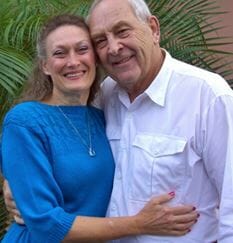
Daily Point of Light Award honorees #5,000, Kathy and Floyd Hammer, founded The Outreach program to deliver meals to Tanzania.
Since creating Ryan’s Recycling Company, Ryan Hickman, Daily Point of Light #6,726, has recycled about 814,000 cans and bottles./Courtesy Ryan’s Recycling
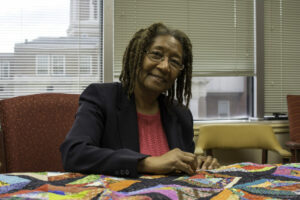
Cheryl Milton, Daily Point of Light #6,488, pictured with one of the many quilts she’s made for individuals in need.
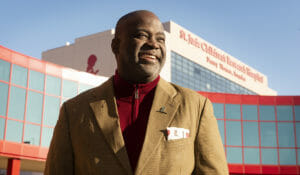
Daily Point of Light Award honoree #6,656 Jason Farmer volunteers with St. Jude Children’s Research Hospital, helping the hospital build relationships and raise awareness in the African-American community.
Natalye Paquin was the president and chief executive officer of Points of Light from 2017–2022.
She is a visionary and results-oriented leader, with more than 20 years of experience providing strategic, operations and fiscal leadership in the nonprofit and public sectors.
“Lifting As We Climb”: How Service Became a Step Up
Points of Light board member Marty Rodgers has led a life of service as a result of being raised in the tradition of giving back.
“My parents always focused on serving our community,” Marty said. “My dad was a family doctor who did house calls, working with the poorest of the poor and teaching residents. My mom was an organizer serving our community and our church. I was raised with the belief that ‘to whom much is given, much is expected,’ and service was a common expectation at both my high school and college.”
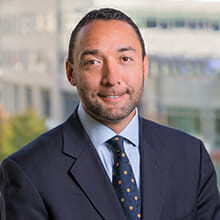
Marty Rodgers, Accenture
Today, Marty is a senior managing director at the global professional services company, Accenture. Professionally, he helps individuals and companies imagine, envision, and prepare for the future in the areas of strategy, IT, and operations management. He also leads his corporate teams in volunteer opportunities in the community.
At Accenture, he strives to ensure that the communities he does business with, from Maryland to Florida to Texas, are taken care of. “We have a responsibility to make sure we’re part of the fabric of those communities and that we’re taking care of both shareholders and stakeholders.”
Service has been woven into his professional life since he started his career, too.
Marty first became involved with Points of Light in 1990 as a pro-bono volunteer, when he started his first job in the service sector designing a fellowship program (the Youth Engaged in Service “YES” Ambassadors Program) to connect young people with nonprofits. In fact, two of his mentors Father Monk Malloy and Dr. Johnnetta Cole who were respectively the Presidents of the University of Notre Dame and Spelman at the time were on the founding board of Points of Light, which makes him especially proud to be a board member today.
“Since I first began my work at Points of Light, I’ve always believed in the power of service for all people at each stage of life. It’s the great connector to work on problems that our communities and country face. Service provides the opportunity to find common ground and roll up our sleeves, working together on a problem eye to eye, arm to arm, and hand to hand. In doing so, we realize our common humanity and our agency to affect change in this great experiment we call democracy in America.”
Through his work at Points of Light, Marty met Senator Harris Wofford and went on to work with him on Capitol Hill as a legislative assistant in charge of national and community service.
He worked on multiple pieces of legislation with the mission to advance public service, including the founding of AmeriCorps and the establishment of a national day of service on the Dr. Martin Luther King Jr. holiday. He also contributed to a series of efforts and programs designed to create service as a pedagogy within multiple pieces of education-related legislation.
Marty’s perspective about service mirrors Points of Light’s Civic Circle. “People are looking to align all the different aspects of their lives around who they are, what they stand for, and what they believe in,” he observes. “Whether it’s the rise of socially responsible investing, purchase power, advocacy, or where you choose to give your time, talent, and treasure, service today is about alignment of purpose across all dimensions of our lives.”
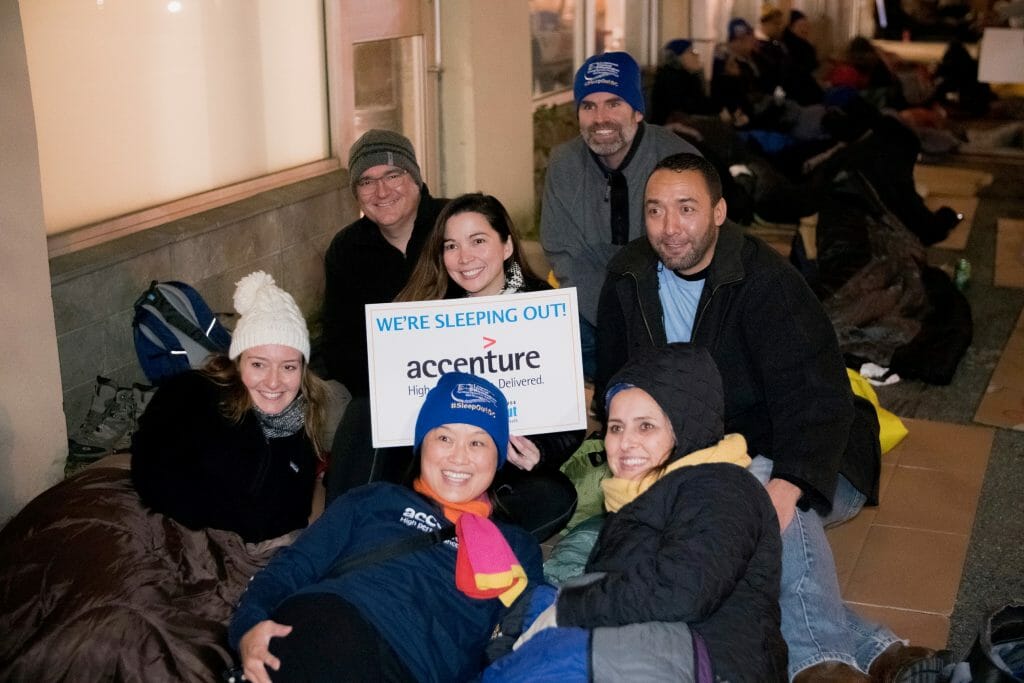
Marty Rodgers, far right, and Accenture volunteers participate in a “sleep out” to raise awareness and funds for homeless youth.
One particular facet of the Civic Circle that Marty feels strongly about is voice. “I was raised to believe in the power of one’s voice, of sharing your experience, journey and truth. That’s the responsibility that we bear for the opportunities we’ve been given. As a person of color who has had all these opportunities, I believe that once you get a chance to be at the table, it’s your responsibility to use your voice and your power — they’re ultimately the same thing — for those who aren’t at the table.”
The idea of “lifting as we climb” coined by Mary McLeod Bethune has always appealed to Marty. “The higher we climb, the more we must lift, continuing to open the doors of opportunity for others,” he says.
Marty is passionate about bettering schools — whether public, Catholic, or charter — and creating opportunities for youth from under-resourced and at-risk environments. Marty is an advocate for education and continues to serve on the board of the Children’s Defense Fund among other organizations including KIPP-DC, Consortium of Catholic Academies, and the University of Notre Dame.
He often quotes one of his mentors, former boss, and founder and president emerita of the Children’s Defense Fund Marian Wright Edelman, who said, “Service is the rent we pay for living. It is the very purpose of life, and not something you do in your spare time.” We at Points of Light can attest that through his work on our board and service in all aspects of his life, Marty is certainly paying it forward.
5 Ways to Get Involved and Support Women’s and Girls’ Rights
Here at Points of Light, we know that leading a civically engaged life isn’t just about volunteering or donating resources, though those are important parts of our
. But there are countless ways you can support women and girls in your community and beyond. In honor of Women’s History Month, here are five ways to contribute your time, talent and creativity to uplift women this month:
Mentor a younger generation
Empowering girls and younger women is one way to make a positive impact that could shape the future for generations to come. Take Juliette Gordon Low, the founder of
, for example. Gordon Low started the organization with just a few close friends and family members to learn new skills and help others in need. Today, Girl Scouts teaches young women to lead themselves and others, advocate for what they believe in and stay active and informed around global issues. Another highly-regarded youth mentorship organization is
There are plenty of organizations dedicated to protecting and advancing women’s rights. From stopping domestic violence and protecting victims through work with your
, you can make a difference with your voice, your time and your skill set. Passionate about putting an end to human trafficking? Check out organizations like
One of the biggest opportunities in the women’s right arena is support for parents, particularly low-income families or single moms. Could you start a diaper drive for the women in your local community like
, which advocates for eliminating the gender pay gap, providing workplace benefits like maternity leave, paid sick leave and ending discrimination against pregnant women and new mothers.
A method of civic engagement that’s newer and so impactful, using your dollars to support businesses championing women is a prime way to make an impact. Find
Changemakers often start by assessing their own community needs and working with the community to find solutions. So take a look around… what’s lacking? Which individuals, businesses or organizations need more support? Think about issues affecting women specifically. Could you donate feminine hygiene products to local homeless shelters, underserved communities, or students? Check out the work that teenagers
As you think through your civic engagement opportunities this Women’s History Month, remember that no action is too small. To find more ways to get involved, check out
Daily Point of Light honoree and Points of Light Youth Network member Sage Hirschfeld talks about why listening and learning is important both for youth and adults.
Listening is one of our world’s most underrated skills. It has the power to expand your worldview and drastically improve your relationships. I implore you to take a moment and imagine what our world would look like if people genuinely listened to each other and put effort into learning about other people’s perspectives, logic and reasoning for their beliefs and actions. That world seems pretty nice, right? It’s also pretty different from the one we live in now.
Why is that? Why do we live in a world where we don’t listen to each other?
Taking the first step to listen is hard. Sometimes we hear things that hurt, either because they include stories of pain and abuse or because they call into question things we previously believed. Sometimes when we listen, we hear things that just don’t make sense in our heads and it takes us time to understand. That can feel really frustrating.
But humans do things that are hard and frustrating all the time (shout out to taxes and physics homework), so what makes listening and learning so different?
The reason we don’t live in a more listening world is because we haven’t built up the stamina for it.
Sage Hirschfeld: “
Once we understand that listening isn’t easy, we’re more forgiving of mistakes, we’re more receptive to the time it takes and we’re more resilient in the messy reality of the learning process.
”/ Sage Hirschfeld
Listening and learning are processes that take time and struggle and that’s not what our society values. Our society has taught us to appreciate what’s fast, easy, and convenient. That’s how we like our food, our social media and even our information. With the polarization of news sources, the information we’re given is filtered based on what will be the most convenient truth for our consumption rather than based on what’s actually happening.
Over time this erodes our ability to tolerate the discomfort that comes from absorbing information that might make us pause. This process involves considering how this information fits into our worldview and whether we need to re-evaluate some of our previously held beliefs. Our listening and learning muscles atrophy and we’re left with very little stamina for perspectives or information that don’t fit neatly into our expectations.
On top of this, our society normalizes that lack of stamina. In America, it’s common to write someone off completely when they have an opinion that differs from yours. Even in our highest levels of government we see this happening. That’s not normal! But we’re so used to it that we’re more surprised to hear about a bipartisan piece of legislation being passed than we are about our government literally shutting down when members of congress refuse to listen to each other.
So what can we do about this?
For the past few months, I’ve been co-facilitating an eight-week virtual seminar on reproductive justice. I’ve watched our multi-generational group take in a curriculum full of stories of injustices that were hard to listen to and perspectives that were so different from their own that it took time and some serious mental legwork to comprehend.
But still, week after week, people kept showing up.
We sat in the discomfort of hard truths and waded through discussions where we felt uncertain. People would ask questions, share stories, make mistakes and then forgive each other (and themselves) for these mistakes. At times it was hard but no one shied away. Or if they did at first, they returned each week to try again.
The secret was that we didn’t pretend it would be easy.
Once we got past that, we were able to go into the struggle together. And that made all the difference.
Once we understand that listening isn’t easy, we’re more forgiving of mistakes, we’re more receptive to the time it takes and we’re more resilient in the messy reality of the learning process.
The key to a more listening world is to see it realistically: a place where there are just as many misunderstandings and mistakes as there are now, but instead of taking them as a sign to jump ship and stop trying, seeing them as signs that we’re not done learning yet, that we need to listen a little harder.
I don’t know exactly how to get to that world. But if I had to guess, I would start with listening. Today, tomorrow, and every day after that.
To read more about listening and learning, download the latest issue of Civic Life Today.
(Really) Listening & (Really) Learning
Consider the power of silence. Maybe there’s not been a lot of it in your world lately. Virtual school, remote working, pets craving attention, landscapers or sirens outside your window, the next appointment or thing to do swirling in your mind, and on and on. But silence is powerful. Silence is necessary. It’s what allows us to listen to what’s around us – to pause and reflect. It also allows us to be heard.
Close your eyes. Be silent. And imagine a time when someone stopped and listened
to you.
When someone heard
you.
What did they hear? What did they learn? What did you?
At Points of Light, our mission is to inspire, to equip and to mobilize. We’re always talking about action and the many ways people are engaged through the lens of our Civic Circle. But the ability to engage – to take action, to do good – becomes turbo-charged when you listen and learn before you move. Listening and learning helps contextualize your situation, amps up your decision-making ability, provides space for empathy and to see another perspective or point of view.
In this month’s edition of
issue, which was all about using our voices. Did you know:
Humans generally listen at a 25% comprehension rate.
85% of all that we know, we have learned through listening.
We listen at 125-250 words per minute, but we think at 1000-3000 words per minute.
Those stats tell me that we learn
so much
by listening – but with so much noise, it is easy to understand why and how we can tune others out.
As we heighten our awareness to the benefits and impact of listening and learning, I’m hopeful that these skills will replace our habits of dismissing, cancelling or shouting at each other in echo chambers. I recently watched the eye-opening documentary
. Then, I recommended it to everyone I know. The movie outlines the ways that – instead of listening to people who may think differently than we do, or who may have new information for us – we seek more of what we know, more of what we believe, and we’ve created our own individual realities and truths online.
Social media has so many powerful, wonderful benefits. But it also allows us to cultivate and curate ideas and beliefs from a circle of people who think just like we do; people who validate rather than challenge our opinions. In an echo chamber, there’s no expansion of our world view, no evolution in how we see it. Instead, there’s how “
we
” see it and how “
they
” see it. Every conflict is reduced to false, binary choice.
So, how do we listen? How do we learn? How do we get comfortable with being uncomfortable, so we can have “better” discussions? How do we advocate for those who don’t have a seat at the table, or better yet, pull up a chair and pass the mic for critical conversations? What have we learned recently on matters of race, or gender, or equity and inclusion at work, clean water, poverty, animal rights, or any other issue that concerns us, at home or in our communities? And how do we recognize that
choosing
not to listen or learn can be viewed as a privilege of a select few. And too often, that choice keeps us running in circles like a little hamster on a precious wheel.
I am so proud of the way the team pulled
together. There are powerful, introspective pieces in it that enlightened and encouraged me. One article asks a simple yet provocative question: “When was the last time you changed your mind?”
At Points of Light, we will continue to uplift the work of others, equip those who want to do more with powerful tools and strategies, and of course, take action. But before that, we pause to do the most important work, the condition precedent to taking action – to
Natalye Paquin was the president and chief executive officer of Points of Light from 2017–2022.
She is a visionary and results-oriented leader, with more than 20 years of experience providing strategic, operations and fiscal leadership in the nonprofit and public sectors.