The Urgency of Now
“We are now faced with the fact that tomorrow is today. We are confronted with the fierce urgency of now. In this unfolding conundrum of life and history, there “is” such a thing as being too late. This is no time for apathy or complacency. This is a time for vigorous and positive action.”
– Martin Luther King Jr.
While the new year is a marker for a fresh start, it’s also a time to reflect on where we need to double down on the tough work that’s already underway. The “fierce urgency of now” that Dr. King talks about is precisely why, at Points of Light, we know that’s what we must do.
The world faces continued rapid change and challenges. According to the
Global State of Democracy
, a publication by International IDEA, half the world’s democracies are in retreat, and the number of democracies has stagnated. Even in solidly democratic countries, there’s been little innovation in systems or structure.
Just last week, the United States House of Representatives was unable to function, as politics took precedence and held up the selection of a majority leader and, therefore, all of the important work of that chamber. Abroad, we see threats against free speech and democracy, like the jailing of Istanbul’s mayor and the refusal to concede elections in Brazil and Fiji.
It’s no wonder that a growing distrust remains the trend. The
Edelman Trust Barometer
shows governments are one of the least trusted institutions, with only 42% of people saying they trust government leaders.
At Points of Light, we’ve been thinking about our role in democracy. Last fall, at a
gathering on the subject
, one of our guests, Eric Liu, CEO of Citizen University, said, “Democracy is a game of infinite, repeat play.” Which means no one is ever “winning” democracy. It’s ongoing, living in all of us – the power of people.
Democracy is a system, and like any system, it can be improved upon to ensure we’re meeting everyone’s needs. The
Points of Light Civic Circle
® is a framework that can help change a system for the better. It’s an onramp to engage people who aren’t quite sure how to get involved, and a way to deepen engagement for those who are purposefully engaged.
Just like Dr. Martin Luther King Jr. led Black Americans and others advocating for equality to use their power in multiple ways – through their purchase power during the bus boycotts, using their voices in peaceful protest, registering voters despite being met with challenges, disputes and loopholes – we need to combine our actions to accelerate the change we want to see.
It’s a strategy that is sticky as evidenced in Points of Light’s
2022
Global Civic Engagement Research
that showed that on the issue of civil rights, racial discrimination and social justice, people are still using their power through multiple actions. Of those who said they took action in this issue area, 77% said they took the time to listen and learn about the issues, 68% used their voice to share information about the issues; and 66% volunteered.
This year, Points of Light is looking at how we can combine and maximize the Civic Circle actions and work with our stakeholders to create change. What would it look like to use the Civic Circle to create a more equitable society?
Derrick Feldmann, founder of the Millennial Impact Project and researcher at Cause & Social Influence, recently shared that people must feel secure about their basic needs – defined as health, transportation and employment – to then move beyond survival mode and care about a social issue outside themselves.
While these are deeply complex issues, we cannot have a strong democracy without a healthy, equitable society. Could we use the Civic Circle to address health equity, as a means of strengthening democracy? These are questions we’re exploring. There is an urgency to answer them, and the moment is now.
What is your urgent question and how is it connected to a strong, vibrant democracy? Are you leveraging your power by combining multiple actions to make progress toward an answer and a solution?
Because that is what democracy is about – the power of people working together to create the change we want to see.

Diane Quest is the interim president and CEO of Points of Light. She has served as an executive leader at the organization since 2016, and brings 20 years experience in nonprofit and social impact organizations leading strategy, external affairs, partnerships, events and crisis communications.
3 Ways to Prep for Global Volunteer Month
Global Volunteer Month
is an annual event to encourage volunteerism and civic action. Learn how to recognize volunteers who are actively participating in bettering their communities for this monthlong event, including National Volunteer Week and year-round. Nonprofits get the opportunity to raise awareness for their organization’s current needs and funding opportunities, businesses have a way to engage every employee in spring volunteer initiatives, and individuals are able to give back to their local communities.
The celebration happens in April of 2023, but now is the time to begin to mobilize your community, employees, family and friends, or your volunteers to participate. Here are three ways to get the ball rolling on your Global Volunteer Month efforts early, so you can maximize turnout.
Plan Your Participation in Global Volunteer Month Starting Now
Contribute your time and talents personally:
So you want to volunteer, but you’re not sure where to get started. Find local nonprofits in your area by searching online, and reach out to them directly to see what their needs are. Maybe there’s a donations drive you can support by donating gently used clothing or canned goods. You can also search for in-person and virtual volunteer opportunities on
Points of Light Engage
, the world’s largest digital volunteer network featuring hundreds of thousands of volunteer opportunities throughout the world. You can even check out these
DIY projects
that are easy to do from home.
Motivate your volunteers or employees
:
Nonprofit organizations will want to consider which programs to elevate during Global Volunteer Month. Invite supporters to make a difference by participating.
Companies looking to engage employees in volunteerism and civic action in the spring might consider partnering with a
Corporate Services & Solutions
partner. Working with a knowledgeable partner in the nonprofit space can help connect you with valuable volunteer opportunities, create strategic plans for employee engagement, increase volunteer turnout across your organization, measure your success and celebrate your employees accordingly.
Share Your Message
Get your stakeholders on board. Points of Light’s
Global Volunteer Month toolkits
include logos, social media graphics and sample messages to easily share your participation with your audiences. It’s critical for nonprofit organizations to communicate consistently throughout April through donor and volunteer outreach. It’s not unusual for people to need to hear about events up to ten times before the message “sticks,” so don’t hesitate to promote your programs, needs and fundraising opportunities for this month early and often.
Companies seeking optimal turnout among employee volunteers will need to do the same. Promote the employee volunteering activities your company is offering, and be clear about how employees can participate. Send out information in your employee newsletters, email blasts or other internal communications, and promote events on social media as well.
Tell Amazing Stories
Finally, you’ll want to make a plan to recognize and celebrate all of the ways your volunteers are contributing to their communities! For individual volunteers, this could mean posting on social media to share the civic actions you took during the month. For nonprofits and companies, you might consider collecting and sharing volunteer stories, videos and photos for publishing throughout the remainder of the year. You might throw a month-end luncheon or other event to celebrate your work.
Recognition and celebration takes careful planning and preparation, so as you’re laying out your plan for the month, make this the final phase and figure out how you will reward your volunteers throughout the month and year round. Two ongoing opportunities for volunteer recognition include
The Daily Point of Light Award
program, which rewards and lifts up individual stories every day, as well as the
President’s Volunteer Service Award
, which recognizes the important role of exceptional volunteers in America’s strength and national identity. Your nonprofit can even
become a certifying organization
so you’re able to offer this prestigious award to your own volunteers.
Download the
Global Volunteer Month toolkit
that’s tailored specifically to you, whether you’re an individual, nonprofit, company or government official. However you choose to get involved in Global Volunteer Month, we can’t wait to hear about the social impact you make in 2023.
Find Your Nonprofit Voice: Build a Bridge Between Donors and Trust
Using your voice to advocate for the causes you care about is a critical part of civic engagement. At the individual level, people use their voices through the conversations they have with friends and family members or what they post on social media. But what does an organizational voice look like – specifically for nonprofits looking to build a bridge between donors and trust? Below are four tips for finding your nonprofit voice.
Learn More About Advocacy
A critical step to unleashing your voice is to be clear that advocacy and lobbying are two different things. Broadly speaking,
advocacy
is defined as “public support for or a recommendation of a particular cause or policy,” whereas
lobbying
is urging “…the public to contact members or employees of a legislative body for the purpose of accepting, rejecting, proposing, supporting, or opposing legislation,” according to the United States Internal Revenue Service. Most nonprofits heavily lean into advocacy to advance their missions and individuals impacted by their work. In fact, advocacy is the backbone of many nonprofit efforts. As an organization, you can add your voice to the public square and join the chorus of individuals seeking to effect positive change.
One useful resource is
Bolder Advocacy
, an organization consisting of lawyers, coaches and nonprofit experts who provide educational resources for nonprofit and foundation leaders on advocacy. They offer a wide range of information, tools and training to help organizations navigate advocacy rules and regulations.
Find Your Voice
When you represent a nonprofit organization, you may feel hesitant to engage your voice in some of these movements or policies that might drive or impact them. You might avoid using your platform in new or bolder ways out of fear of putting off volunteers, funders or other stakeholders. You may be concerned about appearing “too political” or “too controversial” by speaking up about current social or political issues. But in doing so you miss opportunities. You miss advancing your mission, as well as building deeper connections with donors and the very people we serve.
Your staff and Board of Directors should decide on your advocacy strategy. Identify the issue(s) that are connected to your mission and your organizational values. Where it makes sense, engage other constituents such as volunteers or members of your community. Use
this checklist
from the Council of Nonprofits to help you plan effectively.
Listen and Learn
Educate yourself more deeply on current social movements that relate to the issue(s) your organization has identified. From Black Lives Matter to #MeToo to the LGBTQIA+ rights movement to campaigns like the Ice Bucket Challenge, there has been a range of social movements that inspired, motivated and empowered our society in recent history alone.
Evaluate which tools, resources and strategies already exist and which organizations might already be engaged in advocacy related to those issues. Take note of how nonprofits use social media to engage with their communities on these topics, then mimic these strategies on your own social media channels.
Inform Your Network
Finally, spread awareness and share resources, like the “Civic Life Today” issue about
Voice
, offering educational resources help to deepen everyone’s understanding of the issue(s).
Distribute information and answer questions about your new strategies. Help to inform your network about your nonprofit’s current or planned advocacy efforts and why they matter to your organization and the people you serve. Leveraging learning and advocating together strengthens your organization’s connection with your constituencies as you work toward systemic change.
5 Tips on How to be Transparent With Donors
Making sure you know how to be transparent with donors is essential to building trust. While every organization is different, many nonprofits rely heavily — sometimes exclusively — on donor support. In 2021, overall
charitable giving
in the United States increased 8.5% compared to the previous year. While you may be used to considering factors such as
donor churn
and
donor retention
, there’s another area to consider: donors and trust.
As a nonprofit organization, you thrive when your donors trust that their gifts are being spent wisely and effectively. But how do you communicate the impact that donations have in order to meet that gap between donors and trust? The answer is simple — transparency.
Donors and Trust, by the Numbers
The Independent Sector’s
Trust in Civil Society
report explores factors that drive trust in American nonprofits and philanthropy. As part of their key findings, they share that there appears to be a two-way street between trust and civic action.
Donors and volunteers both indicate they have higher trust for nonprofit organizations, while also identifying trust as a necessary factor for them to support the organization.
From the survey:
- 63% agreed that “many factors, including how much I trust a nonprofit to do what is right, determine whether or not I support it financially, or through volunteering.”
- 83% agreed that “nonprofits must earn my trust before I support them.”
According to the report, there are four primary dimensions that comprise trust capital: ability, dependability, integrity and purpose. For nonprofits, statistical modeling indicates that the latter two dimensions, integrity and purpose, contribute the most to building or reducing trust.
Transparency demonstrates both of these facets, even when it means admitting failure. In the article, “
Why Failing Transparently Is a Good Thing
,” author Wayne Elsey, founder and CEO of Funds2Orgs, explains that discussing failure, and the learnings from it, can be a pathway to earning trust.
Here are Elsey’s quick tips for being more transparent with your donors and supporters.
Publish your nonprofit financials.
Even if you have a small organization, place your audited financials on your website. This action alone can significantly help bridge the gap between donors and trust.
Consider getting a Guidestar Seal of Transparency.
With a
Seal of Transparency
from Guidestar, you may be able to increase your donations by 53%. Guidestar is an independent organization, and having their approval can showcase the dependability and credibility of your nonprofit.
Publish your outcomes and impact.
Donors want to know what your organization does and your metrics for success. Be clear and transparent. For all of your programs, give regular updates via a newsletter or email blast. Always publish an annual report of achievements from the past year.
Make sure to have whistleblower and conflict-of-interest policies.
Have policies in place to discourage illegal or corrupt activities and promote speaking up. Not only is this tenet vital to maintaining your organization’s integrity, but it also demonstrates to donors that you understand best practices in these arenas and take corruption seriously.
Experiment and create pilot programs or initiatives.
Finally, nonprofit leaders must develop their organizations. Thinking outside the box with vision and transparency shows you want to be a better nonprofit leader and expand your outcomes and impact.
Want to learn more? Donate is one of the nine elements in the
Points of Light Civic Circle
Ⓡ
, your system for changing systems. Our Civic Life Today issue on
Donate
explores the act of donating, thoughtfully encourages individuals to understand the power of their donations and shows people how to approach donating through a thoughtful lens in order to have the greatest impact.
4 Facts to Make the Case for Your Employee Engagement Program
When launching an employee
engagement program
, you may need to provide supporting reasons for your leadership to invest. Here are four facts to help you make your case for formalizing employee engagement.
Employee volunteers have strong social impact
We know that
volunteers
can be a valuable human capital resource for communities, especially as local governments are often left with a shrinking pool of resources. Employee volunteers may hold the key to bolstering nonprofits and boosting community impact.
- According to VolunteerMatch, nonprofits continue to operate with reduced resources when compared to pre-pandemic operations, even in light of the record number of philanthropic dollars given in 2020.
- 65% of nonprofits said they’re working with reduced resources compared to before the COVID-19 pandemic.
- 10% reported their operations were “temporarily halted” altogether.
- Almost 90% of nonprofits say the demand for their services is rising while nearly 60% say they can’t meet demand.
Add to this picture the fact that
more than 40% of Gen Z employees
see a sense of purpose at work as more important than a big paycheck, and you’re left with an unprecedented opportunity for companies to step up to lend their time and talent to drive positive impact in communities
Volunteers provide a skilled and talented volunteer pool to raise awareness of critical community needs and create quantifiable social impact. In fact,
the
average nonprofit
spends just 2% or less of its total budget on infrastructure, compared to the 20% average traditionally spent by companies.
Employee engagement and employee retention are linked
Employees can discover a host of benefits through their engagement, including the satisfaction that comes from sharing time and talent for a good cause and amplified awareness about the diverse needs of their community.
Gen Z
wants to work for
companies with purpose
.
Ninety-one percent of employees
say their company’s purpose makes them feel like they are in the right place through tumultuous times, like the pandemic and economic instability.
Turnover dropped by 57% in employee groups most deeply connected to their companies’ giving and volunteering efforts, according to
Benevity
. And employees who were more engaged in
donating
and
volunteering
showed markedly
lower turnover rates
. In fact, social impact projects can
reduce employee turnover
by roughly 50 percent.
Employee engagement supports employee wellbeing
According to
MIT Sloan Management Review
, nearly one-third of all employees mention opportunities for education in their reviews. Through a wide variety of volunteer opportunities, employees have access to growing their skills at work and becoming community ambassadors at the same time.
Pride and sense of purpose can come from a strong employee engagement program, enabling volunteers to feel good about their coworkers, their team and the company itself. It builds camaraderie and teamwork and allows for a change of pace by doing something different or applying talents and skills to a new situation. In fact,
studies show
that the more a person volunteers, the happier they become. In fact, people who begin with lower levels of happiness may get an even bigger boost from their engagement.
Varied perspectives give your CSR program a competitive edge
Creating a successful community engagement program takes hard work, an investment of time and resources, and a variety of perspectives. Many companies invest too little in their programs, making measured success difficult to attain. Companies that don’t invest enough will often get limited results, leading to potential cuts in program investment and poor participation. This deterioration continues until the program is so misaligned with the company’s goals that it simply no longer makes sense.
An increasing body of
research
shows that companies with diverse and inclusive cultures have a competitive edge. It’s not a reach to see how the same idea would generate better outcomes for employee engagement. Getting participation from multiple functional areas of the company and senior leaders is essential, each offering different motivations and perspectives. Managers have the difficult task of bringing these diverse parties together to develop a successful volunteer program that molds and adapts as the business continues to grow. A well-thought-out volunteer program can satisfy overlapping motives and unify all stakeholders.
A
s you build your case for initial or deeper investment in your social impact strategy, consider partnering with a knowledgeable and experienced strategic partner like
Points of Light
to help you create a strong employee engagement program.
3 Steps to Help Employees Find the Right Election Volunteer Opportunities
Election Day is drawing nearer and we’ve reached the fourth and final installment of our series on how to activate your employees to more fully participate in democracy and find the right election volunteer opportunities. Pr
eviously we’ve explored how you can support employees to
vote
, to
listen and learn
, and to
use their voice
.
There are countless opportunities for volunteerism on Election Day – which will take place Tuesday, November 8, 2022 – as well as early voting during the days and weeks leading up to it.
In this article, we’re covering some of the top ways you can
mobilize your workforce
to lend their time and talent in volunteering to promote voter turnout and advocate for the causes and candidates they believe in.
Recognize that Corporate Responsibility Plays a Role in Voter Turnout
Points of Light’s recent
research
shows that today’s workers expect businesses to lead by example. Sixty percent of people choose where they work based on their beliefs and values, and companies are starting to take notice of this trend.
According to the
Civic Alliance Corporate Civic Playbook
, 94.7% of respondent companies gave their salaried and hourly employees time off to vote. That time included anywhere from two hours to a full day off. When you indicate to your employees that fulfilling the civic responsibility of voting and promoting voter turnout is crucial to participating in democracy, you demonstrate that your organization cares about more than just your bottom line.
Provide Paid Time Off to Vote and Volunteer on Election Day
While providing time off to vote is no doubt a critical component of sustaining and fostering a healthy, thriving democracy, so is the support of volunteer-related activities around elections. Consider giving your employees the opportunity to engage in any one of the many election volunteer opportunities that exist during this season, from staffing the polls to providing transportation for voters who need it. You might even host a polling place at your company site, allowing your employees to volunteer their time and efforts throughout the day.
“Many Americans believe that U.S. democracy is at risk. Today, it is business and specifically ‘my employer’ that is seen as the most trusted institution and sector best poised to drive social impact. Companies have the ability and perhaps even the responsibility to signal trust in the democratic process through workplace policies and incentives that support all employees in voting and participating in our country’s electoral process.”
– Christine Schoppe, chief strategy & growth officer, Points of Light
Publicize Election Volunteer Opportunities
In addition to supporting your workforce in volunteerism on and leading up to Election Day, you can also provide them with tools and resources to find election volunteer opportunities. Send an all-staff email blast or mention volunteer opportunities in your next team meeting or newsletter.
Points of Light Engage
offers a global database with in-person and virtual volunteer opportunities in your area and beyond. Include a link to Engage in your internal communication materials to support employees in finding election volunteer opportunities that best suit their needs and capacity.
For more on the importance of volunteering in creating and sustaining democracy, check our
Civic Life Today: Volunteer
. This digital magazine explores the power of every single volunteer, finding the right volunteer opportunity, the diversity gap in volunteering and much more.
Don’t miss our first three posts in this four-part series that cover ways to activate around
voting
,
listening and learning
, and
voice
.
What is Civic Engagement?
At Points of Light, we believe we’re on the cusp of a new era, one we call the
Civic Century
– an age when people become the driving force that transforms our world. We believe when future generations look back on this time, they will see it as an era of sustained and meaningful civic engagement. But
what is civic engagement
?
Answering the Question: “What is Civic Engagement?”
Simply put, civic engagement is change led by the power of people. In this modern era, it isn’t as always as simple as individuals volunteering their time and effort to advocate for the changes they wish to see in the world. Today’s generations engage in a variety of ways – from how they spend their dollars with socially responsible companies to how they use their voices on social media. People are eager to understand, identify and engage in the full scope of civic life.
That’s why we created the
Points of Light Civic Circle
, a framework designed to help individuals and organizations lead, lend support and take action for causes they care about. The
nine elements of the Points of Light Civic Circle
demonstrate the many ways people can become more civically engaged, whether it be their career calling, making an informed donation to a cause or taking a small action taken in the workplace.
Here are some articles on civic engagement you can read through for more information. And be sure to check out our digital magazine,
Civic Life Today
, for deeper dives into each of these elements, including interviews, supporting resources and more.
Listening and Learning to Foster Equity in Volunteerism
Karmit Bulman
, Esq., executive director of the Minnesota Association for Volunteer Administration (MAVA), talks us through
listening and learning
to build equity in volunteerism and providing services. We discuss MAVA’s recent initiatives and the important work they are doing as an organization to listen and learn.
Helping Communities Through Voter Engagement
Voting
is one of the key ways communities can advocate for themselves and an important part of participating in a democracy. But since 501(c)(3) charitable organizations are limited in what they can legally do during elections, we published some guidelines on how to help your community members
activate to vote and build accessibility and equity
among all voters.
How to Leverage People’s Purchase Power to Move Your Mission Forward
Have you considered the collective
purchase power
of your volunteers? The truth is that the way your volunteers spend their dollars and consume their goods can have a lasting impact on the communities you serve – as well as the world at large. In this article, we share
three ways you can help activate the purchasing power of your volunteers
in ways that serve the very causes your organization is addressing each day.
Add These 9 Reads to Your Civic Engagement Book List
Calling all bookworms! Have you been following our series on ways you can activate around the
Points of Light Civic Circle
? If you’ve checked out our other articles with resources like
apps
,
documentaries
and podcasts you prefer the written word, we’ve got the civic engagement book list you’ve been waiting for.
These books take a deeper dive into the various elements of the Civic Circle, a framework designed to help individuals connect to opportunities and understand that doing good comes in many forms. Written by authoritative voices in their spaces of expertise, these reads are a must for any budding volunteer, donor, social entrepreneur or engaged citizen.
Looking for an easy-to-understand guide on donating responsibly? Advocate Dan Pollotta delivers in this book exploring topics from researching nonprofits to understanding overhead ratios to the actual impact you’re making with your donations. Written for people from all walks of life and of all ages, Dan will demystify donating so you can make better decisions about where and how to give.
American poet, essayist and playwright Claudia Rankine is perhaps best known for her award-winning collection of essays,
Citizen
, but
Just Us
is a powerful confrontation of racism. She demonstrates what racism looks like in the United States – from restaurants to theaters to airports – in this moving arrangement of essays, poems and images.
Using your wallet to make a statement? Influence your clients and customers to do the same? Become a conscious consumer and master marketer for good with this comprehensive guide to marketing based on shared values and a unique brand purpose. Even if you aren’t in marketing, this book can help you more fully understand how the companies you support with your dollar are marketing to you. A must read!
It’s not often we get to peek into the personal lives of military personnel, and even less common for us to hear detailed narratives from women in combat. Journalist Helen Thorpe follows the lives of three women deployed to Afghanistan and Iraq and the effect of their military service on their personal lives and families – over the course of twelve years. It’s a compelling illustration of just what it takes for military personnel to serve their countries.
If only social entrepreneurs had some kind of manual for exactly how to launch their enterprise… psst – they do! This playbook is the authoritative guide on the three phases of the start-up to scale-up process. Written by two Wharton professors, this tough-love approach will help social entrepreneurs avoid common pitfalls and navigate the landscape of solving the world’s toughest issues in innovative ways.
Penned by journalist Erin Geiger Smith, this book looks at the past, present, and future of voting, including the ongoing fight for voting rights. It covers the voting process, actionable steps for voters to take to become more civically engaged, and an examination of why, in the 2016 presidential election, about 40 percent of Americans didn’t vote. Even the most well-versed voter will walk away having learned something new about democracy from this read.
Your voice matters, but using it to better the world is not always clear-cut. Get a leg up with insights about the ways you choose to live your life. Jonah Berger takes us deep into the concept of social influence and how others’ behavior shapes our own. Once we fully understand why we do the things we do, we can decide what we want to to resist and what we want to embrace.
Poverty remains one of the leading issues our world has yet to solve, and it can feel so big and overwhelming that you may not know where to start. Join Peter Singer on this journey of exploration into the current state of global poverty and how you can be part of the solution. You may be surprised at some of the ways you can start working to end poverty right now, in your very own community.
VeraWorks President Bea Boccalandro teaches readers how to transform “meaningless” jobs into purpose-driven ventures in her book about making work more fulfilling. Through real-life stories and plenty of tools, tips and techniques, she offers employees in any industry a way to draw civic engagement into the workforce.
Intrigued? Time to get reading!
Tag us on social media
to share your favorite book from the list, and let us know how it impacted you and your journey of advocating for the causes you care about.
This piece is part of a series that highlights the many ways you can activate the
Points of Light Civic Circle
using various tools.
Check out all the ways you can live your best civic life
.
The Points of Light Civic Circle Offers Real Ways You Can Change the World
Sixty-six percent of Americans don’t believe they can make a big impact in the world.
That figure is according to Points of Light’s
research
on civic engagement. But what if we told you there are actually many ways to drive change?
Today’s political climate can feel divided or even stagnant, but the truth is, you really can make things better, starting with your own community, one act of kindness at a time. And those aren’t just words. We’re here to share real, practical ways for you to make a difference.
The Points of Light Civic Circle
helps people connect to opportunities and understand that doing good comes in many forms. It is a framework that represents your power to lead, lend support and take action for causes you care about and live your best civic life.
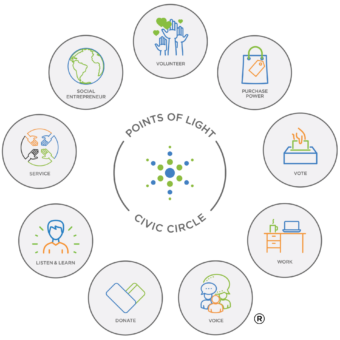
The Civic Circle provides actionable examples of all the ways you can change your community to reflect the world you want to see around you. In fact, you’re probably doing some of these things already. Are you helping a neighbor by picking up groceries or chaperoning on your child’s class field trip? You’re volunteering. Did you vote in the last election or help others get to the polls so they could vote? Those acts of civic duty illustrate the “vote” element. When you buy a product, do you choose to support companies that reflect your values or advance a social cause? That’s called “purchase power.” There are nine elements of the Civic Circle, and countless ways to bring each one to life.
This blog is the first in a seven-part series that will help you find real and manageable ways to activate the Civic Circle through
apps
,
documentaries
,
podcasts
,
books
,
TED Talks
and
blogs
.
We also offer other resources to help you connect with all the ways you can become empowered to be the change you want to see in the world. Check out our
videos
that provide an in-depth look at each element of the Civic Circle. And don’t miss
Civic Life Today
, our digital magazine series. Each issue takes a deep dive and provides materials, ideas and inspiration so that you can become civically engaged. Get started today, and launch your own civic engagement journey with these tools.
This piece is part of a series that highlights the many ways you can activate the Points of Light Civic Circle using various tools. Check out each one so you can live your best civic life:
- Apps
- Documentaries
- Podcasts
- Books
- TED Talks
- Blogs
Volunteer Power Across Causes Remains a Constant Need, Even in a Crisis
Points of Light’s Civic Circle
offers nine paths to civic engagement because we know that change led by the power of people comes in many forms. Points of Light
Global Network
affiliates tell us that volunteering is one of the primary ways people have supported the humanitarian relief efforts in and around Ukraine. They also explained that, because this crisis comes on the heels of the COVID-19 pandemic, there have been unforeseen ramifications including volunteer burnout as well as a singular focus on Ukraine relief work from those who want to remain engaged.
“People stopped helping in other areas, as they used to, and everyone wants to help the Ukrainian refugees — which is great — but when I talk with corporate partners or volunteers, they’re not interested in helping children, elders,” said Agnieszka Lissowska-Lewkowicz, who is the President of
Points of Light Global Network
affiliate and Polish non-governmental organization Centrum Wolontariatu. “We have to find a balance.”
There are countless needs waiting for support, from trash pickup in your neighborhood to walking dogs at your local animal shelter. There are so many ways to shine a light on your community by volunteering for a cause that speaks to you. To find a cause area that you feel passionate about, check out Points of Light’s
volunteer webpage
, home to the world’s largest volunteer network.
When you’re ready to begin working on your next community-based project, keep in mind these tips for tips for successful volunteering:
- Identify and Research the Causes You Care About
Figure out which areas of focus are important to you and which organizations you want to support. Now there are more ways to get involved than ever before. Consider whether you prefer to join volunteer opportunities that are in person or virtual.
- Decide on Skills-based vs Learning Opportunities
Think about what skills you have to offer or whether you’d like to learn something new. Some organizations are looking for specialized talent like translators. Others may offer volunteer opportunities that require training, such as becoming a crisis counselor for Crisis Text Line.
- Find Balance
Be realistic about balancing your volunteer time with other areas of your life, like your job and your family. Volunteering as a family may be one way to combine family time with living your best civic life.
Points of Light operates with a network of innovative volunteer-mobilizing organizations who serve more than 177 affiliates across 38 countries around the world. Together we are inspiring, equipping and mobilizing more people to use their time, talent, voice and resources to create positive change in their communities. Learn more about our Global Network.



