Around the World, People are Finding Connection in Service and Volunteerism
Sometimes — okay, often — stepping away from your desk and the Zoom box is the best way to find inspiration, in real life and unfiltered by media and algorithms. That has been my experience in the past month with a focus on the very specific ways that volunteerism, service and civic engagement unite us. They bring purpose and connection, both recently identified as important to our mental health and wellbeing by the U.S. Surgeon General.
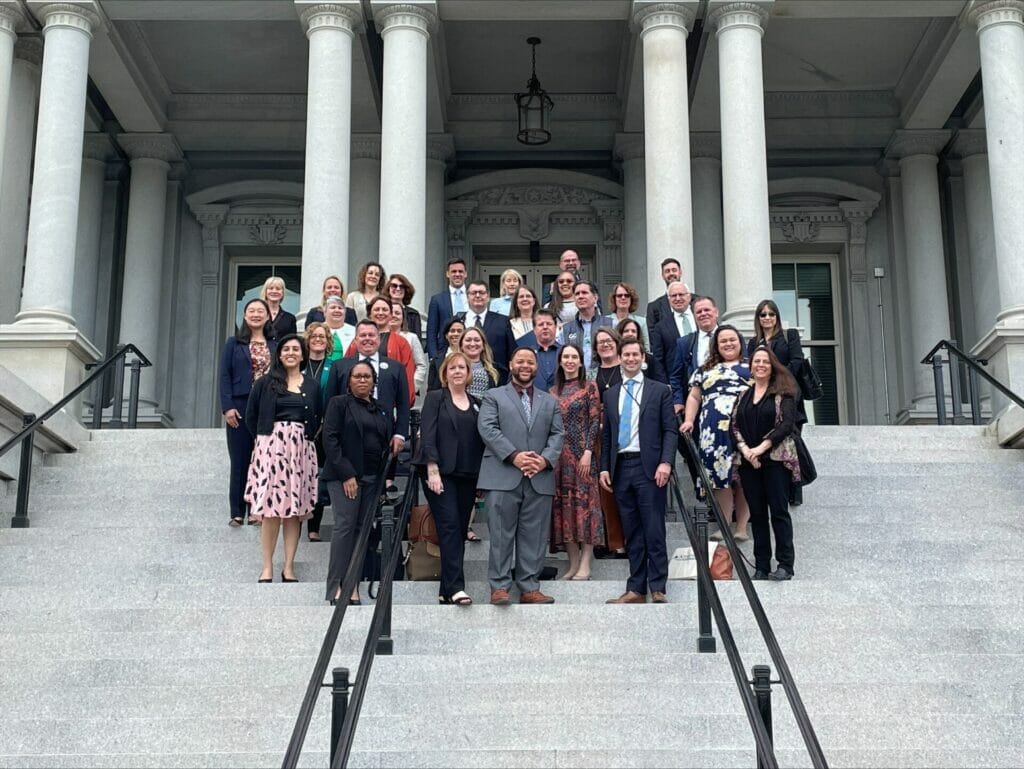
In our deeply divided nation’s capital, at the end of April, Voices for National Service held their annual
honoring members of Congress from both parties for their support of national service programs. The “in real life” headline from that evening: members from both sides of the aisle complimenting the other and demonstrating respect and bipartisanship. For example, Representatives Tom Cole (R) and Gwen Moore (D) each spoke about their personal connections to national service and how it bridges the political divide when they are working on legislation to support AmeriCorps, both having experienced firsthand how critical national service is to the social fabric of the nation. Democratic Senator Chris Coons and Republican Senator Bill Cassidy agreed when they met with the Voices for National Service Steering Committee members.
In the United Kingdom, recognizing the value of service and volunteerism has become engrained into the culture and that was lifted up during the festivities celebrating the King’s Coronation. People throughout the U.K. were asked to have community lunches together and to serve together over the coronation weekend.
A small Points of Light delegation was invited to London for this celebration as part of a partnership with the U.K. Prime Minister’s office which began issuing a Point of Light Award daily in 2014. The Queen followed with a
weekly in 2018.
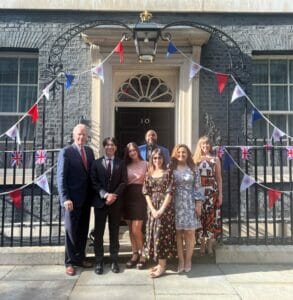
We joined roughly 100 others at 10 Downing St. for their “Big Lunch.” In addition to our delegation of U.S. Daily Point of Light honorees, UK and Commonwealth Point of Light honorees, and a group of Ukrainian refugees, we were joined by Prime Minister Rishi Sunak and his family, First Lady Dr. Jill Biden and U.S. Ambassador to the UK Jane Hartley.
Sitting at this table was a very surreal “in real life” experience, to say the least. But it was remarkable to watch community leaders and volunteers connect across cultures and geographies as they shared stories about their service, their community and the causes they care about.
The U.S. Daily Point of Light honorees who joined us were
, a 19-year-old Bostonian who launched “Catching Joy,” a nonprofit that organizes hands-on service projects and promotes kindness for kids and teens.
Every one of these individual points of light is intentional in the ways they’re taking action – especially as young people. Their commitment to changing the world goes deeper than the occasional one-off volunteer activity. It is a lifestyle, and they’re less willing to compromise their commitment to the issues that matter to them. This attitude aligns with multiple bodies of research. One
found 77% of Gen Z said it was important to work at organizations whose values aligned with their own. Their increased focus on living a life in which service in civic engagement is at the core gives me great hope that their increased action leads to a more open and inclusive generation who can find common ground.
These global points of light showed us not only that service unites, but most importantly, that they have unlocked the benefits of purpose and connection through civic engagement. Experiencing – in real life – these moments of bipartisanship, collaboration, connection and celebration, while focusing on the work that unites us, provided a boost of inspiration and hope.
5 Must-Ask Questions for Corporate Partnerships with Nonprofits
Collaborating with nonprofit partners plays a significant role in achieving your company’s social impact goals, especially as it relates to employee engagement. Nonprofit organizations have deep expertise and experience in the areas where your company seeks to create impact along with an ever-evolving sense of the best ways to get involved – whether that’s through donating financial and in-kind resources or through traditional and skills-based volunteering.
When you are first reaching out to a nonprofit or NGO to start conversations about how your company can provide support, you’ll want to ask a few questions to ensure a potential partnership will be mutually beneficial. And that’s the first key factor to establish – that the work you may do together will benefit both organizations and that your business needs do not overshadow your nonprofit partner’s needs. After all, they are truly the
in improving a particular social condition or working with a specific population, and the greatest opportunity for a successful collaboration comes from working alongside each other to create shared value.
Here are five questions to help you identify and elevate their needs in order to determine ways to partner together:
What are you hoping to achieve through your mission? Do you have current projects or programs that align with [COMPANY IMPACT AREA, such as education, environment, workforce development, veterans, etc.]? Of course, you’ll want to do some internet and peer research about the organization first, before you approach them. But confirming their mission, goals and offerings will ensure you start out on the same page. This is also a great time to ask about diversity in leadership and equity in operations to ensure values align.
Are there things that you have wanted to do but haven’t had the resources? For example, is there a population you haven’t been able to serve, a need you haven’t been able to meet, or internal processes you’d like to improve? Allow them to dream big but also be transparent with the amount of support you’ll be able to provide. Do not push them out of their core work if their mission would be compromised and new programs wouldn’t be sustainable.
Are you currently working with any other organizations or companies on this issue? It’s always a wise idea to understand your potential nonprofit partner’s current corporate partners and to get a feeling for their experience working with other businesses. Keep in mind, if they are a smaller or newer NGO, they might not yet have an extensive track record. However, if your company or corporate foundation does have strict guidelines around duration of nonprofit status, you’ll want to ask that specific question at the outset.
Would you be interested in collaborating with another organization to support this issue? Remember, the goal is to create a synergistic relationship, and your potential partners may not have the bandwidth or capacity to bring along another corporate partner. Let them be transparent with you. Should they need to decline, follow up with them at a later date or ask for recommendations for nonprofit organizations with similar missions or goals.
Do you have ideas for ways to engage our employees in volunteer projects to support your mission, whether they are in-person or virtual, traditional or skills-based? If it’s service opportunities that you seek, let them know that upfront. Follow up with additional questions around capacity, resources (people, processes and technology) they might have in place to support these opportunities. Not all nonprofits have access to the same resources, so they may not be able to accommodate your volunteers meaningfully now. If measuring the impact of employee volunteers is paramount to the partners you choose, ask this question, too, so that data collection and a shared sense of impact can be developed. You might have just the expertise and capacity to help them think through creating and measuring meaningful opportunities via your volunteers and budget.
By asking these questions, businesses can gain a better understanding of the nonprofit partner’s values, programs and impact, and ensure that the partnership is aligned with their own goals and values. This can help create a more effective and sustainable partnership that achieves outcomes and benefits both parties and the communities or causes your company’s social impact strategy aims to support.
National Service – Bringing out the Best in America
Points of Light is proud to welcome AmeriCorps CEO Michael D. Smith as a featured guest at the 2023 Points of Light Conference. Learn more about him and the exciting lineup we have planned. Register today!
In 1839, Alexis de Tocqueville came to the United States and reported back to his French contemporaries that Americans are a people who “confronted their problems and addressed them,” and that civic participation is foundational to their form of democracy.
Nearly 200 years later, as we navigate life in the shadow of a global pandemic that pulled back the curtain on deep and lasting inequities, Tocqueville’s words still ring true.
American people continue to show up for their neighbors, continue to volunteer for causes that matter and continue to embrace national service to not only strengthen their communities—but also improve their own lives–whether that’s by gaining skills that give you a leg up in your career, earning money for college or to pay back student loans, decreasing isolation, increasing longevity or improving physical and mental health.
As the CEO of AmeriCorps, the federal agency for national service and volunteering, I witness this belief in the power of service every day, from all corners of the country. Each year AmeriCorps provides nearly $1 billion in funds to support hundreds of thousands of AmeriCorps members and AmeriCorps Seniors volunteers at nonprofits and municipalities that provide evidence-based solutions for children and families in nearly 40,000 locations.
In the period immediately following the earliest cases of COVID-19 in the US, Tocqueville would have seen that 19th-century American spirit of service alive and thriving. At one of our darkest moments, AmeriCorps members, along with countless volunteers, pivoted and provided vital support to more than
, including 2.5 million people at pandemic vaccination sites. And while these members and volunteers were critical, we knew we needed to come up with bigger solutions, which is why, in partnership with the Centers for Disease Control and Prevention, we launched
to create a pipeline to fill the enormous public health worker shortage, drive more equitable health outcomes, and create career opportunities for people with varying levels of formal education and experience.
The pandemic did not slow the challenges arising from climate change. In the wake of fires, floods, hurricanes and tornados in recent years, AmeriCorps members serving with
have stayed on the ground aiding emergency management response, assisting residents, removing debris and rebuilding homes. The work is not easy, but these members are tireless, well trained and eager to help build communities back better than before disaster. Recently, AmeriCorps members
, from storm surges, flash floods and tornado outbreaks. Members provided urgent help—mucking out homes, temporary roof repair, removing hazardous trees and supporting FEMA Voluntary Agency Liaisons.
As students and teachers converted to virtual learning in 2020, AmeriCorps members and AmeriCorps Seniors volunteers were right alongside them, stepping up and showing up during one of the most challenging times in recent memory. As schools continue to grapple with learning loss, overcrowded classrooms, and growing childhood mental health challenges, AmeriCorps Seniors volunteers serving with the Foster Grandparents Program support students, teachers and families in providing the care and attention children need to thrive.
, who serves as a Foster Grandparent volunteer with Puerto Rico’s Cerebral Palsy Center. Guillermo supports children with developmental disabilities, cerebral palsy, neurological disorders and multiple severe disabilities to live their best lives. His service helps students in underserved communities integrate into the school, offering tutoring and custom curated curriculums such as social work, physical therapy, speech-language pathology, special education, summer camps and more.
Research and results show that national service is one of the most effective tools we have as a country to build unity, open doors to education and employment and drive social change. In a world that can feel like we’re being torn further apart, or that our problems are eclipsing our promise, AmeriCorps is bringing us together. When you’re joining together to rebuild after disaster, to teach a child to read, to provide food to neighbors in need, ideology tends to go out the window and barriers fade. Through service, we see one another’s humanity.
During the pandemic we saw the number of volunteers decline who were serving formally with a nonprofit as so many community-based organizations had to shut their doors or work in a reduced or virtual capacity. But
. And the numbers of individuals that helped their neighbors—such as going to the grocery store for an elderly neighbor or creating a learning pod for children of essential workers and first responders—stayed strong and steady at pre-pandemic levels.
Tocqueville was right. There is something special about this country of ours. Everyday Americans of all ages, races and walks of like go out of their way to reach out, give back and lift up others. Our nation is stronger as a result—and the individuals who serve are stronger as well. There’s a role for everyone to play:
If you are a corporation, consider joining Employers of National Service and partnering with nonprofit organizations and state service commissions to provide matching dollars to increase benefits for national service members.
If you are a university, consider joining Schools of National Service to attract students with real-world service experience to your degree programs.
If you are running a volunteer center, such as a foodbank or a shelter, AmeriCorps can be a force multiplier to help you reach more people. Consider applying for a grant through AmeriCorps VISTA to bring on additional staff capacity or the Volunteer Generation Fund to help recruit, retain and manage volunteers.
Nonprofit organizations of any size can consider applying for an AmeriCorps State and National grant to make an even bigger impact on your mission.
Michael D. Smith is CEO of AmeriCorps and a featured guest at the 2023 Points of Light Conference. Learn more about him and the exciting lineup we have planned. Register today!
5 Points of Light Conference 2023 Sessions That Will Keep Your Social Impact Work on Trend
is a gathering for social impact professionals who are passionate about civic engagement. It empowers nonprofit, government, business and civic leaders to make a bold impact in their communities, providing the resources and inspiration to do so.
Join us June 14-16, 2023, in Chicago to experience more than 50 workshops with actionable takeaways led by industry experts, four keynote and panel discussions, compelling leadership discussions highlighting best practices and connection with fellow changemakers ready to collaborate and amplify your efforts.
Here are five sessions at this year’s conference that will give you winning strategies, shape the future of CSR, and help save $2 Trillion.
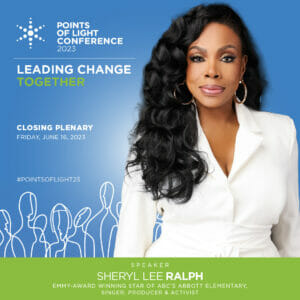
1. CLOSING PLENARY LUNCHEON: LET YOUR LIFE SHINE WITH SHERYL LEE RALPH
Join Sheryl Lee Ralph, Emmy-Award Winning Star of ABC’s Abbott Elementary, singer, producer and activist. She’ll talk about the power of using your voice and tapping into joy to overcome obstacles and facing challenges with positivity. She’ll share insights about the ways that people are looking within themselves for creativity, imagination and lasting energy to make real, sustainable change.
2. CIVIC ENGAGEMENT LEADERSHIP SUMMIT: THE LEADER AS A PERFORMER AND ACTIVIST
The Civic Engagement Leadership Summit is a dynamic session designed specifically for leaders of nonprofit organizations preparing their organizations for growth and mission success. Attendees will explore how to address complex topics through advocacy, theatrical leadership and the role of the arts as a platform for promoting the well-being and resilience of people and communities. Attendance will be limited, nonprofit leaders must apply after registering for conference.
3. CHANGE YOUR COMPANY, CHANGE YOUR WORLD: MAKING THE MOST OF EMPLOYEE NONPROFIT BOARD SERVICE
What does it mean to serve on a nonprofit board? Benefits to the nonprofit, employee and company can look different, and companies need to find clarity as they prepare their goals and develop a strategy for internal buy in with their nonprofit board service programs. Companies must have a clear vision of how board service helps both internally and externally with their greatest asset: their employees.
This session with Takita Battle will focus on benefits to companies and the nonprofits they work with as they collaborate. The time is now to start thinking and reimagining your Nonprofit Board service.
4. HOW CORPORATIONS CAN LEAD THE CHARGE TO ADVANCE EQUITY IN THE 21ST CENTURY AND SAVE $2 TRILLION ANNUALLY
Join Anu Gupta and Caroline Horste for this discussion on the benefits of building equity within corporations. Social scientists show that racial inequity costs our economy more than $2 trillion annually, and that number doesn’t account for the tremendous suffering it creates in our workplaces and communities.
At a time when diverse communities are drifting farther apart, businesses are uniquely positioned to heal the divides while strengthening their bottom lines. In 2022, BE MORE with Anu, a corporate diversity, equity, inclusion and belonging (DEIB) e-training company, established an exclusive partnership with B Lab US & Canada to oversee their network-wide DEIB learning journeys. This partnership with B Lab represents the first full-scale, multi-national DEIB initiative available to all interested companies who have publicly committed to “being a force for public good.”
In this session you’ll learn how CSR professionals and impact-driven corporations can use this case study to adapt a strategic roadmap for partnerships.
5. TRENDS SHAPING THE FUTURE OF CORPORATE SOCIAL RESPONSIBILITY
Corporate Social Responsibility has never been more important or intrinsically linked to business success. Yet, the work is changing rapidly in terms of nomenclature, strategy and who a CSR professional needs to partner with.
Join Lacey Gaitan for this session looking at the
that are most significantly shaping the future of CSR and the everyday work of CSR & ESG professionals. We’ll explore social issues and advocacy, tying CSR to ESG, engaging employees in CSR decisions, equity/trust-based philanthropy, increased collaboration across the organization, growing emphasis on sustainability, increased reliance on data and storytelling and the new volunteerism landscape.
If you haven’t yet registered for the Points of Light Conference 2023, head over to our
, featured three leaders of corporate social impact who have implemented a network of employee volunteer champions. This engaging discussion on these people-centered models revealed how to implement, support and strengthen social impact activities, and answered some common employee engagement questions.
We know it takes significant effort to start, maintain and continuously improve this type of people-powered model. Our aim is to provide additional insights, tips and strategies that will help you develop and cultivate a successful community engagement strategy, supported by passionate and committed employees who can serve as ambassadors for your company.
Let’s dive in and answer some of those employee engagement questions, and don’t forget to check out
What are ways that employee champions drum up enthusiasm when most coworkers are working from home?
Being an ambassador of your company’s social impact efforts is an increasingly important role, especially now that hybrid and remote work has been embraced. Examples of ways these champions can continue to engage their colleagues include taking advantage of the wide variety of online communication tools available.
This could look like sending informative emails on a regular basis, hosting virtual “lunch and learns” educating volunteers before the start of a volunteer project or campaign, sharing positive stories about recent nonprofit partners or grantees, and celebrating milestones and accomplishments. Encourage your employee champions to consider gamifying these opportunities by hosting virtual trivia about your company’s social impact strategy or creating an online roster of their frequent volunteers complete with photos and fun facts. Remember to provide them with the support they need to motivate their coworkers to get involved.
Just as you want to foster a sense of community with your champions, they will want to do the same for the department or territory you’ve paired them with.
What kind of incentives or recognition is in place to motivate employees to take on the role of champion or maintain their volunteer leadership?
We’ve included a list of several ways companies have chosen to recognize employees for their contributions as an ambassador of their social impact efforts in
.
Additionally, consider taking a deep dive into your company’s policies for compensating those who take on additional efforts such as acting as a volunteer leader or leading an employee resource group. At least one company, LinkedIn, has begun
annually, at the end of each year of their term. Consider whether your company adopt this method.
As also mentioned in the learning brief, think about ways you can provide these leaders with opportunities for growth and development in partnership with your HR team. These opportunities to work closely with leadership, participate in a unique development program or manage a grantee relationship—great additions to someone’s resumé—will appeal to those who are career-oriented.
How do you handle budgeting for the volunteer efforts these champions might organize or support?
This concept can vary significantly from company to company. Many might provide a champion with access to a budget for their particular market or department – and if not direct access, the review/approval process for requesting use of those funds.
Others keep the budget central to the social impact team, especially if champions are in place to help lead a global initiative like a week of service. Still others may not need access to budget at all because they are tasked with storytelling and amplification, rather than leading a specific project. This is, however, an important piece to think through when building out the model and champion responsibilities.
What do champions get in return from a business perspective?
Social impact ambassadors can receive several benefits in return for their efforts beyond the intrinsic satisfaction of contributing to a greater social good. Here are a few examples:
Professional development: Acting as an employee volunteer champion can provide opportunities for professional development and skill-building. These ambassadors may gain experience in leadership, project management, communication and delegation.
Recognition and visibility: Social impact ambassadors may receive recognition and visibility for their contributions. Possibilities could include being featured in company communications or being recognized at events or in the media.
Networking opportunities: Serving in a champion capacity can provide opportunities to network and connect with others who share similar interests and values. Think collaborating with other champions, senior leaders, their peers at other companies or partnering with community organizations.
Personal fulfillment: Contributing to a greater social good can bring a sense of personal fulfillment and satisfaction. Champions can help employees feel more connected to their work and to the community. They might also take pride in supporting their employer in reaching new heights through talent acquisition, increased retention, improved reputation, maintaining license to operate and helping to foster the sense of belonging that community engagement provides their fellow employees.
Advancement opportunities: Social impact ambassadorship can provide opportunities for advancement within the company. Champions who demonstrate leadership, initiative and commitment to the program may be considered for promotion or other career advancement opportunities.
How do you measure the success of your champion model?
Evaluating the success of a champion network can be challenging, but there are several key performance indicators (KPIs) that a company can use to measure its effectiveness. Here are a few examples:
Impact: The primary goal of a social impact change program is to create positive change in the community or society. So, the success of the program could be measured by the extent of the impact it creates. Include metrics such as the number of people helped, the amount of money raised for a cause or the level of awareness raised around a social issue. Ultimately, consider whether the model is helping the company achieve its social and business impact goals, along with the specific objectives you set out for your champions.
Engagement: Think of engagement success as two-fold – are your champions more engaged, and are the employees they oversee more engaged? One of the primary goals of an ambassador program is to increase employee engagement. Measuring engagement levels could include tracking the number of employees participating in volunteer activities, the amount of time and effort contributed by champions or the number of partnerships created with community organizations.
Employee feedback: Gathering feedback from employees on the ambassador program can also be a valuable way to evaluate its success. Look to surveys, focus groups or offering “office hours,” to provide insights into what is working well and what could be improved.
Ultimately, the success of an ambassador model will depend on the specific goals and objectives of the program. By identifying the key performance indicators that align with those goals, the company can measure the program’s success and adjust as needed.
Want to see the full webinar? Check out Advancing Social Impact Today and don’t miss our free white paper on the subject so you can build an employee champion network at your company, starting today.
Leverage These 10 Research-based Facts and Stories of Inspiration to Drive Change
Content Warning: Points of Light is proud to share the following information; however, we acknowledge that these issues may be difficult for some readers. We encourage you to please care for your own well-being above all.
Mental health, COVID-19, gun safety and domestic violence have all come to the forefront of
about overall health. These cause areas affect everyone, from students and employees in workplaces to professional athletes and entertainers to healthcare workers themselves.
When cause areas like these come into focus, equipping social impact professionals and everyday people with research is one impactful way Points of Light can honor our commitment to civic engagement. Research can help you understand the current needs and concerns of people in your community so you can develop an action plan to meet those needs.
Here are 10 research-based facts about mental health, safety and issues related to both, along with stories of everyday people driving change in their communities around these causes. With this compelling research and these inspiring stories, we hope you’ll feel equipped to drive real and sustained change in your own community.
10 Research-Based Facts about Mental Health, Domestic Violence, Gun Safety, and COVID-19
1. Thirty-nine percent of people are concerned about MENTAL HEALTH when compared to other issue areas.
Of the respondents, Gen Z showed the highest concern about mental health issues at 44%, with Millennials following closely at 42%, Gen X at 40% and Baby Boomers at 31%. This generational breakdown may reflect the increase in conversation and education around mental health over the past few decades, becoming a less taboo topic for younger generations.
2. Thirty-five percent of respondents said they have been personally impacted by mental health issues.
Typically, people are most moved to action when they experience the impacts of a specific issue. While this might mean a personal lived experience, often people can access empathy when a loved one has been impacted.
3. Eighty-three percent of people chose to respond to this issue through VOLUNTEERING.
and represents one of the most powerful ways to lend hands-on support for a cause. Nonprofit organizations rely on their volunteers to help drive their missions forward and stretch donor funds as far as possible. When it comes to mental health, respondents said they volunteered their time and talent either by intentionally helping someone else or volunteering with an organization, whether in-person or online.
See how servicewoman Michaela White is advocating for mental health in the military.
4. Fifteen percent of people are concerned about GUN SAFETY when compared to other issue areas.
This statistic reflects a drastically lower level of interest when compared to the broader topic of mental health. This could reflect the fact that fewer people are personally impacted by gun violence when compared to mental health, but it could also reflect the charged political nature of conversations around gun safety. Interestingly, men and women showed equal concern about this issue at 15%.
5. Sixty percent of respondents took the time to learn about gun safety.
is another element of the Civic Circle and, for gun safety, is perhaps the most critical. Learning about a social issue can help educate you about the many nuances rather than having a “blanket” perspective on it. It can also help you make more thoughtful and informed decisions about how to approach solutions. People believe that some of the most helpful actions related to gun safety involve individual effort, like personal education on the issue and
Read about high school student Yating “Tina” Tang who is lifting up the marginalized and combating gun violence through activism and art.
6. Thirty-two percent of women said DOMESTIC VIOLENCE was one of their top areas of concern, compared to 22% of men.
Domestic violence is another cause area with interest being driven by those most commonly affected by the issue – in this case, women. While men are certainly not exempt from domestic violence, women are considerably more likely to experience it. Thirty-four percent of respondents reported that a close friend or family member had been impacted by domestic violence, a statistic that could lend itself to increasing empathy and concern among all people, regardless of gender.
7. Sixty-eight percent of individuals took time to post and share content on their social media channels around the issue of domestic violence, while 63% intentionally helped someone affected by domestic violence.
See how Air Force member Matthew Storer is helping families escaping domestic violence to start anew.
8. Fifty-five percent of people are concerned about COVID-19 when compared to other issue areas.
Unsurprisingly, COVID-19 was one of the top-ranked issue areas in terms of concern. Since the COVID-19 virus, and the ensuing pandemic, affected every single person across the globe, it’s no wonder that many people showed the most interest in this issue.
9. Sixty-three percent of Baby Boomers cited COVID-19 as a top concern.
Since people over the age of 65 are more at risk of severe illness from COVID-19, it is clear why Baby Boomers, among all the generations, would be the most concerned about this issue. In contrast, 49% of Gen Z cited COVID-19 as a top concern, while Millennials and Gen X showed interest at 51% and 58%, respectively.
10. Seventy-nine percent of respondents made a donation to a COVID-related cause or organization.
is another element of the Civic Circle, and encompasses contributions of money, services or goods to a cause. Since the landscape of the COVID-19 pandemic has largely moved from disaster response to recovery, it makes sense that individuals are choosing to donate to organizations responding to the crisis.
Read about public health employee Alyssa Antczak’s efforts to set up mass vaccination clinics and organize COVID-19 testing sites during the pandemic.
Want to keep diving? Take a look at these topics to find out how you can leverage our research to take civic action in your own community:
Transform Your Volunteer Appreciation: Become a Service Enterprise Organization
Often organizations that I have worked with and supported pre-COVID had a big volunteer appreciation event, but during the pandemic those events had to be put on pause, so organizations began to ask volunteers how they really wanted to be appreciated. Many said a simple and genuine thank you, to use their time well and to include them in the organization.
What better way to show volunteer appreciation than to invest in improving how your organization engages and supports them? During
, I encourage you to take a moment, pause and reflect on how your organization is engaging the skills, talents and time that volunteers are giving.
Do you have opportunities for volunteers to serve throughout your departments or service lines your organization offers?
Do you have volunteers and pro-bono services sprinkled throughout the organization chart?
Does your organization’s culture embrace volunteers as a key resource for realizing your mission?
If your organization’s culture doesn’t yet have answers to these questions, start by exploring how your organization can participate in Points of Light’s
(Association of Leaders in Volunteer Engagement).
In addition to giving your volunteers a token gift and/or celebratory event, you can showcase all of the work your organization was able to accomplish due to their contributions, assure them that you are investing their time and talents in the most impactful ways, and that the organization recognizes and appreciates all that volunteers bring to the organization. This transformation doesn’t happen overnight, but with the help of our Service Enterprise Program, you can begin to evolve the organization’s culture through this change management process that helps nonprofit organizations effectively and efficiently leverage the time and talent of volunteers to help deliver their social mission.
We realize that you may have a great
program, but to take it to the next level, to truly integrate volunteer engagement into the organization culture, you are going to need more. Service Enterprise helps your organization through this change management process.
First, we facilitate a self-assessment research-based diagnostic and offer a debrief that will help your organization recognize the strengths and areas of opportunity that currently exist. Together, we select a team that will carry the organization through the change management process and bring together leadership, volunteer engagement professionals and more. The team attends training and has dedicated time and activities to focus on better engaging and supporting volunteers (and often all human capital) at the organization.
You will also join a network of peers working toward operating as a Service Enterprise. This network often shares resources and helps each other along the journey. Your Service Enterprise Trainer will provide you with additional coaching and support to meet unique needs and address challenges within your organization.
Imagine, at your next volunteer appreciation event or in your April 2024 newsletter, you’ll be able to tell your volunteers that you not only appreciate the way that they continue to lean in and fight for your cause by sharing their time and talents, but your organization has achieved the national volunteer engagement accreditation of Service Enterprise. As a Service Enterprise certified organization, they’ll know that their time is well invested when they spend it advocating for your mission.
To learn more about Service Enterprise or how to connect with volunteer engagement professionals across the country contact Kayla Paulson at
heard, spread awareness and garner widespread support. By reaching audiences across the nation and the globe, social media influencers can harness their social impact by educating and informing the masses on current-day issues, solutions and organizations working to create change.
Here we’re featuring six changemakers who partnered with Points of Light during
throughout April to amplify this movement through their social media platforms. Their messaging lent support to promote volunteerism in communities around the world.
was created to empower literacy for children and families worldwide through local sustainable libraries, education and arts programs. The organization’s founder, Taylor Moxey, is passionate about the power of reading to promote creativity and innovation in both children and adults. This young philanthropist is already a published author, award-winner and creator of a daily mantra card deck.
The three Florida-based Taylor Moxey libraries are constructed of pod-style buildings created from repurposed shipping containers, providing a sustainable approach to creating more spaces for youth and families to cultivate their love of reading and education.
You can
is a Paralympian, adaptive model and disability advocate. Born without her left hand and forearm, Dani has represented the United States at the summer and winter Paralympic Games. She fiercely advocates for inclusion in the outdoors for people with disabilities.
From playing sports from a young age and excelling against non-disabled peers, Dani went on to a decorated career in professional sports, including track and field, Nordic skiing, trail running, backcountry skiing and more. She advocates for disability inclusion in sports and is currently working toward establishing an avalanche course for people with disabilities.
Meet
Sir Darius Brown is a powerhouse teen social entrepreneur, speaker, shelter pet advocate, philanthropist, recipient of the Global Child Prodigy Award and founder & CEO of
, where he designs and creates handmade stylish bow ties for dogs in animal shelters.
At the age of 2, Sir Darius was diagnosed with speech comprehension and fine motor skills delay. But by the age of 8, his fine motor skills started to improve after he began assisting his older sister with cutting fabric and learning how to use a sewing machine. During this time, he discovered his passion for making bow ties. Beaux & Paws was founded during the devastation of Hurricane Harvey and Hurricane Irma, in an effort to help displaced pups become more adoptable with adorable bow ties that help them look their best.
Meet
was born with congenital amputation, but that didn’t stop him from becoming a successful track athlete and top wrestler in high school. In 1992, Trey started playing wheelchair basketball with team Air Capital in Washington D.C., eventually becoming a three-year captain and two-time All-American for the Edinboro men’s wheelchair basketball team. He then played professional basketball for two years overseas in France.
A published author, husband and father, Trey is an advocate for equality and equity, shining his light on issues that individuals with disabilities face within our society. Since embarking on the Paralympic stage in 2009, Trey has continued to empower all athletes on all levels in their respective sports. He uses his athletic platform to spark difficult conversations with high-ranking personnel within government, corporations and private agencies
Meet
when she realized she had a knack for juggling — a skill she recognized after joining a competitive soccer team at age 8. Through a combination of soccer juggling, appearances at special events and public speaking, Hollis has raised more than $660,000 for St. Jude Children’s Research Hospital, with the help of thousands of individual donors, juggler volunteers and partners supporting her cause.
Hollis has since become an advocate for youth in philanthropy, speaking and writing about how young people can take a passion and turn it into a way to get involved with the causes they care about. Having completed a Certificate in Philanthropy and Nonprofit Organizations through Northwestern University’s School of Professional Studies, she’s currently working with Howard Moskowitz, PhD, a pioneer in the field of consumer analytics and market segmentation. Together they are applying his research methodology and technology to help St. Jude and other nonprofits and philanthropists communicate with their audiences for maximum return.
Meet
in 2012 to economically empower marginalized women and support their children. Since economic empowerment is the way to financial independence for women, these sisters spotted an opportunity to utilize their knowledge and passion to pave the way for future generations of women to be more equipped for economic success.
The organization’s four-pillared approach invests in women to become financially savvy, digitally capable, career confident and socially connected. The programs are based on the organization’s theory of change model and are crucial enablers for women to accomplish their financial, career and personal goals. Through FFG programs, women summon the courage to commit to action which builds competence and, in turn, gives them confidence.
Meet
2023, and continuing to celebrate individuals and organizations around the world affecting change and advocating for social good. We’ve been featuring a handful of
affiliates who are positively impacting their communities through volunteer recruitment, recognition and special events throughout April.
The Points of Light Global Network operates with a network of innovative volunteer-mobilizing organizations that serve more than 145 affiliates across 39 countries around the world. Together, we are inspiring, equipping and mobilizing more people to use their time, talent and resources to create positive change in their communities.
is a member of the Points of Light Global Network and is Los Angeles’ largest volunteer action center. The organization aims to unite Angelenos and inspire action for a more equitable Los Angeles.
We spoke with Samantha Wheeler, director of communications at L.A. Works, to talk about why volunteering matters and how the organization utilizes its resources to uplift volunteers and the overall mission.
How is your organization recognizing Global Volunteer Month this year?
L.A. Works has volunteers across many different categories and programs, and we intend to highlight them across social media this month. We have reels and posts planned to highlight corporate volunteers, volunteers who are over 55, FAVE volunteer families, climate action/disaster preparedness teams, VISTA members and general volunteers.
What resources or tools are you providing to volunteers to help them get involved in their community?
We utilize our website, social media, tabling events and canvassing to get people involved.
How are you recognizing and thanking volunteers for their contributions during Global Volunteer Month?
We are using a social media campaign to thank all of our volunteers – from corporate volunteers to family volunteers and all in between – for their service.
What role does volunteerism play in your organization’s overall mission and objectives?
Volunteering is the heart of what we do. Our purpose is to make sure that Angelenos work on local needs through hands-on service and feel empowered to address the most critical needs in Los Angeles.
What’s one piece of advice you’d give someone who’s looking to get more involved in their community through volunteerism?
Volunteering is a great way to follow your passion. We have so many volunteers come to us because there’s a specific area that they care about but maybe they don’t get to explore because of work obligations. Volunteering is an excellent way to engage in something you care about.
It’s also a great way to discover a new interest. We’ve also had volunteers who discovered they had an interest in something new nurtured by a few hours of service in a specific area, not to mention the benefits of volunteering: meeting new people, learning new things, lowering blood pressure to name a few.
Ways to Engage your Company in Global Volunteer Month
This month, take a short pause to celebrate the power of people who tackle society’s greatest challenges and build stronger, more vibrant communities through volunteerism and everyday actions.
Starting April 1, Points of Light and organizations around the world join together to celebrate
. Throughout the month, we invite you to shine a light on the employees who use their time and talents to volunteer or engage in their communities through one of the components of
to access tools and resources to help you participate. Then, check out the following simple ways your company can get involved this year:
Amplify your company’s social impact work by highlighting your employee volunteers and the impact they have year-round in the communities where they live and work. Share volunteer stories on social media using hashtag #GlobalVolunteerMonth and tagging @PointsofLight to inspire others in your community and around the world.
Send a note from senior leadership that recognizes your company’s commitment to creating change. In the toolkit, you’ll find sample messaging along with links to graphics we encourage you to use.
Share our Civic Life Today digital magazines with employees to remind them of all the ways they can make a positive difference in their community.
Contact your local Points of Light affiliate to learn what communities need and how your employee volunteers can help.
Thanks to our lead sponsor, Phillips 66, and supporting sponsor, UPS, during the month we’ll be spotlighting individuals and organizations that are making a difference in their communities. We invite you to read and share
to showcase ordinary people doing extraordinary acts, big and small, with the goal of making this world a little better for others. Happy Global Volunteer Month!