Key Takeaways on Education and Literacy Development from Points of Light’s Research
It’s back-to-school season in many parts of the world, it’s natural to begin thinking more about education, its place in our society, and how well it’s serving people in its current state. There is nothing quite as important in building resilient communities and future leaders as education and access to education. Education equips young individuals with literacy development, critical thinking and reasoning capacities, and so much more that will serve them throughout their lives.
But education isn’t always a straightforward cause area, and many people are concerned about policies, funding and curriculum across today’s education landscape.
As back-to-school season ramps up, we are looking at some takeaways from
Education was one of the top five issue areas of concern across all four countries surveyed by Points of Light. This is perhaps unsurprising given the particular impact of the COVID-19 pandemic on education systems. At one point, 94% of children were out of school, and this will have a rippling effect for years to come. It’s no wonder that 40% of Gen Z respondents, born from 1997 to 2012, said this was an area of top concern, as they were the generation most directly impacted.
Making strides in education can mean getting involved in a variety of ways including
to support educators and advocate for school-aged children.
But if we are to make the greatest possible impact, we must take into account the early education systems as well. These are the institutions responsible for educating children in some of their most formative years providing social, emotional and cognitive skills to become lifelong learners.
See how computer science student Karnika Choudhury is passing on coding skills to youth with learning disabilities.
Interests in Education vs. Early Education
When asked about cause areas of top concern, 36% of people reported being concerned about education when compared to other issues. However, that number was cut in half when it came to early education, which only 18% of respondents cited as an area of top concern, when compared to other issues.
Learn more about retired teacher Suzanne Bergman, who spent her career working in early childhood education and now tutors under-resourced children with New Horizons of Southwestern Florida.
Gender Divides in Concern About Education
When examined further, there was a distinct gender divide in the respondents showing concern for early education vs. education in general. When it came to early education, women reported being more concerned (at 21%) than men (at 15%). However, in the more general education category, these statistics were neck-and-neck, with 37% of women and 35% of men reporting education as an area of top concern.
Generational Differences in Perspectives on Education
Gender wasn’t the only factor contributing to different responses across education. There was also a generational divide. While 36% of Baby Boomers expressed interest in the more general education category – making them the second most concerned, out of the four generations polled. However, only 13% of Baby Boomers expressed interest in early education, ranking them last for this category, and significantly lower than any other generation, despite the well-documented lifelong benefits of early childhood education.
See how book-lover Teresa Gerald is spreading access to resources and supporting literacy in her local library system.
Education stands as a cornerstone for building resilient communities and nurturing the next generation of capable leaders. The good news is, there are ways to support education by voting for supportive policies, volunteering in classrooms and after-school programs, advocating for educators, and serving on school boards. Plus, by recognizing the significance of early education, we can ensure a solid foundation for childhood development. Bridging the gender and generational gaps in concerns about education will lead to a more cohesive and impactful approach. As back-to-school season approaches, it’s a time for a renewed commitment to education and early education, empowering our communities and ensuring a brighter future for everyone. By combining elements of the Points of Light Civic Circle®, we can amplify our impact and inspire real and sustainable change.
See how self-taught student from Afghanistan Nessar Hekmatjo is helping other displaced students adjust to life in the United States.
Want to keep diving? Take a look at these topics to find out how you can leverage our research to take civic action in your own community:
Beyond Volunteering: How Social Entrepreneurs Revolutionize Problem Solving
Civic engagement comes in many forms, like volunteering, donating, voting or using your voice. But have you heard of social entrepreneurs? These individuals get to the root of causes. They identify a need that has not been met by traditional structures and work to solve it, often through innovative means.
This month, Points of Light is focusing on
, a framework that opens the door to social impact through volunteering as well as less traditional avenues, including using your purchase power, listening and learning, and more.
What Does a Social Entrepreneur Do?
Social entrepreneurs use creativity to think outside the box. Unlike socially-conscious business entrepreneurs, social entrepreneurs are defined by their resourcefulness and relentless pursuit of innovative solutions to complex problems. Social entrepreneurs must raise funds to finance their initiatives, but their work centers on creating effective solutions to society’s most pressing issues above all else.
Social Entrepreneur Examples
While many small business owners may be socially conscious, social entrepreneurs are on a particular mission to meet a need that hasn’t been met by governments, corporations or nonprofits. Then, they find an innovative way to go about meeting this need.
These Daily Point of Light honorees are social entrepreneurs who use their hearts, hands and minds to help strengthen communities and solve persistent problems.
William Cabaniss– sells vanilla extract, donated 135,000 meals to East Tennessee.
Sara and Mateo Molina – sells cookies benefitting most vulnerable people in Cali, Columbia.
Darius Brown – started Beaux & Paws to sell his handmade bowties with proceeds supporting animal shelters.
Arushi Gupta– creates artisanal stickers and donates all proceeds to over 20 children’s hospitals across the U.S.
For instance, Wangari Maathai was the first African woman to win the Nobel Peace Prize for founding the Green Belt Movement in 1977. This movement helped work toward a solution to the vicious cycle of environmental destruction and poverty in Kenya, as it allowed a sustainable alternative – planting trees to generate income. To date, the
has planted over 51 million trees in Kenya alone, and over 30,000 women have been trained in trades like forestry, food processing and beekeeping.
Celina de Sola, co-founder of
, is forging partnerships among institutions and individuals to empower youth, mobilize action and build communal resilience as the organization works to address the root causes of poverty, violence and migration in Latin America and the Caribbean. Glasswing builds partnerships with institutions like public schools to achieve long-term change through youth-centered, trauma-informed programming.
David Yeung is the co-founder of
, an umbrella of brands offering a diversified and innovative social enterprise model – to promote shifting to a plant-based diet as a crucial means to tackle global warming and food insecurity. The company’s vision is to provide easy ways for people in Greater China and East Asia – as well as the rest of the globe – to reduce meat in their diets and therefore contribute to a more sustainable and eco-friendly way of eating.
What the Research Says
Did you know that more than half of the public agrees that small business owners should take a public stand on social issues, and that 67% of small business owners agree? Or that nearly three-quarters of the public makes donations at the point of sale?
Research is critical to understanding the global population’s perspectives, opinions, habits and preferences – crucial elements for current or aspiring social entrepreneurs to have a pulse on.
In support of Small Business Month, thanks to the generosity of
, Points of Light is excited to announce the release of a new research report, Leading Locally: Small Business and Social Change. This report explores the expectations, perceptions and ways in which small businesses are taking action to support social issues and their communities.
While the report will be released on June 6, 2023, Points of Light will also host a special webinar on July 19 at 1 p.m. ET to explore the key findings and insights with the research team led by Derrick Feldmann, managing director of
While this article focuses on social entrepreneurs and small businesses, larger socially-conscious organizations are needed in today’s world, too. Points of Light’s The Civic 50 recognizes the 50 most community-minded companies in the nation each year as determined by an annual survey administered by True Impact. See the 2023 honorees here.
Supporting Social Entrepreneurs
Find social entrepreneurs who are working to solve issues you care about, and choose to back them with donations, direct purchases or promotion via your social networks. Uplift these individuals and organizations, and you’re contributing to the social entrepreneurship movement.
You can also choose to support small businesses, especially those that include social responsibility programs or initiatives. For more ideas on how you can get involved with social entrepreneurship and lend your time, talents and resources to any cause area, check out Points of Light’s
Want to explore more? Check out these additional resources:
Civic Life Today: Social Entrepreneurs: This digital magazine explores how these innovators get to the root of causes by identifying a need that has not been met by traditional structures and working to solve it. This resource is free to download.
Reclaiming Social Entrepreneurship: This TED talk from social entrepreneur Daniela Papi Thornton explores the difference between being a social business founder and a system change leader.
Social Entrepreneurship 101: This online course from Acumen Academy helps budding social entrepreneurs to chart their course for changemaking, tackling problems across public, private and nonprofit sectors.
Family Volunteering Insights for Small Organizations
We interviewed 1,000 participants of organizations with under $1 million in revenue
. We wanted to know how to create programs that work for families, how to recruit families to participate and how to make it easy – and fun – for them to volunteer.
Here’s what we heard from project coordinators we surveyed about how to engage families and young people in volunteer efforts:
Include Youth Voices When Planning Family Volunteering Opportunities
Talk to young people about why volunteering matters. Let their excitement help make it a family priority. Let them describe what they’re doing, and explain how they’re having an impact.
Communicate Via Multiple Methods Well in Advance With Reminders
Send an email and a text. Remind volunteer families several weeks before, a week before, a day before and the day of. People are busy, and reminders help ensure they fulfill their intention and their commitment to volunteer. If you can, keep your events at the same time of year to make it easy for families to plan and stay engaged year after year.
Create a Family-friendly Environment
Ensure families know that children of all ages are welcome. Make plenty of age-appropriate activities available and create opportunities for little ones to help. Provide kid-friendly refreshments, too.
Reward Volunteers
Create incentives for your volunteers to want to come back, and share the impact they’re having. Offer student volunteers extra hours if they bring parents, or feature students with families who volunteer on social media.
Start Early, Plan and Be Organized
Make sure people feel as if their time is being used well. If they have a great experience, they’re more likely to return. Some organizations don’t have a lot of success doing several small family volunteer events throughout the year in cities where there are so many competing interests. However, doing an “end of the year” project, for example, where students get to show off their work and win prizes, combined with the group volunteering experience, often results in higher attendance and participation each year.
Family and youth volunteer projects are so impactful, and getting them right makes a huge difference for families and for the people and organizations who benefit from their service.
Social entrepreneurs get to the root causes of today’s issues and work to find innovative solutions. They identify a need that has not been met by traditional structures, research the existing landscape and then lead the charge to solve the issue in a new way.
While social entrepreneurs operate outside of organizations, did you know that they can exist within organizations too? Social “intrapreneurship” has a few definitions, but generally, it is the “Successful adaptation of entrepreneurial attitudes and strategies inside of a bureaucratic organization.”
Think about your own organization – do you know any intrapreneurs? They could be existing leaders at your organization or even highly-engaged volunteers that serve with you. Or maybe you are one yourself. There are many different qualities you might expect from an intrapreneur, but here are a few common ones.
Qualities of Social Intrapreneurs
Social intrapreneurs are passionate about the cause or issue they are supporting. Like any successful social entrepreneur, they take the time to understand the issue they are seeking to address. (By the way,
about issues before acting on them is another element of Points of Light’s Civic Circle!)
They’re also willing to take risks. They don’t see the status quo or any traditional approaches as limiting to their potential, and they’re comfortable with taking data and their broader lived experiences to try different ways of solving issues.
Social intrapreneurs are resilient and driven, helping them to be more adaptable to adversity. Beyond resiliency though, there is a hopeful optimism they possess. They truly believe change is possible and that they have the passion to make it happen!
Intrapreneurs are also able to understand and work within existing organizational structures, while also seeing opportunities to adapt them in order to foster change. Intrapreneurial talent can be a significant benefit to your organization in moving your mission forward and serving your community. Instead of forcing these individuals into a box, it’s a good idea to cultivate their creative solutions and encourage idea sharing.
Supporting Your Social Intrapreneurs
If you read through that list of qualities and have one person or a few people in mind, read on for a few ways your organization can help support and cultivate their intrapreneurship (ideas adapted from
First, create a culture of learning. This may come as no surprise, but an organizational culture that is unwilling or unable to adapt and learn will likely not be able to support new, entrepreneurial ideas. A culture that values creativity and future thinking will better fit intrapreneurs seeking to create change.
Next, recognize biases. We all have them; no one is exempt. Fostering a culture or system that avoids biases isn’t possible unless you can recognize them in the first place. Three to be particularly aware of:
Authority bias: Our tendency to attribute greater accuracy to anyone in a higher position. Also known as the HiPPO effect – or the Highest Paid Person’s Opinion.
Bandwagon bias: Our predisposition to replicate and emulate what others are doing.
Law of the instrument: Our habit of becoming unquestioningly enamored with a methodology, process or tool. Hence the well-known idiom, “if you have a hammer, everything looks like a nail.”
Finally, try to see innovation as an opportunity, not a requirement. Great ideas can come from anywhere, but they shouldn’t just be more criteria on a job description. Ideas are opportunities and leaders should assume that there is already much untapped potential throughout their organizations. Organizational structures should invite everyone to the innovation table.
What other ways can your organization foster innovation and creativity to support social intrapreneurs? Do you have any particular intrapreneurs who have inspired you? Share with us on
was filled with memorable moments, but one that stood out in particular was this year’s Youth Summit. In case you missed it, here’s a recap of what went down… Don’t forget to mark your calendar for June 14-16, 2023 so you can be in attendance at next year’s Conference.
with the day’s Daily Point of Light Award for her efforts in environmental conservation.
“With the right support, young people, you are changing the world,” Natalye said, before handing things off to President and Board Chair of KPMG Foundation Anita Whitehead. Anita introduced the various ways the KPMG Foundation has revitalized its mission and poured funding into equity and diversity efforts, committing millions of dollars to this focus.
, 2021 Time Kid of the Year and Ambassador for Kindness, who spoke about his personal journey and gave helpful advice to any young person looking to make a change.
“Sometimes, I have to admit, it’s not easy seeing a problem so large and figuring out how to go out there and make a big impact on that problem,” shared Orion. “But I think that with a little determination, perseverance, courage and compassion, you can really do anything.”
He encouraged young people who see problems they want to fix to be proactive, reaching out to adults who can help them secure the resources they need to contribute their talents and energy to that issue. He also encouraged adults with resources to support kids with a vision, as the power to change the world lies in this type of collaboration.
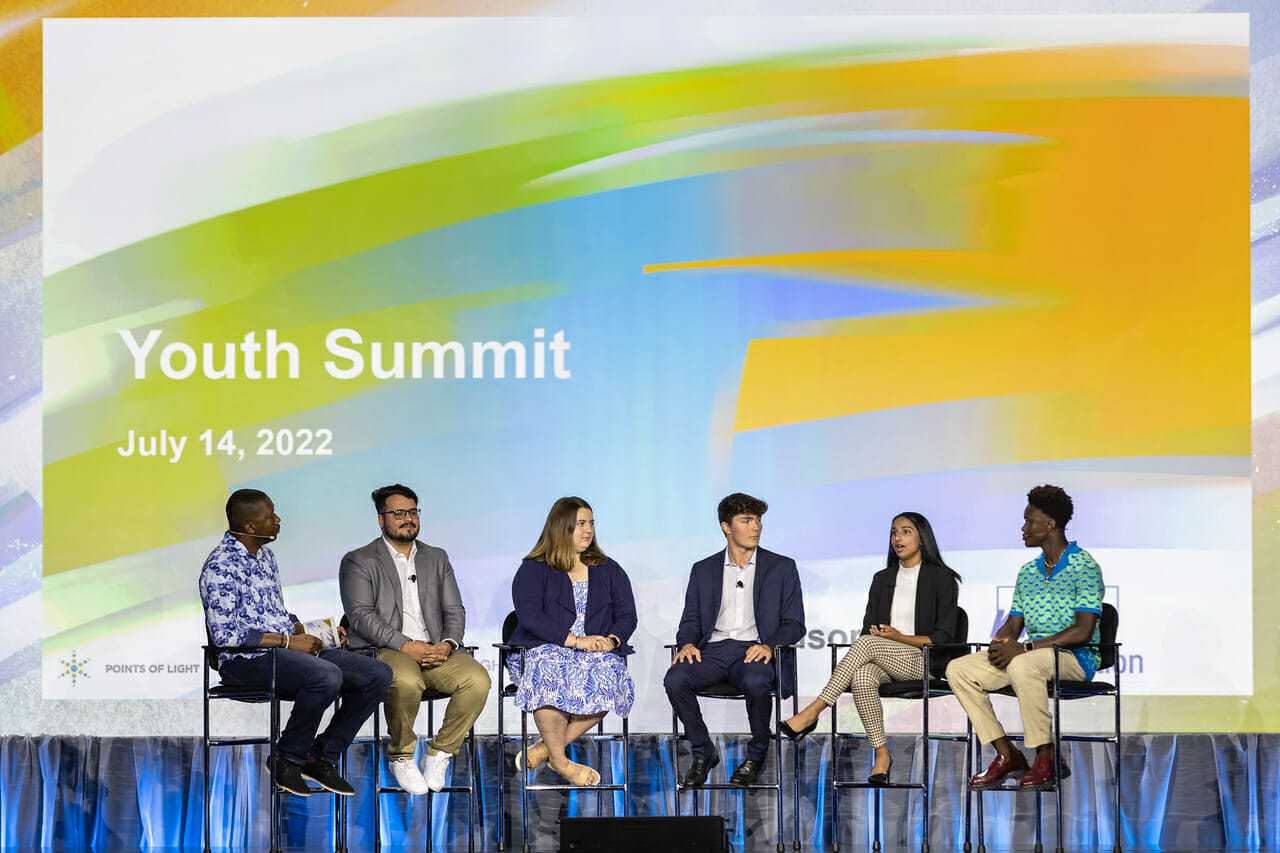
Following Orion’s chat with Anita, four members of the Points of Light Youth Council—
—and Generation Amazing Youth Advocate Sayed Alam—joined a moderated panel discussion. Each spoke about their individual civic journeys and shared touching moments from their experiences.
From fostering hope in communities through uplifting words and gestures… to reinforcing the message that we are never alone, but supported… to releasing one’s ego in volunteering and learning to be a team player… these five leaders passed on a wealth of knowledge and encouragement for all the civically engaged youth in attendance. “Embrace the vulnerability of not knowing what you’re doing,” shared Adom Appiah.
One theme highlighted again and again was the importance of listening and learning before acting. Several Points of Light Youth Council members spoke about how their nonprofits or initiatives had changed as the leaders themselves continued to learn and grow.
Eleanor Ann Schoenbrun talked about “allowing the experience to evolve” with her – changing what she was doing as she continued to learn more and more, and honoring the people sitting across the table from her, even if she disagreed with them.
Hearing from community members about what would help them most, instead of assuming that they already knew what was most supportive, was illuminating for these leaders. Many times, they made strategic decisions for their volunteer projects or even revamped the structure of their nonprofits based on the feedback they heard from those they were directly working with.
While this year’s Youth Summit featured a powerful group of young leaders, Points of Light is committed to uplifting youth voices every single year at the
. So don’t miss next year’s conference in Chicago June 14-16, 2023—save the date now so you can join us in person.
The Power of the Youth Voice with 2021 Time Kid of the Year
The Points of Light Conference is a rich experience for civically-minded folks of all ages and with all levels of experience.
We value the voice of youth, which is why we host a special Youth Summit as part of our overall conference experience each year. This summit is an all-conference session that will feature inspirational stories from young civic leaders who demonstrate that age has no limit in addressing the issues facing our world.
KPMG Foundation President Anita Whitehead will open the session with a discussion with Orion Jean, 2021 Time Kid of the Year and Ambassador for Kindness, about his story and what guidance he has for other young people.
This young man is on a mission, sharing the gift of reading with hundreds of thousands of kids. At only 11 years old, Orion has already created waves in his community with his involvement and advocacy. He has used his $500 in prize money from a kindness contest to donate toys to a local children’s hospital. He has also hosted food drives and partnered with a relief group to collect 100,000 meals for Texas families. And now he’s focused on spreading the gift of literacy to local households that may not have access to books.
Following the keynote, four members of the Points of Light Youth Council – Esha Venkat, Chase Hartman, Eleanor Ann Schoenbrun and Adom Appiah – will participate in a moderated panel discussion around the theme that youth are a powerful force for change. They’ll discuss listening and learning, mindful engagement, finding your “why” and “how” and much more.
Esha Venkat is a 16-year-old global changemaker, ambitious servant leader and groundbreaking “girlpreneur” passionate about advancing social progress across the globe. She is the co-founder and COO of NEST4US and a junior at Broad Run High School. In 2020, Esha and her sister, Shreyaa, were recognized with The George H.W. Bush Points of Light Award for their servant leadership.
Chase Hartman of Tampa, Florida is a 16-year-old community changemaker, youth leader and “kidpreneur” dedicated to finding solutions to some of the toughest challenges in our country. Chase co-founded a nonprofit called Eco Brothers and an award-winning book distribution project called “read.repeat.”
Eleanor Ann Schoenbrun is from El Paso, Texas, and is the founder of Pennies FUR Pets and Kans for Kids. She is a member of the Yale College Class of 2025 with prospective majors in economics and global affairs. She joined the Points of Light family at eight years old when she became a National Make A Difference Day Winner for Pennies FUR Pets, benefiting homeless pets in her border city.
Adom Appiah is an author and the founder of Ball4Good – a nonprofit that supports communities through sports, volunteering and grantmaking. The Ball4Good team has fostered partnerships with community-based organizations to address homelessness, childhood cancer, child abuse, autism awareness, cultural representation and public health.
Youth ages 13 to 18 from local organizations will be in attendance, but Youth Summit content isn’t just for young people. The session is appropriate for attendees representing nonprofits, national service, government, social entrepreneurs and businesses that work with youth or who consider youth a target audience.
Be sure to check our agenda for other workshops with sector experts that highlight youth-focused efforts for organizations. And join us for this year’s Youth Summit by registering for the 2022 Points of Light Conference, held July 13-15, 2022.
A Year of Service: An Alternative Option for Young People
For high school students and college students alike, saying senior year is a busy and stressful time is an understatement. If you’re in high school, you’re probably beginning to complete the Common Application and registering to take your SAT. If you’re in college, maybe you’ve just completed a summer internship or you’re still looking to get work experience as you take your last year of classes. You’re preparing for the next step in life and may be wondering if the step you’re taking is the right one. Perhaps you feel just a bit under pressure during this transitional time.
Instead of going straight into college or entering the workforce immediately after graduation, some may decide to take a gap year. For others, neither their parents or bank accounts may support that kind of time off. Another option remains, however. Completing a year of service is one step that an increasing number of young people consider instead.
issue can give you a lot of details on what service means to those of us at Points of Light. In a nutshell, service is when you commit your time, energy and talent to public, national or military service. Traditionally, you’re giving a larger part of your time and/or skill than you would with volunteering. Many service roles are considered part-time or full-time positions.
How do you know if a year of service is right for you? Ask yourself:
Would you like to spend the next 9-24 months doing something a little different that positively impacts a community?
Are you able to devote your time and energy to a particular cause or work with a community that may or may not be different than your own?
If you’re looking to work in a community different than the one you grew up in, are you willing to learn about the community first and understand how they define their needs, then partner with them for a solution?
If you answered yes to any of these questions, take a look at a few service year options that are a good fit for people looking to give their time and skill for one to two years.
The largest service year umbrella program where you can find federally-funded opportunities through its three main service year categories: AmeriCorps State and National, AmeriCorps VISTA and AmeriCorps NCCC (National Civilian Community Corps).
Age or Experience Required
The age and experience requirements vary based on the particular program. See more on opportunities
Full-time AmeriCorps State and National members are given a modest living allowance, health care benefits and childcare, and they become eligible for the
A federally-funded program for U.S. citizens who would like to complete a service year abroad. You’ll partner with communities to make changes that are sustained after your service year is complete.
Age or Experience Required
U.S. citizens ages 18 and over are eligible. The program is best suited for young people with a college degree, making it a better option for those who aren’t looking to take on traditional employment right after college.
Benefits
Volunteers receive housing and a living stipend that enables them to live in a manner similar to people in their community of service as well as healthcare, student loan benefits, a stipend to help them transition into life after their service is complete and career and graduate school support.
Are there other options?
There are many state, city and private institutions that offer short term or yearlong service opportunities, such as
. Think about a particular issue you’d like to learn more about or part of the world you’d like to work in and there are sure to be service opportunities available. Always check with the Better Business Bureau or other authority to ensure the opportunity is legitimate. Happy decision making!
5 Ways to Volunteer During Back to School Season
We’re officially closing out the summer season and heading back to school; it’s an excellent time to begin or continue our commitment to civic engagement. Plus, September is National Literacy Month, so what better time to focus your service efforts on promoting literacy and access to education? Below we’ve compiled a list of some DIY service projects and volunteer ideas you can do to make it a successful school year for students. Additionally, always ask around in your community to see who is already doing some of this work and how you can support them.
Start a mobile library or hold a book drive. Early access to books is a key step in education, however many families aren’t able to afford or access books regularly. One way you can help provide greater accessibility to books is to start your very own mobile library, or hold a book drive in order to get more books into the hands of kids! Check out our detailed instructions here for starting a mobile library.
Tutor and Read to Youth. You can work with an organization like Story Mentors or Get Ready Set to help school-aged children become more confident readers. Sometimes, it just takes a little one-on-one time with a patient adult for a young reader to master the skills they need. JT Wu, a Daily Point of Light Honoree, founded Preface, a nonprofit that promotes childhood literacy by pairing high schoolers with elementary school students to mentor and read to them. You can work with a young person through a similar organization and make a big impact!
Put together a back-to-school backpack. According to the National Retail Federation, a caregiver will spend on average $789.49 on back-to-school supplies. For some families, this can be very challenging. So if you’re able, why not put together a backpack for a fellow student who needs one? Read our guide for tips on how to identify someone who might need a backpack, pulling together all the supplies and delivering to your school. Many local nonprofits will also hold backpack drives.
Host a Literacy Game Night. Help youth (and adults too!) practice their speaking skills and learn new vocabulary words by hosting an in-person or virtual game night. Games like Scrabble and Simon Says are ideal group activities for people with a wide range of verbal skills, and more advanced games like Scattergories are a fun way to build those more advanced linguistic skills. Daily Point of Light Honoree Sneha Nadella has done incredible service work with the World Literacy Foundation and knows the power of helping non-native English speakers to learn the language. Check out our step-by-step guide to help English Language Learners from anywhere in the world.
Inspire Students Love of STEM. As new fields are developed every day, young learners need to continue to be passionate about important fields like science, technology, engineering and math. Daily Point of Light Award honoree Serena Pei volunteers with Engage STEM, to ensure access to students for STEM tutoring and provides resources for learning outside the classroom.
Supporting Young Volunteer Leaders: How to Help Youth Become Passionate and Engaged in Community
When we think of leaders, we are not always thinking about those under 25. However, we know that Generation Z, those born after 1996, are already leaders making substantial changes in our society and there’s a lot we can learn from them. In our civic engagement research, we found that Gen Z was the most civically engaged generation. These young leaders are setting the new standard for civic engagement, leading the way through actions like:
advocacy through social media
using their purchasing power
making employment choices based on the impact a company has on the world
While those in the generation following, Generation Alpha (born 2011-2025), are still developing as leaders, they’re following in similar footsteps with the support of their parents. In fact, in a
by Civic in partnership with Hart Research Associates, 99 percent of parents prioritized developing character, integrity, and finding happiness over getting a good job and being prepared for college. We know that volunteering and giving back in meaningful ways helps young people in attain these attributes and there are ways adults can help young people reach their world-changing goals.
Supporting the Civic Life Development of Young People
Here are a few ways to help young people you know based on where they are in their leadership journey.
For the developing volunteer leader (typically Generation Alpha):
Include them in tasks to help them build confidence. Researchers Lucía Alcalá and Sheina Lew-Levy found that delegating daily tasks to our youngest helpers rather than allowing them to sit on the sidelines can build confidence in their ability to contribute and may encourage them to be more helpful later in life. This can include asking them to help by bringing you supplies or making them responsible for a part of a project.
Lead by example to help them envision their future. Whether it’s volunteering in the community or being kind to neighbors and strangers, seeing adults they look up to modeling helping behaviors sets an example for young people on how they can work to address issues in their community. It can even be doing things you’re already passionate about, like Daily Point of Light honoree Wendy Wu, a piano teacher who shares her love for music and volunteering with students of all ages.
Help them learn about various ways to give back. There are a lot of great books you can read with young people or shows you can watch that address the impact of giving back. After reading and discussing Kids Who Are Changing the World (You Should Meet) with my own six-year-olds, they decided that they’d like raise funds for a local family shelter so that the children living there can have toys to play with. You can find more resources in the Youth and Family Corner of the Volunteer Issue of Civic Life Today.
For the independent volunteer leader (typically Generation Z):
Help them feel more fulfilled by directly connecting them to ways to help others. It’s not an understatement that the isolation and loneliness brought on by the COVID-19 shutdowns have substantially impacted the mental health of young people. Research has shown that volunteering positively impacts social and emotional health and gives young people a sense of belonging. You can direct older youth to in-person opportunities through our platform Engage or instructions on how to build their own activity through our Virtual Volunteering toolkit.
Understand that the issues that may be of most concern to young people may not be your top issues. Recognize the areas that young people are most concerned about and help them address those issues in ways that resonate with them. It’s important to remember that their world view may be different and supporting their vision for the future will help them actualize it. One activity you can do to get everyone on the same page is our Courageous Conversations
Empower them by looking to them as true leaders and experts. Allowing youth to truly lead the change they want to see can have greater impacts than adults alone can produce. Frances Leung and Nicole Kim, who are bringing Gen Z BIPOC youth together to make youth activism communal and accessible through their work with the Nonstandard Project, are examples of young people leading work and having a real impact.
For all youth:
Give guidance and be supportive of ideas.
Depending where young leaders are in their development, they may need varying levels of guidance. Be supportive of their ideas and look to use the
approach when helping think through ways to strengthen their projects.
Finally, be an advocate for young volunteer leaders. Help others understand the importance of youth voice, youth guidance and youth as true co-leaders in your volunteer program development and implementation. The work we do with them ensures they’re ready to continue to lead for decades to come in areas beyond volunteering.
Choosing Light, Finding Power in Hope
Have you ever thought about the fact that a tiny pen light can break through the darkest unlit room? Why is that? The smallest amount of light penetrates darkness, even when darkness surrounds us.
The news reminds us of the darkness. Police shootings continue a year after an uprising for social justice. Violence has erupted between Israel and Hamas. And each of us has our own personal darkness to work through. It is because of the darkness that we must always try to find our light.
How do you find light when darkness abounds? For me, it is by seeing the
big
possibilities in
small
measures of progress and consciously choosing hope
as a daily practice
.
As we approach June 2021, nearly six months into the year after 2020, the year that changed the world all at once, I invite you to pause and reflect and take time to chart (y)our course for the new normal. A better normal.
We all recall where we were last summer, especially after the death of George Floyd, physically, emotionally, spiritually. Navigating and grounding ourselves in ambiguity and tapping into new levels of awareness. There was and remains a lot to do. People are getting off the sidelines and using their position and platforms to make new things happen.
Last summer, people of all ages, races, ethnicities, and backgrounds came together in cities around the world to raise their voices in protest of social injustice. We saw new conversations in boardrooms about systemic inequality, business made room for different perspectives, and companies used the power of their brands to take a stand on issues that impact their employees, the communities where they do business, their investors, and ultimately their shareholders.
Record numbers of Americans voted in 2020, many of them young people. We have our first female, first African American, first Southeast Asian Vice President in Kamala Harris and millions of girls, particularly little brown girls, now see themselves and their world differently. We saw the state of Mississippi change its flag, replacing a symbol of the confederacy with the magnolia, a flower that symbolizes dignity.
These small and large steps are measures of progress and reflections of light.
Those of us in the nonprofit space have dedicated our careers to the ideals of eliminating human suffering, inhabiting a clean planet, and creating a world that provides dignity for all. Together, we connect donations, resources and the time and talent of more than 77 million individual volunteers with the people who need it most. Nonprofits in the United States have been immensely effective.
Yet, here too, there is work to do.
Nonprofit leadership doesn’t always reflect the communities we serve. In the United States, there are more than 1.6 million nonprofits. Each year, the nonprofit sector spends $2 trillion annually, and employs 10 percent of the US workforce. However, nonprofit boards have not kept pace with the changing demographics of society, and currently are 78 percent white. Funding isn’t equitable either, and Black-led nonprofits have 45 percent less revenue than white-led ones.
This summer the
in new funding to help stabilize and sustain nonprofits in the wake of both the pandemic and the epidemic of social injustice.
My hope for some of this funding is that it also makes space for
, who are filling the needs in communities unmet by traditional institutions. Ordinary people who see a need and create a new way to solve it while also having a positive impact on society. Social entrepreneurs change the expectation by challenging the traditional way of operating, and often-times are the unexpected leader who emerges with a approach and as a bonus, with new partners. They are our youth filled with curiosity and imagination, seniors with more discretionary time and wisdom from life experiences, and overlooked or sidelined community members of all races and ethnicities whether from big cities, small towns, rural areas, and indigenous nations.
Each of these people have light within them. They share it every day. And though the news shows us all the darkness, I encourage you to look around and find the light in yourself and in others around you. It may feel dim right now, but even the smallest of light in the darkest space can illuminate a clearer path for yourself and others.
Natalye Paquin was the president and chief executive officer of Points of Light from 2017–2022.
She is a visionary and results-oriented leader, with more than 20 years of experience providing strategic, operations and fiscal leadership in the nonprofit and public sectors.




 Following Orion’s chat with Anita, four members of the Points of Light Youth Council—